Thursday, October 27

The Book Cave Podcast Episode #150: Perry Rhodan

Along with hosts Ric Croxton and Art Sippo, as well as fellow guest Andrew Salmon, I talk Perry Rhodan and a whole bunch of other stuff as the conversation takes us.  And a good time was had by all....

You can check it out at The Book Cave's own website:  http://thebookcave.libsyn.com/the-book-cave-episode-150-perry-rhodan, or at iTunes.  Then browse around a bit in The Book Cave.  It's full of pulpy and comic-book goodness - my kind of reading!

Cheers, and Ad Astra!

Sunday, October 23

Demon Knights #1, Legion Lost #1, and Wonder Woman #1 (Nov 2011)

“Seven Against the Dark”

When the New 52 line-up was first announced a few months ago, I didn't immediately jump on this title. I've never been a fan of the character of Jason Blood, The Demon, even if he is a creation of Jack “the King” Kirby's from his tenure at DC in the early 1970s that added so richly to DC's mythology – Darkseid, the New Gods, OMAC, Kamandi, and so forth. I was familiar with the character from various appearances, but he never really grabbed me. But the medieval setting, for one, made me look at this one again, and the fact that another character I recently developed kind of a liking for – Madame Xanadu (see the wonderful recent Vertigo series by Matt Wagner) – is announced as part of it, and the fact that it's written by Paul Cornell made me decide to give it a shot. Then, for what it's worth, in Cornell's Stormwatch there seems to be a hint that there's a connection there as well. I'm in for at least the first arc. This first issue is mostly just set up, letting us see such things as the “origin” of The Demon when Etrigan is bonded to Jason Blood by the wizard Merlin, the coming together of several characters from DC's occultish titles into a group opposed to what looks like the Big Bad for at least the beginning arc – none other than old Legion of Super-Heroes, latter-day Justice Society foe Mordru (and those temporal tags neatly invert the actual internal chronology, but that's comics for you!) along side some Queen who seems to command a ravenous Horde – a group that includes such as Sir Ystin The Shining Knight, Vandal Savage (amazing that he ever was on the side of the angels … not sure he is here, considering I think he's going to be an ally of Etrigan's), and some warrior woman whom I wouldn't want to cross! The appearance of The Shining Knight in the incarnation created by Grant Morrison a few years ago, plus the title “Seven Against the Dark,” further makes me wonder if there's going to be overt connections between this story and Morrison's mind-bending Seven Soldiers epic wherein Sir Ystin first appeared. I'm intrigued at the very least. Next: Here Be Dragons!

“Run from Tomorrow, Part One: Present Tense”

Even though this is one of the two New 52 Legion titles, and Legion of Super-Heroes is my all-time favorite superhero franchise bar none, I can't say I really cared for this that much. Part of the wonder of the Legion is the generally bright, shiny future that is presented (even as tarnished as it has been in recent years), and the idea of a group of Legionnaires cut off from the main group, stranded a thousand years in their own past in our present, is not entirely appealing to me. Even though I think it's been said their exile is permanent, I hold onto hope that it's not and this will just end up being a second Legion Lost miniseries. Whatever, it's not so bad as to make me not buy it – as a Legion title it would have to be worse than dreadful for that to happen, and it's not. It just doesn't catch me in and of itself.

The gist of the plot is a group of Legionnaires chased a villain from the 31st century back to the 21st century to try to head off his intention of releasing some future plague in our present to destroy the future. They fail – and end up themselves infected. And in the process, a couple of their number appear to be killed in the destruction of their Time Bubble. The issue ends with Timber Wolf asking the question, “What do we do now...?” Next: Outbreak!

“The Visitation”

This is another one I'm not so sure about. Of the mainstream DC titles relaunched here, I figured Wonder Woman was probably the one in the most danger of being dropped by me pretty quickly. I've seldom collected the individual comics, although I've picked up a number of trades of her more notable stories through the years. I really like the character, but her solo adventures generally just haven't grabbed me, not enough to make me buy the monthlies. I mainly jumped in here because she is one of DC's Big Three, the “Trinity.” I figured I'd give it a try. Another point of hesitancy for me is the writer, Brian Azzarello. He's written some good stuff and some bad stuff. Since I mainly am into the superhero stuff, I've read more of his bad stuff than good stuff because generally that just ain't his forte! And the recent First Wave DC “neopulp” experiment that he oversaw was, for me, a bitter disappointment. But here I am.

I must say this is a different Wonder Woman – visually not so much, but in mood and mythology seemingly so. I think I'll grow to really like the much deeper connection with Greek mythology that is being cultivated here, although as a Wonder Woman/superhero story it is a shift in tone that by its nature I find quite jarring. It'll have to grow on me. I think it will. It does play explicitly to one of the basic tropes of Greek mythology – mortals are just playthings in the rivalries of the gods, which manifests in one way that the head of the gods, Zeus, is a randy old fart who routinely goes around impregnating mortal women and thereby pissing off (to paraphrase one of the characters) his wife, Hera. Wonder Woman ends up in the middle, protecting a young woman targeted by Hera because she is unknowingly pregnant by Zeus. We get to see other of the gods, such as Hermes, as well as other creatures from mythology along the way as well. And there are other conflicts between the gods sure to spill out into the mortal world. As I understand it, that's the overall gist of this new Wonder Woman – protecting humanity from the capricious whims of the gods. It sounds interesting. I'll stay aboard for at least a while, give it time to develop. I've probably overused this word lately, but it is if nothing else intriguing.

Cheers, and thanks for reading!

Saturday, October 22

Batman and Robin #1 and Batwoman #1 (Nov 2011)

“Born to Kill”

Tomasi and Gleason are a good team who did great things on the Green Lantern Corps title in the past few years. It's too soon for me to tell how well that will translate to the world of Gotham City and the New 52 Batman and Robin. No point in lamenting (surprisingly) the new team of Bruce Wayne Batman and his son Damian Wayne as Robin, and luckily Dick Grayson's tenure as Batman teamed up with Damian has not been wiped from continuity, is even referenced in these pages. Damian is having a bit of trouble adjusting to working with his father instead of “Grayson,” which manifests itself in a degree of surliness that is somewhat beyond where he had grown to of late. As a coworker who read this issue before me stated, “He's still the little shit,” but then he's only seen Damian in a few cases up until now and hasn't experienced the growth the character has undergone in the couple of years since he was introduced. To wit, at one point, arguing with his father, he slips and refers to “Grayson” as “Dick” instead. ! Really, I think if you look past the surface, Damian is one of the more interesting and well-developed characters in comics today. For that reason if no other I'm on board here with enthusiasm. Of course, since this is a Bat-title, that's pretty much assured anyway.

Briefly told, this issue sees Bruce take his son for one last visit to the site where the saga began, where Damian's grandparents were gunned down that night long ago. One last visit, because the site is going to be bulldozed and developed, and Bruce has determined to stop honoring their last night on Earth and start honoring their wedding anniversary instead. A situation develops that finds them averting a nuclear catastrophe at Gotham University – but in which Damian displays a bit of his usual recklessness that endangers the criminals they are fighting and brings down a stinging rebuke from Bruce. I think Bruce is having a bit of trouble adjusting to working with his son as Robin as well!

There's a framing sequence that doubtless sets in motion what will be the overall story for the early issues of this title, set in Moscow, where a Russian agent of Batman, Inc., comes to a bad end, even being rather graphically and lowered alive and conscious into a vat of acid on the last page in a horrific sequence that ends with his captor proclaiming that it's now time to pay Bruce Wayne a visit. Next: Bad Blood.

“Hydrology, Part 1: Leaching”

Well, I said I'd believe this comic would finally appear when I was holding it in my own hands, and not before. I guess I have to believe it's out now. It has been literally years in coming since it was first announced, and in the past year was delayed time and again, the most recent at really short notice round about February, I think at the time the final decision to go with a full-on Relaunch-boot-vamp-whatever this is was made, in order to just have it come out with all the other new #1s.

This is a beautiful comic, as much painted as drawn, although that does have its drawback in that I sometimes find it hard to follow the story itself through a variety of odd, artistic panels that seem to break all the rules of graphic storytelling. What do I know about those anyway? All I know is it makes it hard to follow, and I've been reading comics for how long? – 45 years? Anyway, it is nonetheless beautiful.

As to the story, some bizarre, beautiful spirit (?) is drowning parents in the process of taking their children in the Latino quarters of Gotham City. Kate Kane Batwoman is on the case, having unsuccessfully tried to prevent one instance, whose parents begin this story by telling GCPD Special Crimes Unit leader Maggie Sawyer how El Angel Rojo de La Muerte, “Dark Red Angel of the Night,” Batwoman, had saved them but failed to prevent their children from being taken. Maggie is visited by Kate, who is startled (?) to see a picture of Renee Montoya and to discover that Maggie knows about her and Renee's relationship (“Detective, remember?”). Well, Kate and Maggie set up a date … was that why Kate was there, or was it related to the case? Anyway, as indicated when we last saw her in Detective Comics (a year or more ago?), Kate's cousin Bette Kane is joining her as a “sidekick” – but Kate will not have her as Flamebird, Bette's former identity, and is insisting on training her anew. The Flamebird costume is out – “You don't need that garish costume … You need a uniform.” Bette ends up military fatigues and a mask rather than a traditional super-heroine costume! Anyway, she finds the whole thing a bit humiliating. And then there's an ugly scene when Kate's estranged father shows up. For the benefit of those who maybe are picking this up new – the hypothetical “new reader” DC is trying to court in this initiative – there is a pretty good recap of the defining event of Kate's childhood, the kidnapping and apparent death of her mother and twin sister … except that the twin sister apparently did not die and has returned as the villainess of the first Detective Comics arc a couple of years ago, “Alice.” And Jacob Kane apparently knew that Beth was not dead – Kate has not forgiven him and it looks like she has no intention of doing so.
(This is a huge image file!)
Interspersed with this we see Department of Extranormal Operations agent Cameron Chase being tasked by Director Bones to bring in Batwoman – a task she does not relish given how well their attempt to bring in Batman a few years ago went! – and also a meeting between Commissioner Gordon and Maggie Sawyer regarding the case of La Llorona – “the Weeping Woman” – “That's all I have to go on, Commissioner. A ghost story.” “If that's your only lead, Detective,” Gordon tells her, “you follow it. Until this case is solved and those kids are found … whether you believe in urban legends or not.” And the issue ends with Batwoman, inspecting the same crime scene where a teenage girl was killed in the abduction of her younger cousin that Gordon and Sawyer were overseeing, being approached by Batman. She bristles: “This is my crime scene now.” “I'm not here to take it back. … But we do need to talk. … I have a proposition for you...” To Be Continued.

Have Bruce Wayne Batman and Kate Kane Batwoman formally met? Last I remember, he was stalking her in a different guise in the #0 issue that came out forever ago, determining that she is indeed a good prospect for Batman, Inc.

I do have one complaint about the art – mainly the coloring. I don't know if it's intentional or not, but there are times Kate Kane looks so pale as to be literally vampiric in her appearance. Sometimes she is literally chalky-white (see above). Other times the variance from other characters' flesh-tones is not nearly so severe. This actually is a quirk that appeared during the later issues of the Detective Comics run, so I'm sure it's intentional ... I'm just not sure what they're going for.

Overall, an intriguing issue. Frankly, I didn't really miss Greg Rucka who has overseen almost every other appearance of Batwoman since her creation a few years ago, including the great run she had in Detective Comics a couple of years ago.

Thanks for reading, and Cheers!

Superboy #1 (Nov 2011)

“The Clone”

Well, the first question I had seems to have been answered. The entire continuity of the previous clone-Superboy who was created in the wake of the Death of Superman storyline now almost twenty years ago (Lord, how time flies!), lately known as Conner Kent, has been wiped.

This story begins with the clone still in some kind of amniotic fluid tank, seemingly a failure in that brain activity has so far not been detected. Doesn't mean it's not there, though, because he has been telepathically aware and studying the cloning team even as they've been studying him. In light of the seeming failure though, the determination is made to put the body down and hopefully learn something from the autopsy. That – plus sympathy from one of the scientists, a young red-head named “Cait[lyn?]” – triggers his awakening, and that of his powers – and the slaughter of all the rest of the team. The story jumps to an almost idyllic story of the clone, now looking much like the old Conner, recently enrolled in a school in small-town America along with a pretty platinum-haired girl named “Rose.” But it's quickly apparent something is wrong, because the clone absolutely ignores a housefire with a victim screaming from the upstairs window. It turns out this is a virtual-reality environment by which the young woman scientist is now trying to study the “cellular subconscious” and determine 1) who the human DNA that stabilized the Kryptonian DNA came from, 2) why that “cellular subconscious” keeps creating a small-town America world, and 3) why it seems to have no empathy for the pain of other beings. Her studies are cut short, however, with the arrival of Templar, a creepy bureaucrat-type who has a mission for “the Superboy. Against a background showing the New 52 Teen Titans, Templar says: “I have a very unusual problem. … Several, in fact. … Superboy in how I plan to solve them.” We also “hear” “the Superboy's” internal monologue: “If resolving a situation for him is going to get me out from under these people once and for all...? … That's a small price to pay for freedom.” Next issue: Alien Prison Break!

Incidentally, “Rose” exists outside the VR world – as Rose Wilson, complete with both eyes but still a mercenary, whose assignment is to put the clone down if necessary. That is an interesting development given the relationship that was developing between the two of them at the very end of the previous series.

Overall, it's too soon to tell whether I'll like this new clone-Superboy. I had grown to really like Conner Kent in recent years, and I will miss him. I don't like the “Tron”-style battle-suit that we've seen, including on that last page. I like that horrific "robot-Superboy" image of the cover even less, but that thankfully seems to have nothing to do with the story inside except for having elements of that same "Tron-suit" in its design.  But I am curious about how this will develop, and have to say that this first issue does present a character that is surprisingly sympathetic given his obvious emotional deficiency, truly a lost boy in a strange world. I'm sticking with it for now. Hopefully he will find his empathy pretty soon and start his journey along the path toward heroism.

Cheers, and thanks for reading.

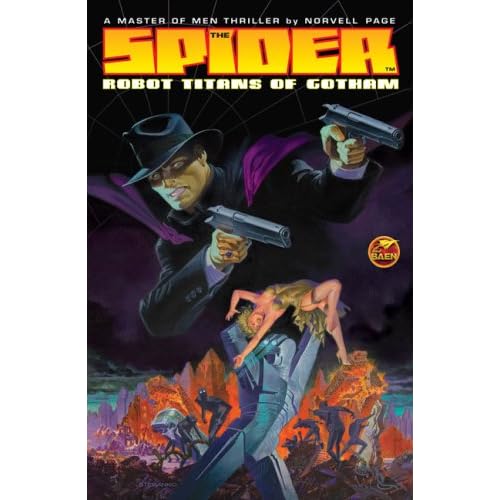
The Spider: Robot Titans of Gotham (2008)

By Norvell W. Page

Because the three novels in this present volume from Baen Books are perportedly linked to a certain degree, I'm writing them up as one entry as they are here republished. I actually finished reading it a couple weeks ago, but last week was mid terms and the week since has been catching up on my professional duties. This weekend is the first extended time I've had in a while to sit down and work on my blogs.

How are the three novels linked? Well, it's a little more obvious for the first two, both reprints of adventures of the 1930s pulp hero The Spider from his eponymous magazine that lasted for over a hundred issues through the 1930s and into the early 1940s, and I'll get to that. I still haven't puzzled out exactly what the connection is for the third, which is from an abortive pulp magazine entitled The Octopus that lasted for only a single issue. Frankly, I've not been able to confirm for certain that it was even written by Norvell Page, since each pulp hero's adventures actually appeared in stories attributed to a house name whether or not the usual writer actually penned any particular one or not. Norvell Page did write the lion's share of Spider novels, but there were other authors and he was not in fact the first. The first two were actually an anomalous situation in that the author's real name did appear as R. T. M. Scott. But once Norvell Page took over with the third, the house name of “Grant Stockbridge” would be used for all, even the ones not written by Page. The same was true of Lester Dent, who wrote most of the Doc Savage novels under the name “Kenneth Robeson,” although there were a scattering of other writers, and of Walter Gibson who was almost but not always hidden behind the name of “Maxwell Grant” on the covers of The Shadow. The Wikipedia article for the 1938 movie serial The Spider's Web which borrows the name of its villain from this story only says that “The Octopus was a villain in a single issue pulp believed to have been written by Norvell Page who wrote most of The Spider pulp stories” (my emphasis). It's not certain that the “Randolph Craig” house name covered Novell Page, but it is likely that he had at least some hand in it. I'm in no way a “lit-critter” (my old drunken mentor's term for the literary criticism types), but it seems very much like Page's style – and even moreso! The Pulp Reader blog did a little investigating last year and came to the conclusion that a couple named “Edith and Eljer Jacobson wrote the original story and then it was retooled/rewritten by Page to make the hero fit more of the Spider mold. This would explain why the story in places seems typical of Norvell Page's work and at times even more grotesque, and horrific, the prose more purple without quite the polish of his Spider work.” As I said – “like Page's style – and even moreso!” (Pulp Reader had just previously written a review of this story that is well worth reading, then reconsidered his acceptance of Page's authorship and did a bit more digging.)

Which rambles a long ways from a review of this present volume.

There is first a framing sequence by Joel Frieman that basically introduces the first tale and establishes a tenuous connection between it and the second. Pulp author Norvell Page is upset that one of his Spider stories was blatantly plagiarised by the creators of the Superman Sunday newspaper strip. We are told this against the background of the rising – exploding – comic book market that is sucking all of the oxygen out of the room for the old hero pulps, which are by now on their way out as evidenced by the declining remuneration Page is getting for his writing. This framing sequence taking place in January 1941, The Spider itself would last only a couple more years. Popular Publications, the publishers of The Spider, accept an out-of-court settlement of cash from Detective Comics (i.e. DC) for silence regarding the plagiarism (“They don't want Superman to be known as 'The Man of Steal'?” Page asks.) Page finds an old prop pistol once used by the cover painter for The Spider and has it in his pocket shortly afterward when he is ambushed by some ruffians in the street. He pulls the gun on them, to bluff them – they don't fall for it – but then a gunshot rings out and his attacker falls shot dead! And we're taken immediately into ...

Satan's Murder Machines (originally published in The Spider for December 1939)

Frankly, although this is a typically gripping and over-the-top adventure of The Spider with a villainous gang terrorizing the City in powerful, flame-throwing, almost indestructible robotic armor suits, the background of the story as highlighted in the prelude is far more interesting. Because a “rip-off” of this story did appear as a Superman story, not in the comics themselves but rather in the Sunday newspaper strips from 3 November to 22 December 1940, under the title “Bandit Robots of Metropolis,” written by Jerry Siegel with pencils by Wayne Boring and inks believed to be by Don Komisarov (actual creator credits are hard to come by for the early days of comics – attribution of all the creators would not appear consistently until the 1970s). “When robot bandits invade Metropolis and demand tribute, Superman must find the robots' lair and rescue Lois.” So reads the blurb at the Grand Comics Database (specifically http://www.comics.org/issue/371986/#596403) about half-way down the page. This is not the only time, moreover, that this Spider story has influenced other super-hero and pulpish characters. It's cited as being the inspiration a couple decades later for Stan Lee and his brother Larry Lieber's 1963 creation of the Marvel Comics hero Iron Man for Tales of Suspense #39, as well as the gigantic mechanical monsters that open the 2004 movie Sky Captain and the World of Tomorrow – http://www.newsarama.com/comics/spider-iron-man-war-moonstone-100608.html. I wouldn't be surprised if there were other such “homages.” In 2010 Satan's Murder Machines was finally adapted as such into comic book form by Moonstone Publications, albeit under a different title: The Iron Man War (see previous link).

Death Reign of the Vampire King (originally published in The Spider for November 1935)

This is another tale of The Spider, much like any other, basically about a madman who unleashes trained poisonous vampire bats onto the various unsuspecting populations of various cities – the action's not confined to New York this time – until against seemingly insurmountable odds The Spider brings him down. It is the name of the villain that gives the connection to the first story. He is The Bat Man. (Say it with the deep, gravelly voice.) And he does have a black, scalloped, bat-wing cape.  But there's not a whole lot else to say about it other than that it may have also enjoyed comic adaptation, although the very source for that statement – http://homepage.mac.com/cdkalb/spider/pulps/list.html , go down to #26 – links to a page that seems to indicate otherwise, that the 1990 Eclipse series was based on another Spider novel entirely, Corpse Cargo – see http://homepage.mac.com/cdkalb/spider/comics/truman.html .

The City Condemned to Hell (originally published in The Octopus for February-March 1939)

I've already addressed the authorship question above. The Octopus was one of only two pulp titles with the title being the name of the villain. The other was The Scorpion, which may have been an effort to jump-start this series with a new name. This story has a lot of things in common with The Spider stories, but is even wierder and more outrageous. Jeffrey Fairchild is The Skull Killer – another half-crazed, obsessive foe of criminals with a ring whereby he leaves his mark on the forehead of his victims – like The Spider and his vermillion spider ring. Fairchild is also a doctor, however, with a third identity as an elderly physician named Dr. Skull. He has an invalid brother to whom he is devoted, but who despises him, while being devoted to his doctor, Dr. Skull. Dr. Skull also has a comely nurse, Carol Endicott, providing a love interest for Jeffrey, but who does not know that Fairchild and Skull are one and the same (nor of course that he/they is/are The Skull Killer), and there are hints that there's a love triangle between Carol, Jeffrey, and his brother. I'm not sure what plans Page – or whomever – may have had for this series if it continued, but I bet it would have been wild! Unfortunately, it didn't continue. Besides a series taking its name from the villain being a problematic proposition, this story was probably just too weird …

The villain here seems very Lovecraftian, a mysterious figure known as The Octopus who has a method utilizing a burning ultraviolet beam to transform normal humans into deformed, vampiric monsters who can't survive in regular light, who need UV, plus living human blood to survive – whose veins now run with a seawater-like substance. Yep, it's weird. Fairchild, The Skull Killer, ruins his current plans, but the villain does get away – what his next scheme would be we'll never know.

I have no idea why this story in particular is included in this volume. Sure, the conventional wisdom is that it was written by Norvell Page (see above), but even so.... There is a tenuous DC Comics Superman-Batman connection linking the two Spider stories, even giving the overall title for this collection, parallelling the Superman Sundays title “The Robot Bandits of Metropolis” becomes The Robot Titans of Gotham, combining elements from Superman and Batman in one title. That's clever. But whatever the reason they chose this odd little story to round out this volume, I'm glad they did. It was an experience to read, and I'm glad to have had the opportunity.

So. What happened to Page after the attack with which the prelude ended? I thought there would be an epilogue that would pick that little story up and even reveal the rationale for this collection. There's not. There is a follow-up collection from Baen books, The Spider: The City of Doom. I've not read it, and I'm not sure when I'll get around to reading it. I have peeked at the first pages, however, and yes there is another prologue that seems to take up from this one. My curiosity will take me there before too long, I'm sure.

'Til then, Cheers, and thanks for reading!

Perry Rhodan #14, Venus in Danger (1972)

By Kurt Mahr

After a hiatus of several months, I've taken back up with the leaner, and hopefully meaner, Perry Rhodan Reading Project blog.  If you're interested in reading more, go here or click on the banner link at right.

Cheers, and Ad Astra!

Wednesday, October 19

Stormwatch #1 (Nov 2011)

“The Dark Side, Part One”

This is the first truly new title of the DCnU that I'm giving a shot. I never read the old DC-Wildstorm imprint title of the same name. What little I knew about it, that it was a “rawer,” “edgier” version of the Justice League just didn't (and in itself doesn't) really appeal to me. However, from what I can gather this is meant to be a central title of the New 52, relating stories of superhumans who are not superheroes, in a team that has been around for centuries in one form or another. It's definitely being integrated into the new main DC universe – with a central character being Martian Manhunter, who I generally like in a team setting (though never so much on his own). And it's written by Paul Cornell, who has now written a couple of things I've enjoyed – the Lex Luthor story arc through the 890s of Action Comics, followed by the return of Superman to that title in the “Reign of Doomsday” story arc that finished out that venerable pre-Flashpoint run, plus the brilliant Knight and Squire miniseries. So I'm in. Frankly, at this point, I'm not quite sure what to make of it – it's too soon to tell. I like what I see so far, however.

Briefly, several plot lines are started right off the bat – actually, we're kind of dropped right into the middle. There's some kind of mystical horn been blown, with ominous portents – that seems to be a giant artifact in the Himalayas; one of their number investigates what appears to be the moon itself preparing to attack the Earth in what seems some bizarre plan to prepare the Earth for some coming threat; and a team including Martian Manhunter tries unsuccessfully to recruit a “Superman-level” being called Apollo into their number only to be taken out by a dark-clad figure calling himself Midnighter who proposes a different type alliance to the powerhouse. Along the way we're introduced to a bunch of (to me, at least) new characters very quickly, but fairly effectively, and we get a quick sense of their attitude toward the new upstarts: “Do we look like 'super-heroes?,” asks Jack Hawksmoor of Apollo – “They're amateurs. We're the professionals. … Stormwatch has been protecting the world from alien threats for centuries.” We actually see glimpses of that history (and hints of why I'm glad I'm also picking up Cornell's other DCnU book, Demon Knights) in a character's mental flashbacks. And Justice Leaguer Martian Manhunter helps clarify the difference between this team and others such as the League in the two hats he's wearing: “I am known in some quarters as a hero. I can wear that shape. But when I need to be a warrior – I do it with Stormwatch.” I'm feeling good about this title.

Cheers, and thanks for reading.

Tuesday, October 18

Detective Comics #1 and Batgirl #1 (Nov 2011)

I find myself in a funny position regarding this book. I've never been a Tony Daniel hater - I've actually liked most of his stuff - and I was pleased when the initial feedback regarding his first issue in the New 52 was generally positive. Then I read it for myself, and I'm not so sure I like it so much. It seems excessively gruesome, with the Joker literally losing face in the end. I mean, really – having the skin flayed from his face by a new villain called “The Dollmaker.” He likes it.  He says it felt "fangasmic."  Before that, though we got to see a Joker whose characterization seemed a bit too “hoo hoo hee hee” for me – I found myself thinking of Cesar Romero, of all things, and that ain't a good thing. Granted, this Joker is a bloody fiend – but the giggling fool aspect can go too far, verging on silliness. It just seemed off. But most of all, I'm not so sure about the characterization of Batman himself, who seems quite different from the one I've seen so far in Flashpoint #5 and Justice League International #1 – the two places I've indisputably seen the “current” DCnU Batman. That one seems somehow less the brooding Dark Knight than we've seen in recent years – although there was movement away from that already pre-Flashpoint. This one, however, not so much – in fact, maybe he's closer in spirit to the one appearing in the new Justice League #1, set five years in the past. Which makes me wonder if a brief rumor – based on a statement by Tony Daniel that he later retracted – that Detective would be, like Action Comics, set sometime in the “past” for its first story arc, may indeed be the case. It's hard to tell. Yes, Jim Gordon appears younger, but so does he in Batgirl, which is presumably set in the “present.” Batman's interior monologue intimates that he and the Joker have been foes for six years already, however. I would actually be fine with an extended time-line for Batman, beyond the five years that the New DC superheroes have been “public,” since the first adventures of the Justice League. A decade or so would seem to be necessary, in fact, to accommodate the careers of Dick Grayson, Jason Todd, and Tim Drake as Robins before the current Robin, Damian Wayne. (And that's ignoring Stephanie Brown's brief tenure, if that – or she – even still exists.) There's been some talk that Batman did exist as an “urban legend” before five years ago. On the other hand, what happens to the Joker at the end would seem an odd direction to take the character for a story set in the past. Without a doubt, I am curious where this is going, and that is a good thing.  I will be back.

“Shattered”

I'm not going to belabor the fact that, as cruel as it would sound were we talking about a real person, I wish DC had left Barbara Gordon a wheelchair-bound paraplegic. She was such a good character on so many levels as Oracle. But they have instead de-aged her to her early twenties at most, three years after being critically injured and paralyzed by the Joker brought her first career as Batgirl to a sudden end. Batgirl is back now, following a still-unexplained recovery. The word “miraculous” is indeed used. I'm sure we'll learn more. But, pardon the pun, she's still not very steady on her feet. Throughout this issue we get to “hear” via her internal monologue how unsure she is – overeager to get back into the superhero “game,” but out of practice and even fundamentally unprepared. Especially when the villain aims a gun at her just like the Joker did – causing her to freeze up and allow him to murder his victim right in front of her. And that's the cliffhanger ending. In between her first and second outings as Batgirl, we get to see Barbara moving out of her father's home, striking out on her own, taking an apartment with what looks to be the beginning of a new cast of supporting characters. It's all written by Gail Simone, which means it's really good. And it's the Batgirl we have now. I can live with it – but I miss Stephanie.

Thanks for reading -- and Cheers!

Tuesday, October 11

Justice League International #1 (Nov 2011)

“The Signal Masters, part 1”

Last night, a bit later than usual because of (1) Previews not shipping until the first rather than the last Wednesday of the month, and (2) some unrelated issues going on at my mail-order comics source, I received my “end-of-September” shipment of books, with the bulk of my DCnU #1's. It has been a long wait. I had, of course, gotten the new Justice League #1 with the August shipment, since it was one of only two DC Comics to ship the last week of August; I had also given into the buzz and digitally double-dip purchased the new Action Comics #1 several weeks ago based on the almost uniformly – and deservedly – good reviews it was impossible to avoid seeing. My thoughts on those first two issues of the New 52 can be seen via the links associated with their respective titles. Both of those issues tell stories set in the past of the new “present” – five years in the case of Justice League, something more than five years in the case of Action Comics. So this is my real introduction to the new status quo, the way things stand right “now” in the post-Flashpoint universe of DC Comics.

A little background. I never read any of the previous Justice League International series (there were more than one, right?). My main exposure to some of these characters as a group is through the recent Justice League: Generation Lost series. Booster Gold, of course, I really grew to like between 52 (is that really five years ago?) and his just-ended series. I was looking forward to the group in Generation Lost continuing in a new JLI series before the announcement of the Relaunch. This is, however, not what I was looking for at that time. So I'm trying to approach this as something totally new – which is what you have to do. I don't think that in the new continuity these characters really have any history together.

Anyway. All in all, this issue is pretty good … but not outstanding. Basically, by five years after superhumans “go public” in the new DCU, the United Nations believes it needs its own team, under its own authority and control. So they assemble a group of basically second-tier heroes under the “leadership” of Booster Gold – “Great Q rating, knows P.R., craves attention … A leader I can control,” Andre Briggs, Head of U.N. Intelligence informs the U.N. Global Security Group at the team's inception. The team is assembled as much as anything for political considerations – Ice is “sure to be popular with our Scandinavian members,” Vixen is in because “Zambesi will appreciate your courtesy,” and so forth. The balance of the team includes Fire (Brazilian), Rocket Red (Russia), August General in Iron (China), Godiva (the U.K.) – and Guy Gardner Green Lantern, because “it's hard to say no to a Green Lantern.” Not to worry – He says no as soon as he learns that Booster Gold is to be the leader. A suggestion of a “J[ustice] L[eague] connection” via Batman is rejected – “I thought the idea wa a team we could control. No,” states one of the GSG flatly. Not to worry on that count, either – Once the team is together and dispatched on their first mission, to investigate a missing UN research team in Peru, Booster finds that their pilot is indeed Batman. “Why – ?” – “Thought you might appreciate the help,” Batman replies. He leaves unsaid the fact that, as he had previously told Guy Gardner, the UN must have some ulterior motive in making Booster the leader (right after he had cautioned him, “Don't sell Booster short”), and he means to discover it.  What he does is not undercut Booster, rather assuring him he's along not because he's afraid Booster can't cut it, but rather because they're shorthanded, as well as “A few of us [the "real" Justice League?] happen to think it's a good idea to have a connection between our teams.” At which point, Booster asks, “Does the U.N. know you're here?” which brings forth the funniest line of the issue:  “I've always enjoyed your sense of humor, Booster.” So far, I'm really liking this Batman in all the contexts that we've seen him – Flashpoint #5, Justice League #1, and here.

Anyway, the issue ends with a giant humanoid creature of some sort bursting out of the earth – it appears that the new half-formed team recognizes it – “Is that … what I think it is?” Godiva asks – as Booster shouts, “Pull back! PULL BACK!” The character bits such as above that we get along the way I find far more interesting than whatever this threat is. There's also some kind of subplot – the JLI's new headquarters is to be the Hall of Justice – but crowds are demonstrating outside because that's public property being taken over by the UN. And some among the crowd are willing to resort to violence to make their point that the UN can't be “buying off” their heroes – they set a bomb that engulfs the Hall in flames. “So much for the U.N. takin' over the Hall.” – “Now that is what I call justice – ” I need a lot more information than we're really given here to follow what's going on here.

Overall, I enjoyed this issue. Jurgens is a good writer, and most of these characters I think he's pretty familiar with. Booster Gold, of course. Rocket Red is a hoot. The art by Lopresti and Ryan – solid. Nevertheless, something here just doesn't grab me like I figure DC is hoping this Relaunch is going to. As I said above, the “menace” of some kind of earth-monster just seems a bit … mehh. I'll keep reading, for a while, but unless things pick up I may end up dropping this title, probably going to trades rather than monthlies. We'll see.

Incidentally, it turns out that the mysterious black-haired woman on the original cover image back in May has become the blonde Godiva.  That after disappearing altogether in versions of the shot released in the interim.  Frankly, I don't know what the big to-do was -- other than to give people like me false hope that the original black-haired woman might be Alexandra from the Booster Gold tie-in issues to Flashpoint somehow making her way into the DCnU.  Hope that was of course dashed as she was killed off in the last issue of Booster Gold.  Not sure why they did that, and frankly I would have thought having a Greek member of the JLI would have made sense, too.  Oh well.  I still think they had some larger reason for developing that character -- even though that reason may have ended up wiped away by the decision to use Flashpoint to reboot (can I use that word?) DC continuity altogether, with no ties to the old DCU (so they claim).  This is, of course, just some more of my "random ramblings."  We'll see what happens.

Cheers, and thanks for reading.

Gotham City Sirens #26 (Oct 2011)

“FriEnds, Part Four”

Oops! I only thought I was finished with the “old” DCU … for some reason I did not get this comic with my end-of-August shipment, but rather with my somewhat delayed end-of-September shipment. I'm not sure why … my assumption that it was delayed in shipping until the first week of September was immediately refuted simply by googling it and finding that reviews were already hitting the web the last week of August. Maybe my mail-order source was shorted their copies. Whatever, I finally did get it.

It's a decent end to a generally fun series. After a knock-down, drag-out fight among the three principals that leaves Catwoman at the mercy of Poison Ivy and Harley Quinn, we find out that the whole reason that Selina took up with Harley and Ivy back in issue #1 was more or less as an agent of Batman, who thought he was manipulating her although she knew what was up from the beginning – the purpose being to moderate their more criminous impulses so he would not have to go after them. Ivy refuses to believe it, but Harley demonstrates that, for all her wackiness, there is a brain in there by immediately seeing the truth in what Selina tells them: “... he knew Catwoman would keep you and me from doing any real damage. … With her, there was even a chance that you and I might help him keep Gotham a safer place. … And the kicker is … he was right.” The alternative was that they would be taken down. “I kept you free,” Selina tells them. “Until you forced me to put you in Arkham.” Asked by Harley why she cared, Selina replies, “Because, believe it or not, I've never thought you were evil. You are more than that. ... Both of you. … And you sitting in Arkham … Gotham would be worse off for it. … And so would I.” Ivy is pissed that she has been so manipulated. Bruce Wayne Batman, who has been so far letting the three ladies resolve this on their own, jumps in as Ivy goes wild – and gets a roundhouse kick to the chin from Selina. “That's for thinking you can manipulate me” – then she holds Bruce at bay long enough for Harley and Ivy to escape. You can tell from the final two panels – Bruce looming ominously over Selina, followed by black – that he is not pleased.

And so the Sirens go their separate ways. I do have one question – By the timing, wouldn't it have been Dick Grayson Batman who “manipulated” Selina into the alliance with Harley and Ivy? So why did Bruce get kicked in the jaw? Or was that part of Selina's continuing obfuscation regarding the identity of Batman, for Harley and Ivy's sake? She had mentioned earlier – and I don't think it's the first time in this series – that Batman is not one person, but a “title.” So why would that be necessary? It's just kind of niggling at me.

Anyway, this brings the story of the Sirens to a satisfying end. As I said above, I have generally enjoyed this series. Far more often than not it's been a fun ride, and even if the past few issues haven't been “fun,” they've been better than I expected given that they were a long, drawn-out breakdown of an often strained friendship between three characters who, as Selina herself says, can't easily be categorized as “good” or “evil.” Heck, the “bad-girl” aspect of their characterizations has been part of the charm, as it was with the preceding Catwoman series. With the added bonus of never knowing what kind of zaniness might come from Harley. I will miss it. I hope the new Catwoman series that's for all intents and purposes replacing it is a worthy replacement.

And with that, I think I really have finished off the old DCU monthlies.

Thanks for reading – and Cheers!

Sunday, October 9

Warlord of Mars #9 and Warlord of Mars: Dejah Thoris #6 (Dynamite 2011)

Dynamite's adaptation of Edgar Rice Burroughs' A Princess of Mars rushes to its conclusion as John Carter and his new allies, Tars Tarkas's green Tharks, burst into the midst of the wedding of Dejah Thoris and Sab Than, prince of Zodanga. Carter himself finds it hard to refrain from striking down Sab Than, but to do so would forever deny himself hope to marry Dejah Thoris according to inviolable Barsoomian custom. Tars Tarkas handles that little problem, dashing Sab Than's brains out against a pillar. John Carter and Dejah Thoris are joyfully reunited. The victorious Tharks free the prisoners of Helium with whom they man as many captured Zodangan airships as possible and rush to the aid of Dejah Thoris' besieged homeland. It's at this time that we finally are introduced to Kantos Kan – in the original novel he and John Carter have long been comrades by this point, but oh, well – and Helium is saved. Dejah Thoris' ruling grandfather and her father welcome John Carter and the green warriors at his back with open arms. As in the original novel, the next ten years (Earth years as John Carter usually counted them) are recounted very quickly – “For ten years I fought for Helium. The people never tired of heaping honors upon me or their beloved princess. … All the while a show-white egg incubated on the roof of our palace. … Often Dejah Thoris and I stood before our little shrine, anticipating [the] day the shell should break.” Fans of the original books will know that all Martians, green and red, are oviparous. Yes, the beautiful Dejah Thoris lays eggs!

Anyway, in the tenth year, disaster strikes all of Barsoom. The mighty atmosphere factory stops pumping out the air that the dying planet depends upon – and the keeper of the plant is found murdered. Only he has the secret of entering the plant to restart the pumps … except for John Carter, who discovered the secret during his earlier adventures. Carter rushes halfway across the planet to give engineers access, passing out from hypoxia as soon as he opens the doors … and awakens back in the Arizona cave from whence he had been mysteriously transported to the red planet long before. The book ends with him longing to return, to know if he were in time or if all Barsoomian life, including that of his wife and unhatched son, was snuffed out....

This series has continued its high quality adaptation right to the end of the first epic. It ends, of course, “To be continued...” As the Dynamite series does, taking up next issue with what happened next on Mars after John Carter's mysterious disappearance. In Burroughs' original novels, we never discover who killed the keeper of the atmosphere plant. Based on solicitations, in Dynamite's expansion on the tales, there is indeed a suspect....

Dark Horse Comics' reprint
of Marvel series
That ten-year period between John Carter winning the hand of the Princess of Mars and his disappearance, recounted so sketchily here as well in the original novel, is never filled in by Burroughs himself. Back in the 1970s when Marvel Comics had the John Carter, Warlord of Mars, their series was set within that period. It was of varying quality, if I remember correctly. I sold off that series long ago to help finance my move to graduate school; I only recently reacquired it in the one-volume Dark Horse black-and-white omnibus reprint, but have not sat down and reread it. My memory is of really liking the first story arc but being quite disenchanted with it by the end. One thing it did do, however – or at least the first issue, with art by the great Gil Kane and Dave Cockrum did – is, along with the Frank Frazetta covers to the Science Fiction Book Club hardcover editions of the novels as well as the Gino d'Achille covers to the Ballantine Books paperbacks, help form my mental image of the characters. 
From Dark Horse reprint of
Marvel issue #1
When I picture John Carter, to this day I visualize him as on the opening splash page of Marvel's issue #1. I'm a little surprised that Dynamite did not choose to go that route of placing its stories during that ten-year-gap, but can't really argue with their own plan. It means that within a few months we get to see the beginning of their adaptation of novel #2, The Gods of Mars – issue #13 or so, I think.

“Pirate Queen of Mars, Part 1 of 5: The Bird on the Coin”

Continuing the story of Dejah Thoris, John Carter's princess of Helium, four or five hundred years in the past. After defeating Yorn and the Colossus of Mars, it transpires that Helium's life-giving canals are running dry and the pumping station at the edge of the southern ice cap is not responding. Dejah Thoris leads a team to investigate, finding first in the seemingly abandoned station a mysterious coin with a “Malagor bird” on one face and an unrecognizable human profile on the other, then the station's personnel, who had been attacked and locked in a vault by a mixed lot of reds and greens. Then word comes that their air-frigate is burning. They give chase to a rag-swathed saboteur – Dejah Thoris herself (of course) runs him down and discovers that he is “a moon pirate.” He turns the tables on her, however, and captures her. She awakens trussed up quite fetchingly before the “mixed lot of reds and greens” aboard a pirate vessel, the Jeddessa's Revenge, commanded by a greyish-blue-skinned beauty of the same race as the “moon pirate.” Dejah Thoris has heard of the ship – “You're Phondari, aren't you?” Phondari has caused Helium all kinds of trouble in the past – “a thief and a corsair ….” The issue ends with Dejah Thoris being told by the pirate queen that, “Just do as I say, and we'll have you and your 'subjects' back to granddaddy in short order. … But if you interfere with me in any way during these next few days, I promise you … I'll kill you all.” “To Be Continued...”

According to the “Next Issue” blurb on the letters and news text page, Phondari is one of the “black pirates from the further moon of Mars” (which would be Deimos in English, I don't remember in Barsoomian). Two notes: 1) Burroughs described them as having coal-black skin. I'm not sure if the greyish-blue hue they are given here is a concession to political correctness or not. If I recall correctly, in Warlord of Mars: Fall of Barsoom #1, they were colored more according to Burroughs' description. 2) There's no way for the Barsoomians centuries in the past to know it, especially since in the time of the main Warlord of Mars series centering on John Carter it won't be discovered for at least a few issues, but the “black pirates” are not really “from the further moon of Mars.” It actually makes sense for them to be active in the part of Mars where this story takes place, but I won't spoil that. I just wonder if the mystery of their true origin will be maintained in this story here.

I find it a little surprising that Dejah Thoris would so unhesitatingly plunge into the depths of the cistern to retrieve the coin she sees shining on the bottom, because Burroughs describes the red Martians as unable to swim, indeed having a fear of large bodies of water due to their scarcity on Mars for the past hundred thousand years. The warrior attending her seems quite taken aback as well. I do like seeing that, although the water seems to slough off her naked body like off a duck's back, her hair remains obviously wet for the next several pages. Too often artists overlook such little details. Running off across the ice cap as she does soon thereafter, with wet hair and butt-naked, seems like an invitation to hypothermia, however! Maybe given the very likely greater extremities of cold that Mars reaches due both to its distance from the sun and the thinner atmosphere the red men are better acclimated to low temperatures, although when John Carter and Thuvan Dihn travel to the north pole in the novel Warlord of Mars they are described as suffering somewhat from the cold.

Kaor!

Saturday, October 8

Mystery Men #4 of 5 (Marvel, Oct 2011)

In this penultimate issue, we learn among other things, that (in the Marvel Universe at least) the fate of the kidnapped Lindbergh baby – one of the media firestorms of the early 1930s – was not what we all believed; that the Mystery Men heroes are being compelled by circumstance to act in harsher ways that even they are not comfortable with (with great commentary on one way they deal with it, see below); that Nox (Latin for “Night”) has bequeathed to The General an ability that is, like the power of Achilles, out of legend (although I can't for the life of me find a reference to “Lysseus” as a werewolf-type creature, the name sounds so familiar …); more about the origins of our Mystery Men – including the treachery born of bigotry that compelled Ezekiel Wright to take up the identity of The Revenant; and that The Aviator Sarah Starr has unwittingly become the intersection of an interracial love-triangle between The Operative Dennis Piper and Ezekiel. Along the way, all five of our heroes come together against the Bad Guys – and barely survive the encounter.

I believe it is Ezekiel's narrative monologue that gives a short but wonderful statement rationalizing our comic-book/hero-pulp trope of masked vigilantism: “Before all this began, we were not these people. We could never have done these things. … Maybe that's why we wear masks. … We cover our faces, hide our old selves, and become something else. … We do what needs to be done. … We abandon the luxuries of mercy and pity. … I do what I must, because if I don't, no one else will.” Certainly it's not the first time the role of masks in creating an alternate identity freeing one to do things that one would or could never done otherwise – it's even a phenomenon studied in anthropological and sociological circles – but here it's just so well put I had to quote it.

This book continues to be filled with pulpy comic-book goodness. Both writing and art are top-notch, conveying the 1930s noir mood to perfection. There are, unfortunately, a couple of blemishes right on the opening page, Marvel's typical (I think – I read hardly any Marvel comics in floppy form these days) “Last time...” text recap and intro to the characters. In the first paragraph, the Board is defined as “an alliance of the rich and powerful lead by a man known only as The General” – my emphasis, should be “led.” And in the last paragraph, “the duo has now set into motion plans to sacrafice childred to achieve ultimate power” – again, my emphasis: “Sacrafice” may, based on the number of hits that spelling gets on Google, be a common misspelling of “sacrifice,” but it is still a misspelling. Editor Bill Rosemann, do your job!

(In all fairness, I must admit that I thought the use of the word “sufferance” in the first paragraph – “Benefitting from the city's sufferance ...” – was a similar mistake, but it turns out to be a perfectly valid word and usage even though I still think “suffering” would be better.  Although they can be synonyms, the primary meaning of "sufferance" is "patient endurance" or "tolerance.")

Looking forward to the last issue – and hoping that there will be more adventures of The Mystery Men to come!

Cheers!