Saturday, October 29

Legion of Super-Heroes #1 (Nov 2011)

“Renegade World”

Let's see now: Legion of Super-Heroes #1 (1970s reprint series); Legion of Super-Heroes #1 (1984 Baxter series); Legion of Super-Heroes #1 (1989 five years later series); [Legion Lost #1 (2000); The Legion (2001);] Legion of Super-Heroes #1 (2004 “threeboot” series); Legion of Super-Heroes #1 (2010 “retroboot” series); and Legion of Super-Heroes #1 (2011 DCnU series).

By my count, this is the sixth “Legion of Super-Heroes #1.” And if you throw in the original Legion Lost #1 and The Legion #1 because they were part of a continuing narrative thread, unlike the new Legion Lost #1 which is a “parallel” narrative thread, you can consider it the eighth! ENOUGH ALREADY!

Deep breath. Specifying “continuing narrative thread” as I do brings to mind the oddity that some of the most significant “narrative discontinuities” as well as fundamental shifts and milestones in Legion history are not connected to new #1's of any title. Here's a little more detailed summary of fifty-plus years of Legion history:

Adventure Comics #247 (Apr 1958) – the introduction of the Legion in what was initially just a one-off story of a “teenage super-hero club” from the future putting their inspiration Superboy (“Superman when he was a boy!”) through a hazing process before inducting him into their ranks. That story struck a chord and after several more appearances in various titles, adding quickly to Legion lore, the “super-hero club” got their own series with Adventure Comics #300 (Sep 1962), which would last for about eighty issues until editorial shifts would unceremoniously boot them from that cushy berth to backup status in first Action Comics (#378, Jul 1969 – what a coincidence that DC's main science-fiction series would be degraded the very month that man first walked on the moon!) then Superboy (#173, Apr 1971). 
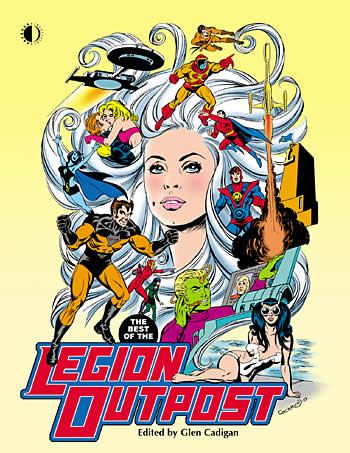
The Adventure Comics years were, however, particularly under the authorship of youthful (age thirteen when he started!) prodigy Jim Shooter, the first great age of the Legion. And it created a new phenomenon in comics – a dedicated fanbase that continued to grow even in the lean years, demanding a return to glory. It's my impression that those lean years were in fact the great age of Legion fandom, from my perspective at least centered around the great fanzine Legion Outpost that flourished during that time.  Nothing like an underdog cause to bring people together.

The Legion of Super-Heroes #1 that appeared for Feb 1973 was basically an experiment – reprints of four of the most significant stories from the Shooter Adventure issues to see if the Legion could really carry itself. Apparently the results were favorable, because Superboy #197 (Sep 1973) saw the Legion return to main feature status, essentially taking over their host's home … and eventually booting him out! That took a while. In quick succession, however, they went from lead feature with a Superboy story as backup (#197), to lead feature with a Legion story as backup (#199), then the classic Superboy #200 (Jan-Feb 1974) appeared which, with the first full-length Legion story in five years set in their own rightful milieu, the future, felt really special, a return to greatness. Yes, I'm aware that #198 was also a full-length Legion story, but it was set in the 20th century and felt more like a Superboy story co-starring the Legion. #200 focussed on the Legion itself, with Superboy as just another member. And that was pretty much how it would be from there on out, more or less. Yeah, Superboy's name did dominate on the cover from several years, and generally he would be pretty prominent in the stories, but he was portrayed as part of the team, not as the main character with guest-stars.

Almost unnoticed because there was no change in the cover logo was a significant shift in status to acknowledge that reality in the official name of the publication, when Superboy #230 (Aug 1977) was followed by Superboy and the Legion of Super-Heroes #231 (Sep 1977). Then, the shift from the 1970s to the 1980s was marked by the appearance of a new title, Legion of Super-Heroes … #259 (Jan 1980) “in a comic all their own at last” as proclaimed by the cover, as Superboy and his very name departed tearfully from what had been his own series for over thirty years (Superboy #1 was way back in Mar-Apr 1949)! His absence from the Legion tales was short-lived, however, but when he came back it was still as just another member, even less of a focus than before, and he probably appeared no more often than any other of the first tier of Legionnaires. Some have always been more popular than others.

Through all these changes in publication status, however, there was a continuing thread of continuity. These were, no matter what changes had developed, the same characters who had been introduced over twenty years before. And arguably the greatest years of the Legion would begin very shortly, inaugurated by writer Paul Levitz and artist Keith Giffen in Legion of Super-Heroes Annual #1 (1982) and Legion of Super-Heroes #290 (Aug 1982), the latter being the first issue of The Great Darkness Saga, one of the best DC Comics stories ever told. It's not Levitz and Giffen's debut on the title, but it is when people sat up and took notice, and Legion catapulted to the status of one of DC's top-selling titles, winning both critical and commercial acclaim …
and earning a new prestigious #1 -- the first with new material -- in a deluxe new format called “Baxter,” with higher paper quality and production values, in Legion of Super-Heroes #1 (Aug 1984).

Relatively soon thereafter, however, things did start to change – radically. 1985: Crisis on Infinite Earths wrought havoc on Legion history as their inspiration, Superboy, was retconned out of being in the DC Comics-wide partial reboot. Attempts were made to create patches, to keep a Superboy as their inspiration by the introduction of the “Pocket Universe,” but editorial mandates and shifts in direction kept cutting such efforts off at the knees and Legion continuity, hitherto long and complex but cohesive, descended into chaos. The title suffered for it, in my opinion, despite Levitz's best efforts … and despite the fact that he obviously loves these characters and writes them better than anyone else, the fact that he'd been writing them continuously for several years started to show. Everyone needs a break from time to time. Various changes in tone, both of story and of art – sometimes radical as with the return of Giffen late in the 1980s, afflicted the title until, in 1989 a significant shift threw the narrative five years into the characters' own future in another:

Legion of Super-Heroes #1 (Nov 1989) – the beginning of the “Five Years Later” era, sometimes called the “Five Year Gap” although to my mind that's erroneous. Whatever. Overseen by Keith Giffen, no holds seemed to be barred as the story took a darker albeit quite offbeat turn that finally – wham – almost immediately in issue #4 (Feb 1990) threw over the connection to Superboy and the Superman legend altogether in the first devastating “Continuity Punch,” delivered by Mon-El, a Superboy surrogate who fairly neatly stepped in to fill the void in a complicated rewriting of many aspects of Legion history. The “Five Years Later” Legion is perhaps the most controversial period in fifty years of publication, polarizing fandom. I think I stand in the middle of the road here, enjoying certain aspects of the new status quo – which undeniably brought a freshness to the saga – while not really liking the basic ideas upon which it was premised. I mean, for me, the Legion will always be connected to Superman at least, in some way, shape, or form, but continuing editorial vaccilation resulted in even such things as the Daily Planet – still publishing in electronic form after a thousand years in the early stage of this period – being banished before very long. Talk about going too far!

Predictably, it floundered, even though there was some good storytelling going on. It just never caught on. Various things were done to revive the magic – a group of younger versions of the characters as they had existed way back during the Jim Shooter/Adventure Comics glory days were literally brought out of cold storage – leading to the ultimately unanswered question of which were the “real” Legionnaires. Were the younger versions clones kept in stasis for all those years, or were the younger versions the originals kept in stasis for all those years while the ones we had been following for all those years were really the clones? Whichever, the young'uns seemed to bring back the magic – first they got their own title – Legionnaires #1 (Apr 1993), which I don't count in my list of #1's above because it's really a continuing, companion parallel thread alongside the main title – then when DC Comics threw up their collective hands in 1994's Zero Hour to effect another line-wide partial reboot to fix the problems that had developed as a result of incomplete implementation of new storytelling after the Crisis on Infinite Earths nine years earlier! –

(I just had to go get some Tylenol.)

- the young'uns became the only Legion in a reimagining of their saga from the very beginning, a new beginning. … And yet there were no new #1's – the Zero Hour Legion, often derisively called the “Archie” Legion, was introduced in (as part of the line-wide “Zero Month” event) Legion of Super-Heroes #0 and Legionnaires #0 (both Oct 1994), followed by Legion of Super-Heroes #62 and Legionnaires #19 (both Nov 1994).

The first radical narrative discontinuity in Legion history did not get new #1's!!! Even though these were new stories altogether, with no connection to what had gone before other than reimagined characters and events including some of the same overall themes.

Not yet jaded after reboot after reboot, still missing the originals to a degree but figuring this was the new status quo that would stick, I quite liked this fresh new Legion although it is another very controversial era in Legion history. It would last – with parallel titles so we had essentially two Legion comics every month – for about five and a half years.  Times were good.  Nevertheless, declining sales apparently drove another radical change in story although not in narrative.

What I mean is that when the first Legion Lost twelve-issue miniseries came along (#1, May 2000), it followed continuity-wise directly from what had just ended. And, with a bit of a gap filled by the six-issue Legion Worlds mini-series (#1, Jun 2001), telling what had happened to the bulk of the team while a dozen or so of their members had been lost at the other end of the universe – therefore really a parallel narrative – so did the new title,

The Legion which took up with #1 in Dec 2001. Through all this, again with a certain darkening of tone and maturing of the characters, there was a continuing narrative thread telling the adventures of what is variously called the Zero Hour Legion, the “Archie” Legion, or the Reboot Legion …

until declining sales prompted another wholesale reboot/reimagining – conceptually, I would argue that this was far more profound discontinuity than even the Zero Hour reboot. Legion of Super-Heroes #1 (Feb 2005) reconceived the Legion as a galaxy-wide movement of youthful rebellion against their stodgy old parents – the watchword was “Eat it, Grandpa!” – that quite frankly in part because this long-time fan (I've been reading the Legion continuously since 1967, the middle of the Shooter/Adventure days) is old enough to be “Grandpa” I didn't much care for although I dutifully bought it and enjoyed it for what it was.

Ironically, however, virtually concurrently with the introduction of what has been called the “Threeboot” Legion, something else happened. In a major crossover between the Justice League and the Justice Society called The Lightning Saga, set in the present (now 21st century, of course – time marches on), characters from the future unmistakeably identified as minimally-tweaked versions of the originals from the mid 1980s Levitz era were introduced! Even to the point that Superman remembered having adventures with them during his youth! At least in part because comics fandom is an eternally aging population (a real problem for the future of the medium that no one seems to know how to address), nostalgia for the “real” – I shouldn't put that in quotation marks because to me they are – Legionnaires who existed from 1958 to the mid 1980s trumped generational conflict and the “Threeboot” never really had a chance. I mean, whatever else you might think of the title, Mark Waid has a legitimate grievance in that DC editorial gut-shot that latest reimagining of the Legion from virtually the beginning! It rocked on for about three years, ironically ending early in 2009, just after the end of the Legion concept's half-century anniversary year, when it was unceremoniously cancelled with #50 (Mar 2009). Because it was really obvious that the version that had legs was the “original,” which appeared here, there, and yonder, gaining momentum, until in 2010 we were graced with
another Legion of Super-Heroes #1 (Jul 2010), continuing the adventures of what by then was called the “Retroboot” Legion because although the broad strokes of almost thirty years of narrative were intact, the next twenty years gap had left inevitable adjustments necessary. Exactly how it all fits together is not entirely clear as yet.

Especially with this latest #1 - see top of this post for the cover.

(Okay. The title of this blog is not Random Ramblings for nothing, you know!  The point of all this is that there have been a whole bunch of Legion #1's but that they haven't always coincided with the really significant shifts in Legion continuity.)
* * *
What about this latest Legion of Super-Heroes #1? As a story, and overall what they promised is so true that I can't discern much of anything that would put the lie to it – that the Legion would probably be the least changed of any title in the transition from pre-Flashpoint to DCnU – this feels like almost a direct continuation from what happened in last month's Legion of Super-Heroes #16. They are still dealing with the aftermath of their conflict with Saturn Queen's Legion of Super-Villains as told both in the Legion title itself and from the Legion Academy faculty and cadets' perspective in Adventure Comics. Several of those cadets, having been tested in a fire that consumed one of their number, have been promoted to full Legion membership because the main team has suffered its own losses and stands at its lowest number in a long time. And yet there is something that did happen in the meantime, leaving several of their number lost in time and presumed dead – what exactly it was that cast the members of the new Legion Lost into the past is not revealed yet, but alone among all the New 52 titles I've read (by no means all) there is here acknowledgment that there was a “Flashpoint Event” – which has slammed shut the possibility of time travel back to the 21st century. The Legion can no longer call on Superman's help from the past – so we know that his association with the Legion is still intact, although we don't know exactly when that began, what that association was, and so forth. Hints in Action Comics #1 are that it goes back to when he was younger, so hopefully the essence of classic “Superboy and the Legion” is still there. Things are looking good. What could have been a real catastrophe taking away “my” Legion so soon after we got it back, seems to have been averted.

Most of all, Paul Levitz is still at the helm, in his rightful place, complemented by the fantastic art of Francis Portela – so I'm confident that the Legion will continue as the title I will continue to buy even if I can get nothing else. Even though I mentioned a bit of a waning in the stories in the mid-late 1980s and attributed it to Levitz being on the title too long without a break, another thought has occurred to me. The various editorial mandates that were coming down had to be interfering with what he wanted to do, and although he adapted to them quite ably, I really prefer to believe that if DC will just let him do what he does best, all will be well and we can all be happy. I'm happy at least!

Cheers, and thanks for reading (if you made it this far!)!

Friday, October 28

Batman #1, Nightwing #1, Catwoman #1, Birds of Prey #1, and Red Hood and the Outlaws #1 (Nov 2011)

I'm going to try to keep this to some quick hits.

“Knife Trick”

Scott Snyder's transition from writing Dick Grayson Batman in Detective Comics to writing Bruce Wayne Batman in the New 52 doesn't constitute even a bump in the road. It's still great! A slightly different tone because they are different characters, sure – and a slight story misstep as well. My biggest qualm has to do with the “cliffhanger ending” – which seems a bit of a cop-out because who really believes that the murderer who tortured and killed some poor schlub and left a message – “Bruce Wayne will die tomorrow” – is really Dick Grayson whose DNA was under said schlub's fingernails? And, while the art is generally quite good, appropriately atmospheric, Greg Capullo needs to get a better grasp of the relative statures of Bruce and Dick, especially, and I would argue that Tim would be about the same height as the other two. I think they probably are all of a similar height at this point in their lives, even if Tim's been de-aged a bit; the main difference would likely be in their different builds. As shown, however, in a scene together, Dick looks about fifteen, Tim looks about twelve – and Damian looks about six! But otherwise, this is a fine relaunch issue – jumps right into a case, acknowledges the recent past, introduces a new status quo and barrels right along.

I really did like the introduction of all kinds of James Bond-esque high tech – holographic face-masks, computer interface contact lenses with facial recognition software and lipreading software included, some kind of remote DNA analysis link back to the Cave in his gauntlet. Wow! This tracks perfectly with the holographic camoflage for the entrance to the Cave and a holographic Alfred in one of the other titles so far – great consistency.

Greatest exchange: Dick, wondering why Bruce left him undercover as the Joker in Arkham for an extra day – there's the mission reason, to be sure of what they'd discovered by the mission, but also, “With all you've been shouldering lately,” Bruce says drolly, “I figured you could use the day off.” – “A day off in Arkham,” Dick replies, nonplussed. “Only you, Bruce … only you.”

(Note:  So Bruce Wayne actually has two assassins coming for him?  See Batman and Robin #1.  I knew he shouldn't have gotten involved with that Batman guy!)

“Welcome to Gotham”

Again, acknowledgment of the past – and move on. Dick is happy to be back as “himself” – Nightwing, albeit in a slightly different uniform that finally gives homage to his original crime-fighting guise of Robin in its crimson “nightwing bird” motif while retaining the basic sleekness of his most recent Nightwing uniform before he took on the mantle of the Bat “for almost a year.” (Although there is ambiguity in his interior monologue, “... while Bruce Wayne was … away.”) There is acknowledgment also that Gotham City threw a lot at him in that time – one of the central themes of Snyder's run on Dick in Detective was the malevolence that is inherent in the City itself.

In this kickoff issue, Dick returns to his childhood “home,” Haly's Circus, playing Gotham again after a long time … with the worry nagging him: “Gotham has a way of twisting the things you love – turning them against you. And after the last year, now I have to wonder … how is Gotham going to use this against me?” After a bit of trapeze work for old times' sake, Dick is ambushed in the streets – a costumed villain who brutally kills two cops who tried to intervene as Dick was distracted by his own change of garb, to Dick's horror. Villain doesn't know that Dick is Nightwing, though – it's at this point, proclaiming that Nightwing has “no idea who you're protecting,” that Villain pronounces the words heard half a world away by Supergirl – “Dick Grayson is the fiercest killer in all of Gotham. And he doesn't even know it.” Which throws Dick off guard enough that Villain gets the drop on him and the issue ends with it looking like he's about to be gutted like a fish. “Next: EVERYTHING BURNS.” Kyle Higgins and Eddy Barrows turn in a fine first issue that keeps me on board.

“... and most of the costumes stay on ...”

One of the two most controversial premiers of the New 52 – the new Catwoman, who seems way more the “bad girl” than she's been of late … including quite a bit more pure eye-candy titillation. Yes, we don't see Selina's face until page three – but plenty of shots of her half-clad boobs and skin-tight-leather-covered ass on pages one and two! And that pretty much sets the tone. There's not a whole lot else to this issue – Selina is attacked in her home, barely gets away with her cats before it is blown up, takes refuge with a friend who's also her fence and who puts her onto another “job” – where Selina, undercover, sees a figure from her past whom she had as a child witnessed killing her friend but who is no longer locked up. Well, he may have served his time, but Selina takes her own vengeance, violently and bloodily. In the temporarily vacated penthouse her fence/friend had hooked her up with, Selina has a visitor, Batman – which quickly and against his will ends up in a horizontal frenzy, although “most of the costumes stay on ...” “Next: THE MORNING AFTER.”

Overall, not terrible, although I have misgivings with this new, more overtly sexual and reckless Catwoman. I think this series will end up being my naughty, guilty pleasure of the New 52. The one thing I most dislike is the fact that she does not know Batman's identity, nor is she certain if he knows hers. That knowledge they shared previously, for the past several years – and the confidence she kept – put her firmly into the Bat-camp, and there was a real sense – at least I had it – that there was a real albeit complicated love between the two. Now it looks like she's just his naughty, guilty pleasure – well, and vice versa. I mean, how could there be “love” without that shared confidence?

The less said about that cover, and its (I think) pretty explicit symbolism, the better....

“Let Us Prey”

Some investigative reporter has been tracking a “covert ops team run by a bunch of supercriminal hotties” on behalf of some mysterious patron – and finds himself basically bait for a group of assassins tasked to kill said hottie ops team – the Birds. We jump right into the middle – in a church (new character Starling utters the words heard by Supergirl – “It had to be a church. … Like I'm not already damned as it is”), with Black Canary and Starling saving the reporter while a series of flashback scenes do establish a previous relationship between Dinah Lance and Barbara Gordon, although whether the latter ever fielded the Birds of Prey is left ambiguous. It could just as well be read that Dinah has been trying (unsuccessfully) to recruit the recovered Barbara, who wants nothing of it. Maybe it will become clearer with time. Anyway, after saving the reporter, it turns out that he himself is a weapon – when he goes KABLOOM right in their faces in an airport terminal. “Next: Mind Over [Deadly] Matters.”

Again, jumping right into the action, catching my interest – introducing an intriguing new character in Starling who simultaneously I know virtually nothing about and feel like she's an old familiar character (maybe because she seems much like Zinda in her basic personality, at least to me). Duane Swierczynski picks up the reins from Gail Simone quite ably … and keeping Jesus Saiz who finished out the previous series provides a real sense of continuity. I'm in.

Incidentally, only Canary and Starling actually appear here.  Katana is suggested by Barbara to Dinah.  Poison Ivy only appears on the cover ... but I've got to say I like her new look.

“I Fought the Law and Kicked Its Butt!”

This is the only New 52 title I intentionally pre-ordered only the first issue, just on a whim, because it is tangentially grouped with the Bat titles. I am so glad I didn't keep the second and subsequent issues in my pull list. Oh. My. This is bad. Artwise, I was developing something of a liking for Kenneth Rocafort's style after my first visceral reaction against it in Action Comics. Here, without a good story carrying it, there's no reason for me to even try liking it. And the story is not good. Basically Jason Todd and Starfire bust Roy Harper out of some third world hell hole, then we find that New 52 Tamaraneans are sex-obsessed powerhouses with the memory of a goldfish. And there's just not any reason for me to go on. I really disliked this issue and don't feel like writing any more. This is off my pull list. With prejudice.

Oh, and this is that other most controversial New 52 title I mentioned above, along with Catwoman. Difference is, I basically like that character. These I don't. Even Starfire, whom I could previously take or leave, actually liked in the Teen Titans context and others. Not this interpretation, though.

Thanks for reading. Sorry for going out on a downer.

Supergirl #1 (Nov 2011)

“Last Daughter of Krypton”

Well, it does seem – seem – it's too soon to really be sure – that my worst fears about the New 52 Supergirl were unfounded. As far as I can tell based on this one issue, the “pissed-off, angry brat whom you'd better not cross” isn't really the character portrayed here. Maybe they were just wanting to garner controversy and hence attention with those initial statements, which on the whole haven't really been borne out by subsequent interviews with the creators, especially the more recent ones. While I don't particularly like the idea of manipulating us like that if it's the case, right now I'm just grateful enough to accept what we do get here – a frightened, perplexed young girl who finds herself alone in a mysterious new world with no memory of how she got there. And her first meeting with humans does not go well, but she doesn't lash out … well, she kind of does, but that's after whe's been repeatedly attacked by big robotic combat suits as well as just had her super-hearing kick in with a deafening thunder of voices from all around the globe (including fragments of dialogue from various New 52 books that must be happening concurrently! – see below). That would frazzle anyone. Even then, once she rips one of the soldiers from his combat suit, she just pleads (in Kryptonese), “<Please... Just tell me where I am?>” And the art is quite good. The expression of anxiety on her face comes across even as it is.

From the beginning: A swarm of incoming space objects slams into the Earth “not all that far from the Kansas Event” of a “long time ago” – the biggest of which penetrates all the way through the planet to emerge in Siberia! I'm glad the unseen individuals tracking the impact acknowledge – “This is impossible...” – 'cause it is, assuming it is just some object on a ballistic trajectory. Tunguska or even bigger, anybody? My guess is that her ship was still partially in hyperspace or somesuch as it passed through the Earth. Be that as it may, we also find out here that there are established “Visitor Protocols” signed onto by the Russians that give someone besides themselves – the Americans? – someone else? – the right of first contact. As Kara digs herself out of the the ground where her ship had come to rest, she thinks she's still asleep, trapped in a bad dream. She's exhausted and perplexed – she's wearing garb her mother would kill her for if she saw her in it before graduation in “another year”; there's a blizzard, which has not been seen on Krypton (really? – the whole planet?) since she “was barely old enough to walk,” and yet she's not freezing. Then a platoon of at least a half dozen “giant metal creatures” appears – confirming for her she's in a dream. When they attack with some kind of glowing purple tentacular bonds – they hurt – they are shocked to see the symbol on her chest, which is not exactly that of Superman, but close enough. Her terror ratchets up – she can't wake up from her nightmare – “Oh gods” (so the New 52 Kryptonians are polytheists, or at least from a polytheistic cultural background? – in our own basically monotheistic culture, even an atheist might exclaim “Oh God!”) – then the yellow sun rises – “Something's wrong with the sun! … This isn't Krypton!” At which point her eyes erupt with heat vision and Robot Soldier I takes the brunt of it, leaving him baking inside a smoldering, melted wreck. (Hey, can't blame her for that!) She's panicking now – “I was just with my friends I was on my way home and I … I … I can't remember.” RS-II knocks her down, she punches him back – over the next mountain. Her eyes still glowing, she can see the veins under her own skin – “How did I – ?! … What's happening to me?!” BOOOM – the armored platoon hits her with a heavy barrage – bombs, blasters – she wonders why she's still alive. Then super-hearing kicks in, overwhelming her with a barrage of voices from all around the world –

– Recognizable snippets to this reader include: “ – is the fiercest killer in all of Gotham. And he doesn't even know it” (Nightwing #1); “I don't talk to fish” (Aquaman #1); and “A church. It had to be a church. Like I'm not already damned as it is” (Birds of Prey #1) –

Kara falls to her knees and screams – going hypersonic in a wail that would put the Dinah's Canary Cry to shame – the robotic armor starts to shatter. RS-V slams into her, stunning her, grabbing her in a huge gauntlet, suggesting, “You just calm down, okay, Honey?” – and has his robotic arm torn off (luckily without his real arm!) and the chassis slammed to the ground and torn open – at which point she pulls him out and shouts, “<Where am I?! Who are you?>” Through his own terror, when RS-III puts a gun to Kara's head and demands, “Put him down,” that soldier pleads for her, “Don't – aggh – Don't shoot! She's just a – hggk – kid! Let's bring her in!” At which point, wondering what language they are babbling in – “Could they be helping Zod? Father's always warning me...” – Kara desperately pleads, “<Please... Just tell me where I am?>”

And Superman swoops in, sweeping RS-III away from her, speaking the first word of Kryptonese she's heard on this cold, alien world: “<Stop.>” Kara looks relieved … “I think I'm dreaming again.”

Unfortunately, “Next: House of El DIVIDED!” I could do without seeing them fight.

Truthfully, I really enjoyed this first issue. I remain to be sold on the new costume. Actually, it's fine from the waist up, but the hip-and-buttocks-baring panty-shorts (no wonder Mother will “kill her” – take it from me, Father would even be less happy to see his little girl wearing that) and the ugly knee-cut-out boots have got to go. Replace the former with some kind of skirt, and the latter with some regular boots, and it would be okay. Actually, it's no worse as is than some of the more ridiculous early-'70s wardrobe Supergirl sported, but still …

With that minor quibble, I am pleasantly relieved by what we got – as I said above, what seems to be a fairly normal teenage girl thrown into a horrifying situation and reacting with extreme violence mainly because she doesn't know the power she's suddenly been endowed with. But once she has a dominant hold on one of her attackers, she tries to communicate rather than continuing the fight. Nothing like the character the initial blurbs back in May and June led me to fear. And, generally speaking, she's drawn as a realistic teenager, not an over-endowed sex object as too many fanboys-turned-artists end up depicting Supergirl. Overall, I'm feeling much better about this title.

Cheers, and thanks for reading!

Thursday, October 27

The Book Cave Podcast Episode #150: Perry Rhodan

Along with hosts Ric Croxton and Art Sippo, as well as fellow guest Andrew Salmon, I talk Perry Rhodan and a whole bunch of other stuff as the conversation takes us.  And a good time was had by all....

You can check it out at The Book Cave's own website:  http://thebookcave.libsyn.com/the-book-cave-episode-150-perry-rhodan, or at iTunes.  Then browse around a bit in The Book Cave.  It's full of pulpy and comic-book goodness - my kind of reading!

Cheers, and Ad Astra!

Sunday, October 23

Demon Knights #1, Legion Lost #1, and Wonder Woman #1 (Nov 2011)

“Seven Against the Dark”

When the New 52 line-up was first announced a few months ago, I didn't immediately jump on this title. I've never been a fan of the character of Jason Blood, The Demon, even if he is a creation of Jack “the King” Kirby's from his tenure at DC in the early 1970s that added so richly to DC's mythology – Darkseid, the New Gods, OMAC, Kamandi, and so forth. I was familiar with the character from various appearances, but he never really grabbed me. But the medieval setting, for one, made me look at this one again, and the fact that another character I recently developed kind of a liking for – Madame Xanadu (see the wonderful recent Vertigo series by Matt Wagner) – is announced as part of it, and the fact that it's written by Paul Cornell made me decide to give it a shot. Then, for what it's worth, in Cornell's Stormwatch there seems to be a hint that there's a connection there as well. I'm in for at least the first arc. This first issue is mostly just set up, letting us see such things as the “origin” of The Demon when Etrigan is bonded to Jason Blood by the wizard Merlin, the coming together of several characters from DC's occultish titles into a group opposed to what looks like the Big Bad for at least the beginning arc – none other than old Legion of Super-Heroes, latter-day Justice Society foe Mordru (and those temporal tags neatly invert the actual internal chronology, but that's comics for you!) along side some Queen who seems to command a ravenous Horde – a group that includes such as Sir Ystin The Shining Knight, Vandal Savage (amazing that he ever was on the side of the angels … not sure he is here, considering I think he's going to be an ally of Etrigan's), and some warrior woman whom I wouldn't want to cross! The appearance of The Shining Knight in the incarnation created by Grant Morrison a few years ago, plus the title “Seven Against the Dark,” further makes me wonder if there's going to be overt connections between this story and Morrison's mind-bending Seven Soldiers epic wherein Sir Ystin first appeared. I'm intrigued at the very least. Next: Here Be Dragons!

“Run from Tomorrow, Part One: Present Tense”

Even though this is one of the two New 52 Legion titles, and Legion of Super-Heroes is my all-time favorite superhero franchise bar none, I can't say I really cared for this that much. Part of the wonder of the Legion is the generally bright, shiny future that is presented (even as tarnished as it has been in recent years), and the idea of a group of Legionnaires cut off from the main group, stranded a thousand years in their own past in our present, is not entirely appealing to me. Even though I think it's been said their exile is permanent, I hold onto hope that it's not and this will just end up being a second Legion Lost miniseries. Whatever, it's not so bad as to make me not buy it – as a Legion title it would have to be worse than dreadful for that to happen, and it's not. It just doesn't catch me in and of itself.

The gist of the plot is a group of Legionnaires chased a villain from the 31st century back to the 21st century to try to head off his intention of releasing some future plague in our present to destroy the future. They fail – and end up themselves infected. And in the process, a couple of their number appear to be killed in the destruction of their Time Bubble. The issue ends with Timber Wolf asking the question, “What do we do now...?” Next: Outbreak!

“The Visitation”

This is another one I'm not so sure about. Of the mainstream DC titles relaunched here, I figured Wonder Woman was probably the one in the most danger of being dropped by me pretty quickly. I've seldom collected the individual comics, although I've picked up a number of trades of her more notable stories through the years. I really like the character, but her solo adventures generally just haven't grabbed me, not enough to make me buy the monthlies. I mainly jumped in here because she is one of DC's Big Three, the “Trinity.” I figured I'd give it a try. Another point of hesitancy for me is the writer, Brian Azzarello. He's written some good stuff and some bad stuff. Since I mainly am into the superhero stuff, I've read more of his bad stuff than good stuff because generally that just ain't his forte! And the recent First Wave DC “neopulp” experiment that he oversaw was, for me, a bitter disappointment. But here I am.

I must say this is a different Wonder Woman – visually not so much, but in mood and mythology seemingly so. I think I'll grow to really like the much deeper connection with Greek mythology that is being cultivated here, although as a Wonder Woman/superhero story it is a shift in tone that by its nature I find quite jarring. It'll have to grow on me. I think it will. It does play explicitly to one of the basic tropes of Greek mythology – mortals are just playthings in the rivalries of the gods, which manifests in one way that the head of the gods, Zeus, is a randy old fart who routinely goes around impregnating mortal women and thereby pissing off (to paraphrase one of the characters) his wife, Hera. Wonder Woman ends up in the middle, protecting a young woman targeted by Hera because she is unknowingly pregnant by Zeus. We get to see other of the gods, such as Hermes, as well as other creatures from mythology along the way as well. And there are other conflicts between the gods sure to spill out into the mortal world. As I understand it, that's the overall gist of this new Wonder Woman – protecting humanity from the capricious whims of the gods. It sounds interesting. I'll stay aboard for at least a while, give it time to develop. I've probably overused this word lately, but it is if nothing else intriguing.

Cheers, and thanks for reading!

Saturday, October 22

Batman and Robin #1 and Batwoman #1 (Nov 2011)

“Born to Kill”

Tomasi and Gleason are a good team who did great things on the Green Lantern Corps title in the past few years. It's too soon for me to tell how well that will translate to the world of Gotham City and the New 52 Batman and Robin. No point in lamenting (surprisingly) the new team of Bruce Wayne Batman and his son Damian Wayne as Robin, and luckily Dick Grayson's tenure as Batman teamed up with Damian has not been wiped from continuity, is even referenced in these pages. Damian is having a bit of trouble adjusting to working with his father instead of “Grayson,” which manifests itself in a degree of surliness that is somewhat beyond where he had grown to of late. As a coworker who read this issue before me stated, “He's still the little shit,” but then he's only seen Damian in a few cases up until now and hasn't experienced the growth the character has undergone in the couple of years since he was introduced. To wit, at one point, arguing with his father, he slips and refers to “Grayson” as “Dick” instead. ! Really, I think if you look past the surface, Damian is one of the more interesting and well-developed characters in comics today. For that reason if no other I'm on board here with enthusiasm. Of course, since this is a Bat-title, that's pretty much assured anyway.

Briefly told, this issue sees Bruce take his son for one last visit to the site where the saga began, where Damian's grandparents were gunned down that night long ago. One last visit, because the site is going to be bulldozed and developed, and Bruce has determined to stop honoring their last night on Earth and start honoring their wedding anniversary instead. A situation develops that finds them averting a nuclear catastrophe at Gotham University – but in which Damian displays a bit of his usual recklessness that endangers the criminals they are fighting and brings down a stinging rebuke from Bruce. I think Bruce is having a bit of trouble adjusting to working with his son as Robin as well!

There's a framing sequence that doubtless sets in motion what will be the overall story for the early issues of this title, set in Moscow, where a Russian agent of Batman, Inc., comes to a bad end, even being rather graphically and lowered alive and conscious into a vat of acid on the last page in a horrific sequence that ends with his captor proclaiming that it's now time to pay Bruce Wayne a visit. Next: Bad Blood.

“Hydrology, Part 1: Leaching”

Well, I said I'd believe this comic would finally appear when I was holding it in my own hands, and not before. I guess I have to believe it's out now. It has been literally years in coming since it was first announced, and in the past year was delayed time and again, the most recent at really short notice round about February, I think at the time the final decision to go with a full-on Relaunch-boot-vamp-whatever this is was made, in order to just have it come out with all the other new #1s.

This is a beautiful comic, as much painted as drawn, although that does have its drawback in that I sometimes find it hard to follow the story itself through a variety of odd, artistic panels that seem to break all the rules of graphic storytelling. What do I know about those anyway? All I know is it makes it hard to follow, and I've been reading comics for how long? – 45 years? Anyway, it is nonetheless beautiful.

As to the story, some bizarre, beautiful spirit (?) is drowning parents in the process of taking their children in the Latino quarters of Gotham City. Kate Kane Batwoman is on the case, having unsuccessfully tried to prevent one instance, whose parents begin this story by telling GCPD Special Crimes Unit leader Maggie Sawyer how El Angel Rojo de La Muerte, “Dark Red Angel of the Night,” Batwoman, had saved them but failed to prevent their children from being taken. Maggie is visited by Kate, who is startled (?) to see a picture of Renee Montoya and to discover that Maggie knows about her and Renee's relationship (“Detective, remember?”). Well, Kate and Maggie set up a date … was that why Kate was there, or was it related to the case? Anyway, as indicated when we last saw her in Detective Comics (a year or more ago?), Kate's cousin Bette Kane is joining her as a “sidekick” – but Kate will not have her as Flamebird, Bette's former identity, and is insisting on training her anew. The Flamebird costume is out – “You don't need that garish costume … You need a uniform.” Bette ends up military fatigues and a mask rather than a traditional super-heroine costume! Anyway, she finds the whole thing a bit humiliating. And then there's an ugly scene when Kate's estranged father shows up. For the benefit of those who maybe are picking this up new – the hypothetical “new reader” DC is trying to court in this initiative – there is a pretty good recap of the defining event of Kate's childhood, the kidnapping and apparent death of her mother and twin sister … except that the twin sister apparently did not die and has returned as the villainess of the first Detective Comics arc a couple of years ago, “Alice.” And Jacob Kane apparently knew that Beth was not dead – Kate has not forgiven him and it looks like she has no intention of doing so.
(This is a huge image file!)
Interspersed with this we see Department of Extranormal Operations agent Cameron Chase being tasked by Director Bones to bring in Batwoman – a task she does not relish given how well their attempt to bring in Batman a few years ago went! – and also a meeting between Commissioner Gordon and Maggie Sawyer regarding the case of La Llorona – “the Weeping Woman” – “That's all I have to go on, Commissioner. A ghost story.” “If that's your only lead, Detective,” Gordon tells her, “you follow it. Until this case is solved and those kids are found … whether you believe in urban legends or not.” And the issue ends with Batwoman, inspecting the same crime scene where a teenage girl was killed in the abduction of her younger cousin that Gordon and Sawyer were overseeing, being approached by Batman. She bristles: “This is my crime scene now.” “I'm not here to take it back. … But we do need to talk. … I have a proposition for you...” To Be Continued.

Have Bruce Wayne Batman and Kate Kane Batwoman formally met? Last I remember, he was stalking her in a different guise in the #0 issue that came out forever ago, determining that she is indeed a good prospect for Batman, Inc.

I do have one complaint about the art – mainly the coloring. I don't know if it's intentional or not, but there are times Kate Kane looks so pale as to be literally vampiric in her appearance. Sometimes she is literally chalky-white (see above). Other times the variance from other characters' flesh-tones is not nearly so severe. This actually is a quirk that appeared during the later issues of the Detective Comics run, so I'm sure it's intentional ... I'm just not sure what they're going for.

Overall, an intriguing issue. Frankly, I didn't really miss Greg Rucka who has overseen almost every other appearance of Batwoman since her creation a few years ago, including the great run she had in Detective Comics a couple of years ago.

Thanks for reading, and Cheers!

Superboy #1 (Nov 2011)

“The Clone”

Well, the first question I had seems to have been answered. The entire continuity of the previous clone-Superboy who was created in the wake of the Death of Superman storyline now almost twenty years ago (Lord, how time flies!), lately known as Conner Kent, has been wiped.

This story begins with the clone still in some kind of amniotic fluid tank, seemingly a failure in that brain activity has so far not been detected. Doesn't mean it's not there, though, because he has been telepathically aware and studying the cloning team even as they've been studying him. In light of the seeming failure though, the determination is made to put the body down and hopefully learn something from the autopsy. That – plus sympathy from one of the scientists, a young red-head named “Cait[lyn?]” – triggers his awakening, and that of his powers – and the slaughter of all the rest of the team. The story jumps to an almost idyllic story of the clone, now looking much like the old Conner, recently enrolled in a school in small-town America along with a pretty platinum-haired girl named “Rose.” But it's quickly apparent something is wrong, because the clone absolutely ignores a housefire with a victim screaming from the upstairs window. It turns out this is a virtual-reality environment by which the young woman scientist is now trying to study the “cellular subconscious” and determine 1) who the human DNA that stabilized the Kryptonian DNA came from, 2) why that “cellular subconscious” keeps creating a small-town America world, and 3) why it seems to have no empathy for the pain of other beings. Her studies are cut short, however, with the arrival of Templar, a creepy bureaucrat-type who has a mission for “the Superboy. Against a background showing the New 52 Teen Titans, Templar says: “I have a very unusual problem. … Several, in fact. … Superboy in how I plan to solve them.” We also “hear” “the Superboy's” internal monologue: “If resolving a situation for him is going to get me out from under these people once and for all...? … That's a small price to pay for freedom.” Next issue: Alien Prison Break!

Incidentally, “Rose” exists outside the VR world – as Rose Wilson, complete with both eyes but still a mercenary, whose assignment is to put the clone down if necessary. That is an interesting development given the relationship that was developing between the two of them at the very end of the previous series.

Overall, it's too soon to tell whether I'll like this new clone-Superboy. I had grown to really like Conner Kent in recent years, and I will miss him. I don't like the “Tron”-style battle-suit that we've seen, including on that last page. I like that horrific "robot-Superboy" image of the cover even less, but that thankfully seems to have nothing to do with the story inside except for having elements of that same "Tron-suit" in its design.  But I am curious about how this will develop, and have to say that this first issue does present a character that is surprisingly sympathetic given his obvious emotional deficiency, truly a lost boy in a strange world. I'm sticking with it for now. Hopefully he will find his empathy pretty soon and start his journey along the path toward heroism.

Cheers, and thanks for reading.

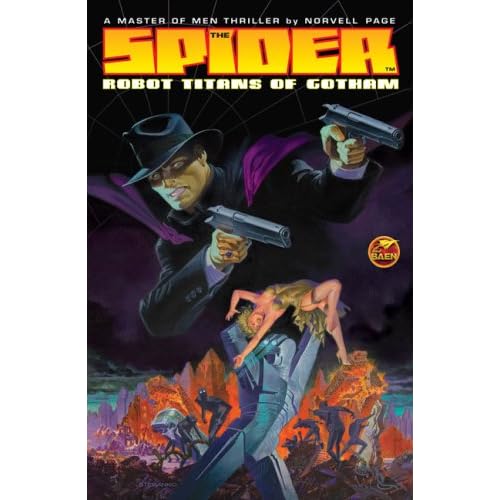
The Spider: Robot Titans of Gotham (2008)

By Norvell W. Page

Because the three novels in this present volume from Baen Books are perportedly linked to a certain degree, I'm writing them up as one entry as they are here republished. I actually finished reading it a couple weeks ago, but last week was mid terms and the week since has been catching up on my professional duties. This weekend is the first extended time I've had in a while to sit down and work on my blogs.

How are the three novels linked? Well, it's a little more obvious for the first two, both reprints of adventures of the 1930s pulp hero The Spider from his eponymous magazine that lasted for over a hundred issues through the 1930s and into the early 1940s, and I'll get to that. I still haven't puzzled out exactly what the connection is for the third, which is from an abortive pulp magazine entitled The Octopus that lasted for only a single issue. Frankly, I've not been able to confirm for certain that it was even written by Norvell Page, since each pulp hero's adventures actually appeared in stories attributed to a house name whether or not the usual writer actually penned any particular one or not. Norvell Page did write the lion's share of Spider novels, but there were other authors and he was not in fact the first. The first two were actually an anomalous situation in that the author's real name did appear as R. T. M. Scott. But once Norvell Page took over with the third, the house name of “Grant Stockbridge” would be used for all, even the ones not written by Page. The same was true of Lester Dent, who wrote most of the Doc Savage novels under the name “Kenneth Robeson,” although there were a scattering of other writers, and of Walter Gibson who was almost but not always hidden behind the name of “Maxwell Grant” on the covers of The Shadow. The Wikipedia article for the 1938 movie serial The Spider's Web which borrows the name of its villain from this story only says that “The Octopus was a villain in a single issue pulp believed to have been written by Norvell Page who wrote most of The Spider pulp stories” (my emphasis). It's not certain that the “Randolph Craig” house name covered Novell Page, but it is likely that he had at least some hand in it. I'm in no way a “lit-critter” (my old drunken mentor's term for the literary criticism types), but it seems very much like Page's style – and even moreso! The Pulp Reader blog did a little investigating last year and came to the conclusion that a couple named “Edith and Eljer Jacobson wrote the original story and then it was retooled/rewritten by Page to make the hero fit more of the Spider mold. This would explain why the story in places seems typical of Norvell Page's work and at times even more grotesque, and horrific, the prose more purple without quite the polish of his Spider work.” As I said – “like Page's style – and even moreso!” (Pulp Reader had just previously written a review of this story that is well worth reading, then reconsidered his acceptance of Page's authorship and did a bit more digging.)

Which rambles a long ways from a review of this present volume.

There is first a framing sequence by Joel Frieman that basically introduces the first tale and establishes a tenuous connection between it and the second. Pulp author Norvell Page is upset that one of his Spider stories was blatantly plagiarised by the creators of the Superman Sunday newspaper strip. We are told this against the background of the rising – exploding – comic book market that is sucking all of the oxygen out of the room for the old hero pulps, which are by now on their way out as evidenced by the declining remuneration Page is getting for his writing. This framing sequence taking place in January 1941, The Spider itself would last only a couple more years. Popular Publications, the publishers of The Spider, accept an out-of-court settlement of cash from Detective Comics (i.e. DC) for silence regarding the plagiarism (“They don't want Superman to be known as 'The Man of Steal'?” Page asks.) Page finds an old prop pistol once used by the cover painter for The Spider and has it in his pocket shortly afterward when he is ambushed by some ruffians in the street. He pulls the gun on them, to bluff them – they don't fall for it – but then a gunshot rings out and his attacker falls shot dead! And we're taken immediately into ...

Satan's Murder Machines (originally published in The Spider for December 1939)

Frankly, although this is a typically gripping and over-the-top adventure of The Spider with a villainous gang terrorizing the City in powerful, flame-throwing, almost indestructible robotic armor suits, the background of the story as highlighted in the prelude is far more interesting. Because a “rip-off” of this story did appear as a Superman story, not in the comics themselves but rather in the Sunday newspaper strips from 3 November to 22 December 1940, under the title “Bandit Robots of Metropolis,” written by Jerry Siegel with pencils by Wayne Boring and inks believed to be by Don Komisarov (actual creator credits are hard to come by for the early days of comics – attribution of all the creators would not appear consistently until the 1970s). “When robot bandits invade Metropolis and demand tribute, Superman must find the robots' lair and rescue Lois.” So reads the blurb at the Grand Comics Database (specifically http://www.comics.org/issue/371986/#596403) about half-way down the page. This is not the only time, moreover, that this Spider story has influenced other super-hero and pulpish characters. It's cited as being the inspiration a couple decades later for Stan Lee and his brother Larry Lieber's 1963 creation of the Marvel Comics hero Iron Man for Tales of Suspense #39, as well as the gigantic mechanical monsters that open the 2004 movie Sky Captain and the World of Tomorrow – http://www.newsarama.com/comics/spider-iron-man-war-moonstone-100608.html. I wouldn't be surprised if there were other such “homages.” In 2010 Satan's Murder Machines was finally adapted as such into comic book form by Moonstone Publications, albeit under a different title: The Iron Man War (see previous link).

Death Reign of the Vampire King (originally published in The Spider for November 1935)

This is another tale of The Spider, much like any other, basically about a madman who unleashes trained poisonous vampire bats onto the various unsuspecting populations of various cities – the action's not confined to New York this time – until against seemingly insurmountable odds The Spider brings him down. It is the name of the villain that gives the connection to the first story. He is The Bat Man. (Say it with the deep, gravelly voice.) And he does have a black, scalloped, bat-wing cape.  But there's not a whole lot else to say about it other than that it may have also enjoyed comic adaptation, although the very source for that statement – http://homepage.mac.com/cdkalb/spider/pulps/list.html , go down to #26 – links to a page that seems to indicate otherwise, that the 1990 Eclipse series was based on another Spider novel entirely, Corpse Cargo – see http://homepage.mac.com/cdkalb/spider/comics/truman.html .

The City Condemned to Hell (originally published in The Octopus for February-March 1939)

I've already addressed the authorship question above. The Octopus was one of only two pulp titles with the title being the name of the villain. The other was The Scorpion, which may have been an effort to jump-start this series with a new name. This story has a lot of things in common with The Spider stories, but is even wierder and more outrageous. Jeffrey Fairchild is The Skull Killer – another half-crazed, obsessive foe of criminals with a ring whereby he leaves his mark on the forehead of his victims – like The Spider and his vermillion spider ring. Fairchild is also a doctor, however, with a third identity as an elderly physician named Dr. Skull. He has an invalid brother to whom he is devoted, but who despises him, while being devoted to his doctor, Dr. Skull. Dr. Skull also has a comely nurse, Carol Endicott, providing a love interest for Jeffrey, but who does not know that Fairchild and Skull are one and the same (nor of course that he/they is/are The Skull Killer), and there are hints that there's a love triangle between Carol, Jeffrey, and his brother. I'm not sure what plans Page – or whomever – may have had for this series if it continued, but I bet it would have been wild! Unfortunately, it didn't continue. Besides a series taking its name from the villain being a problematic proposition, this story was probably just too weird …

The villain here seems very Lovecraftian, a mysterious figure known as The Octopus who has a method utilizing a burning ultraviolet beam to transform normal humans into deformed, vampiric monsters who can't survive in regular light, who need UV, plus living human blood to survive – whose veins now run with a seawater-like substance. Yep, it's weird. Fairchild, The Skull Killer, ruins his current plans, but the villain does get away – what his next scheme would be we'll never know.

I have no idea why this story in particular is included in this volume. Sure, the conventional wisdom is that it was written by Norvell Page (see above), but even so.... There is a tenuous DC Comics Superman-Batman connection linking the two Spider stories, even giving the overall title for this collection, parallelling the Superman Sundays title “The Robot Bandits of Metropolis” becomes The Robot Titans of Gotham, combining elements from Superman and Batman in one title. That's clever. But whatever the reason they chose this odd little story to round out this volume, I'm glad they did. It was an experience to read, and I'm glad to have had the opportunity.

So. What happened to Page after the attack with which the prelude ended? I thought there would be an epilogue that would pick that little story up and even reveal the rationale for this collection. There's not. There is a follow-up collection from Baen books, The Spider: The City of Doom. I've not read it, and I'm not sure when I'll get around to reading it. I have peeked at the first pages, however, and yes there is another prologue that seems to take up from this one. My curiosity will take me there before too long, I'm sure.

'Til then, Cheers, and thanks for reading!

Perry Rhodan #14, Venus in Danger (1972)

By Kurt Mahr

After a hiatus of several months, I've taken back up with the leaner, and hopefully meaner, Perry Rhodan Reading Project blog.  If you're interested in reading more, go here or click on the banner link at right.

Cheers, and Ad Astra!

Wednesday, October 19

Stormwatch #1 (Nov 2011)

“The Dark Side, Part One”

This is the first truly new title of the DCnU that I'm giving a shot. I never read the old DC-Wildstorm imprint title of the same name. What little I knew about it, that it was a “rawer,” “edgier” version of the Justice League just didn't (and in itself doesn't) really appeal to me. However, from what I can gather this is meant to be a central title of the New 52, relating stories of superhumans who are not superheroes, in a team that has been around for centuries in one form or another. It's definitely being integrated into the new main DC universe – with a central character being Martian Manhunter, who I generally like in a team setting (though never so much on his own). And it's written by Paul Cornell, who has now written a couple of things I've enjoyed – the Lex Luthor story arc through the 890s of Action Comics, followed by the return of Superman to that title in the “Reign of Doomsday” story arc that finished out that venerable pre-Flashpoint run, plus the brilliant Knight and Squire miniseries. So I'm in. Frankly, at this point, I'm not quite sure what to make of it – it's too soon to tell. I like what I see so far, however.

Briefly, several plot lines are started right off the bat – actually, we're kind of dropped right into the middle. There's some kind of mystical horn been blown, with ominous portents – that seems to be a giant artifact in the Himalayas; one of their number investigates what appears to be the moon itself preparing to attack the Earth in what seems some bizarre plan to prepare the Earth for some coming threat; and a team including Martian Manhunter tries unsuccessfully to recruit a “Superman-level” being called Apollo into their number only to be taken out by a dark-clad figure calling himself Midnighter who proposes a different type alliance to the powerhouse. Along the way we're introduced to a bunch of (to me, at least) new characters very quickly, but fairly effectively, and we get a quick sense of their attitude toward the new upstarts: “Do we look like 'super-heroes?,” asks Jack Hawksmoor of Apollo – “They're amateurs. We're the professionals. … Stormwatch has been protecting the world from alien threats for centuries.” We actually see glimpses of that history (and hints of why I'm glad I'm also picking up Cornell's other DCnU book, Demon Knights) in a character's mental flashbacks. And Justice Leaguer Martian Manhunter helps clarify the difference between this team and others such as the League in the two hats he's wearing: “I am known in some quarters as a hero. I can wear that shape. But when I need to be a warrior – I do it with Stormwatch.” I'm feeling good about this title.

Cheers, and thanks for reading.

Tuesday, October 18

Detective Comics #1 and Batgirl #1 (Nov 2011)

I find myself in a funny position regarding this book. I've never been a Tony Daniel hater - I've actually liked most of his stuff - and I was pleased when the initial feedback regarding his first issue in the New 52 was generally positive. Then I read it for myself, and I'm not so sure I like it so much. It seems excessively gruesome, with the Joker literally losing face in the end. I mean, really – having the skin flayed from his face by a new villain called “The Dollmaker.” He likes it.  He says it felt "fangasmic."  Before that, though we got to see a Joker whose characterization seemed a bit too “hoo hoo hee hee” for me – I found myself thinking of Cesar Romero, of all things, and that ain't a good thing. Granted, this Joker is a bloody fiend – but the giggling fool aspect can go too far, verging on silliness. It just seemed off. But most of all, I'm not so sure about the characterization of Batman himself, who seems quite different from the one I've seen so far in Flashpoint #5 and Justice League International #1 – the two places I've indisputably seen the “current” DCnU Batman. That one seems somehow less the brooding Dark Knight than we've seen in recent years – although there was movement away from that already pre-Flashpoint. This one, however, not so much – in fact, maybe he's closer in spirit to the one appearing in the new Justice League #1, set five years in the past. Which makes me wonder if a brief rumor – based on a statement by Tony Daniel that he later retracted – that Detective would be, like Action Comics, set sometime in the “past” for its first story arc, may indeed be the case. It's hard to tell. Yes, Jim Gordon appears younger, but so does he in Batgirl, which is presumably set in the “present.” Batman's interior monologue intimates that he and the Joker have been foes for six years already, however. I would actually be fine with an extended time-line for Batman, beyond the five years that the New DC superheroes have been “public,” since the first adventures of the Justice League. A decade or so would seem to be necessary, in fact, to accommodate the careers of Dick Grayson, Jason Todd, and Tim Drake as Robins before the current Robin, Damian Wayne. (And that's ignoring Stephanie Brown's brief tenure, if that – or she – even still exists.) There's been some talk that Batman did exist as an “urban legend” before five years ago. On the other hand, what happens to the Joker at the end would seem an odd direction to take the character for a story set in the past. Without a doubt, I am curious where this is going, and that is a good thing.  I will be back.

“Shattered”

I'm not going to belabor the fact that, as cruel as it would sound were we talking about a real person, I wish DC had left Barbara Gordon a wheelchair-bound paraplegic. She was such a good character on so many levels as Oracle. But they have instead de-aged her to her early twenties at most, three years after being critically injured and paralyzed by the Joker brought her first career as Batgirl to a sudden end. Batgirl is back now, following a still-unexplained recovery. The word “miraculous” is indeed used. I'm sure we'll learn more. But, pardon the pun, she's still not very steady on her feet. Throughout this issue we get to “hear” via her internal monologue how unsure she is – overeager to get back into the superhero “game,” but out of practice and even fundamentally unprepared. Especially when the villain aims a gun at her just like the Joker did – causing her to freeze up and allow him to murder his victim right in front of her. And that's the cliffhanger ending. In between her first and second outings as Batgirl, we get to see Barbara moving out of her father's home, striking out on her own, taking an apartment with what looks to be the beginning of a new cast of supporting characters. It's all written by Gail Simone, which means it's really good. And it's the Batgirl we have now. I can live with it – but I miss Stephanie.

Thanks for reading -- and Cheers!

Tuesday, October 11

Justice League International #1 (Nov 2011)

“The Signal Masters, part 1”

Last night, a bit later than usual because of (1) Previews not shipping until the first rather than the last Wednesday of the month, and (2) some unrelated issues going on at my mail-order comics source, I received my “end-of-September” shipment of books, with the bulk of my DCnU #1's. It has been a long wait. I had, of course, gotten the new Justice League #1 with the August shipment, since it was one of only two DC Comics to ship the last week of August; I had also given into the buzz and digitally double-dip purchased the new Action Comics #1 several weeks ago based on the almost uniformly – and deservedly – good reviews it was impossible to avoid seeing. My thoughts on those first two issues of the New 52 can be seen via the links associated with their respective titles. Both of those issues tell stories set in the past of the new “present” – five years in the case of Justice League, something more than five years in the case of Action Comics. So this is my real introduction to the new status quo, the way things stand right “now” in the post-Flashpoint universe of DC Comics.

A little background. I never read any of the previous Justice League International series (there were more than one, right?). My main exposure to some of these characters as a group is through the recent Justice League: Generation Lost series. Booster Gold, of course, I really grew to like between 52 (is that really five years ago?) and his just-ended series. I was looking forward to the group in Generation Lost continuing in a new JLI series before the announcement of the Relaunch. This is, however, not what I was looking for at that time. So I'm trying to approach this as something totally new – which is what you have to do. I don't think that in the new continuity these characters really have any history together.

Anyway. All in all, this issue is pretty good … but not outstanding. Basically, by five years after superhumans “go public” in the new DCU, the United Nations believes it needs its own team, under its own authority and control. So they assemble a group of basically second-tier heroes under the “leadership” of Booster Gold – “Great Q rating, knows P.R., craves attention … A leader I can control,” Andre Briggs, Head of U.N. Intelligence informs the U.N. Global Security Group at the team's inception. The team is assembled as much as anything for political considerations – Ice is “sure to be popular with our Scandinavian members,” Vixen is in because “Zambesi will appreciate your courtesy,” and so forth. The balance of the team includes Fire (Brazilian), Rocket Red (Russia), August General in Iron (China), Godiva (the U.K.) – and Guy Gardner Green Lantern, because “it's hard to say no to a Green Lantern.” Not to worry – He says no as soon as he learns that Booster Gold is to be the leader. A suggestion of a “J[ustice] L[eague] connection” via Batman is rejected – “I thought the idea wa a team we could control. No,” states one of the GSG flatly. Not to worry on that count, either – Once the team is together and dispatched on their first mission, to investigate a missing UN research team in Peru, Booster finds that their pilot is indeed Batman. “Why – ?” – “Thought you might appreciate the help,” Batman replies. He leaves unsaid the fact that, as he had previously told Guy Gardner, the UN must have some ulterior motive in making Booster the leader (right after he had cautioned him, “Don't sell Booster short”), and he means to discover it.  What he does is not undercut Booster, rather assuring him he's along not because he's afraid Booster can't cut it, but rather because they're shorthanded, as well as “A few of us [the "real" Justice League?] happen to think it's a good idea to have a connection between our teams.” At which point, Booster asks, “Does the U.N. know you're here?” which brings forth the funniest line of the issue:  “I've always enjoyed your sense of humor, Booster.” So far, I'm really liking this Batman in all the contexts that we've seen him – Flashpoint #5, Justice League #1, and here.

Anyway, the issue ends with a giant humanoid creature of some sort bursting out of the earth – it appears that the new half-formed team recognizes it – “Is that … what I think it is?” Godiva asks – as Booster shouts, “Pull back! PULL BACK!” The character bits such as above that we get along the way I find far more interesting than whatever this threat is. There's also some kind of subplot – the JLI's new headquarters is to be the Hall of Justice – but crowds are demonstrating outside because that's public property being taken over by the UN. And some among the crowd are willing to resort to violence to make their point that the UN can't be “buying off” their heroes – they set a bomb that engulfs the Hall in flames. “So much for the U.N. takin' over the Hall.” – “Now that is what I call justice – ” I need a lot more information than we're really given here to follow what's going on here.

Overall, I enjoyed this issue. Jurgens is a good writer, and most of these characters I think he's pretty familiar with. Booster Gold, of course. Rocket Red is a hoot. The art by Lopresti and Ryan – solid. Nevertheless, something here just doesn't grab me like I figure DC is hoping this Relaunch is going to. As I said above, the “menace” of some kind of earth-monster just seems a bit … mehh. I'll keep reading, for a while, but unless things pick up I may end up dropping this title, probably going to trades rather than monthlies. We'll see.

Incidentally, it turns out that the mysterious black-haired woman on the original cover image back in May has become the blonde Godiva.  That after disappearing altogether in versions of the shot released in the interim.  Frankly, I don't know what the big to-do was -- other than to give people like me false hope that the original black-haired woman might be Alexandra from the Booster Gold tie-in issues to Flashpoint somehow making her way into the DCnU.  Hope that was of course dashed as she was killed off in the last issue of Booster Gold.  Not sure why they did that, and frankly I would have thought having a Greek member of the JLI would have made sense, too.  Oh well.  I still think they had some larger reason for developing that character -- even though that reason may have ended up wiped away by the decision to use Flashpoint to reboot (can I use that word?) DC continuity altogether, with no ties to the old DCU (so they claim).  This is, of course, just some more of my "random ramblings."  We'll see what happens.

Cheers, and thanks for reading.