Saturday, September 10

Action Comics #1 (Nov 2011)

“Superman versus the City of Tomorrow”

Woo-hooo! I own a copy of Action Comics #1! Our money worries are over, babe! What? This isn't the Action Comics #1? Oh, mannnn!

– Sorry, couldn't resist. Though in thirty to fifty years (or less), I can see just these thoughts going through some beggar's mind …. I mean, we've all heard of the poor schmuck with the tabloid-size 1970s “Famous First Edition” reprint of that Holy Grail of comic book collecting thinking that he'd just hit the jackpot, right?

Anyway, I don't actually own even this “new” Action Comics #1 anyway … yet. I'll tell that sad but funny story at the end of this post. But this is supposed to be my short review of what looks to be the foundation of the new post-Flashpoint New 52 Relaunch Reboot Notaboot whatever it is, the “DCnU.” And if Justice League #1 was a bit problematic in its execution, at least in my estimation falling short of what it reallty needed to be as the first new title out the gate, the new Action Comics #1 is a masterful achievement that just might do it.

Grant Morrison is an odd writer. He writes some crazy stuff (not the word I usually use). Some I find to be well nigh unreadable. More I find to be so complex as to be rewarding to multiple rereadings. But when he sets his mind to it, he can write some of the best straightforward heroics that at the same time achieve a depth beyond most of his peers. He did that with his recent (and to be continued) long run in the Batman universe, but here he strips away lingering “wierdness” to create what I predict will be a fundamental redefinition of Superman back to his roots. The character that appears in this modern Action Comics #1 is probably the closest to what appeared in the original Action Comics #1 that has appeared in over seventy years. This is very much Jerry Siegel and Joe Shuster's original creation, albeit updated for the early 21st century. And if the casual, hypothetical “new comic book reader” gives it a chance, I think he may well come back.

Everything works – Morrison's writing, Rags Morales' art, which has a clean, classic, almost Golden Age feel all its own. Sure, I find his characters' eyes sometimes wandering off in separate directions like Marty Feldman's, but other than that he is one of if not the best artist for conveying emotion through facial expression. And his Superman looks very much like a kid just out of his teens, in his early twenties, not quite fully grown, which fits with the still undeveloped power-set that he sports here so exuberantly. The “weaker” Superman is mainly evident in the battle-damage he endures – frequent “Gaaaa!”s and “Ow”s escaping him as he suffers electrocution or catches a runaway bullet-train, the latter of which leaves him battered into unconsciousness and pinned against the facade of the Daily Planet building. But did I understand it correctly? – Clark works not for the Planet but for a rival newspaper – the Daily Star, perhaps? I saw the name “Mr. Taylor” (George Taylor) thrown out seemingly as that of Clark's editor. That is so cool! There's also the notable lack of flight – this Superman can leap tall buildings with a single bound, but he's still finding his limits (which doubtless are expanding) – “Can you really jump over the Metropolis Tower?” – “Never tried from here. Stand back, we'll see.” Cool, cool, cool, cool, cool!

The plot in a nutshell: Superman – the name was coined, to General Sam Lane's chagrin – by his own reporter daughter Lois – has been active in Metropolis for six months. He is fighting for the downtrodden, the poor, the oppressed. “You know the deal, Metropolis. Treat people right or expect a visit from me.” The authorities don't know quite what to make of him – well, they're trying to capture him with predictable lack of success. It is well known that he is an alien. Hence the unholy alliance between the US military (I presume Lane's not gone rogue just yet) and an if possible even more egotistical humanocentric military-industrial magnate Lex Luthor than ever. The action of this comic takes place over less than an hour, on the evidence of Lane and Luthor's viewscreen time-stamp. Along the way we are introduced, however briefly, to the land-lady of Clark's dump of an apartment (she even gets to echo the movies' Peter Parker's landlord's “Rent? Rent?”), to typically headstrong Lois Lane and Clark's best friend Jimmy Olsen, as well as to Sam Lane and Lex Luthor. The latter manages, by the end of the issue, to beat Superman down by Lane's deadline of 8 pm by using a series of traps endangering escalating numbers of (usually) innocent lives, including Lois', culminating in “the world's biggest bullet” – the Metropolis Emperor bullet-train. “You wanted Superman, General Lane. Dead or alive. Behold. I give you Superman. Stay in touch.” “Next: Superman in Chains.”

A couple more comments. I'm actually a bit surprised I took to the characterization of Superman in this story so enthusiastically. Don't get me wrong. I don't consider myself to be a cold-hearted bastard unconcerned for the poor and the downtrodden, but neither am I a bleeding-heart liberal as this Superman clearly comes across. [Edit:  That is, of course, a false dichotomy -- but don't get me started on how, in my opinion, "liberalism" is actually more cold-hearted than "conservatism."]  Other than historical interest, that earliest portrayal of Superman by Siegel and Shuster – who was more concerned with terrorizing wife-beaters (alluded to in this issue) – never really held much attraction for me. Of course, I'm a child of the Silver Age when Superman fought cosmic threats and moved planets. I was a bit worried when early reports stated – truthfully, it turns out – that the “social justice” Superman was just what Morrison is going for here. But it works. It works. I think it's a testimony to Morrison's writing. I'm not sure whether other writers can carry it, though, nor am I sure it won't get old really quick. But for now, I'm eating it up.

Second, this is, like Justice League #1, a story set in the past of the New 52 – something more than five years in the past since Superman appears there apparently a few years older and in what is announced to be his new costume comprising Kryptonian battle armor. Here, charmingly, it's just blue-jeans, a Superman tee-shirt, and a rather short cape – you can, of course, see it on the cover image. So I still have only the tag-end of JL #1 as my exposure to the current DCnU. I have no idea what kind of character Superman will have developed into in his own title, or in Justice League and elsewhere. As much as I admire George Perez, I'm worried about aspects of what I've seen announced for that title, as well as so far his drawings of the Kryptonian armor have not worked for me. Jim Lee's are growing on me, but as great – truly great – an artist as Perez is, this type of stuff generally doesn't work for me in his style. Of course, he's just cover artist and writer, as I understand it, so we'll have to see. But as I said, some things that I've seen announced worry me. I'm not in favor of “annulling” the Clark-Lois marriage at all – including apparently having Lois cohabiting with some buff blond dude as some pages released a couple months ago indicate. Call me old fashioned. I'm on board for now, but I'm concerned. (Nothing like I am for poor Supergirl and Superboy, however.)

Morrison on Action, however – I'm with it at least as long as he is!

Also, just a question – since I'm a Legion of Super-Heroes fan, you already know what it is. Morrison has said there is still a connection, thank God. What is it?  [Edit:  Later in the day somebody queried on one of the Facebook pages I belong to regarding something that I totally blew past in three separate readings:  The landlady telling Clark, "Your friends stopped by earlier ... two men and a woman -- a blonde, very nice, very good-looking.  I thought they were actors."  Clark's reaction to this is ambiguous:  "Uh, okay ...," as he excuses himself to call in his latest scoop to his editor.  The Facebook post wonders whether Clark already knows the three "friends," whom he takes -- doubtless correctly -- to be the three founders of the Legion, or would be meeting them for the first time.  I want to know more!]

Finally – here's the explanation for why I don't yet actually “own” this issue: As I've stated before, I get my comics typically a month at a time, at the end of the month, by mail. There's no local comic shop in my town of residence – the nearest is an hour away. I've had this comic, as well as a number of others in the New 52, pre-ordered for months, but with the exception of Justice League #1 which was released on the last Wednesday of August I won't get them until the end of September. But it has been well nigh impossible since Wednesday to go on any of the blogs or comics web-sites that I frequent without seeing glowing reviews of this issue – and others as well, which is encouraging. By the time I got up Wednesday morning, Martin Gray in Edinburgh (six time zones ahead of me) was already gushing forth praise. I tried not to read! – for about three seconds. A few such reviews later and I couldn't wait to read the issue for myself. And with DC day-and-date digital available, I knew I didn't have to. It was like a siren call. I tried to resist – for about three seconds …. Long and short, I have it on my iPad now, and DC Comics essentially sold this comic to me twice. I double-dipped. See – sad, but funny.

Do I regret it? Not one bit. You're welcome to the “donation,” DC. Just keep this stuff coming!

For me, it's back to finish up my July comics, then I've got a stack of August comics to really finish out the pre-Flashpoint universe. It will be bittersweet.

Cheers!

Friday, September 9

Justice League #1 (Oct 2011)

And now for the debut of the “DCnU” –

“Part One”

This story takes place five years ago – in “a time when the world didn't call them its greatest super-heroes … when the world didn't know what a super-hero was.” The GCPD is in aerial pursuit of Batman, who himself is chasing what turns out to be an Apokalyptian Parademon through the night from rooftop to rooftop – until the chase is interrupted by the brilliant emerald glow of Green Lantern. Lantern is incredulous – “Batman? You're REAL?” “And you're too damn bright,” Batman growls back. The GCPD copters go in guns blazing. “Welcome to Gotham, Green Lantern.” So goes the first (so far) known introduction of two members of what will become the Justice League. They seem like oil and water – both seem inexperienced, although Lantern seems (pardon the pun) greener – brash, cocky, too trusting in the omnipotence of his ring. His incredulity escalates when he finds out that Batman has no powers whatsoever – “Your not just some guy in a bat costume, are you? Are you freaking kidding me?!” Whereupon Batman picks his ring right off his finger – his smirk matched only by Lantern's sputtering protest, “How the hell'd you get it off?” “I'm guessing it works off concentration. You – weren't concentrating.” Lantern wills it back onto his finger, “You won't do that again.” “Not unless I want to.” This hilarious interplay takes place as they catch up to the Parademon together – of course it's only now that that speculation is confirmed as it has set a Mother Box into place (“ping”), shouting “FOR DARKSEID!” as it explodes. The Parademon, not the Mother Box – which Batman and Green Lantern investigate. That it is alien technology leads them to think of “that guy in Metropolis” – “Superman” – whom Batman confirms to be an alien. “And he's dangerous.”

In an interlude, Ford High School Titans football player Vic Stone amazes the crowd in a stunning touchdown – a crowd that includes a silent Mysterious Hooded Woman. But his victory is hollow because his father – a scientist who studies the new phenomenon of superhumans – has no time for him. The Green Lantern-construct jet zooms over the field on its way to Metropolis.

Batman and Green Lantern's bickering continues: “You flew us to Metropolis in a glowing green jet?” – “You can't fly, so how else were we going to get here? Talk in a deep voice?” GL's ring has led them to Superman's location – the site of a recent battle. He proposes to go corral Superman for questioning, leaving Batman safe and protected outside in a box. “I can handle this.” If by handling he means being knocked back on his ass for a city block or more by a red and blue blur, then yeah, I guess he does.... Which leaves Batman facing Superman, who proclaims, “I don't handle easy. So … What can you do?” “Next: Batman vs. Superman.”

This issue both succeeds and fails. Amazing art – especially the last page where we see the full glory of the new Superman “Kryptonian armor” look. 
Which just may grow on me. I'm not sold so far, but here it looks good. I do have my doubts as to whether Jim Lee can keep up a steady monthly output, though, especially given his other duties as one of DC's vice presidents. They supposedly are serious about shipping on-time, and apparently some creative teams for “New 52” titles have already been shuffled to keep their promise; it remains to be seen if the bosses will hold themselves to that same standard, however. It will not portend good things if they don't. It's a good story in and of itself … sort of. As an chapter in a larger story, fine. There is plenty of good dialogue and the idea that these are younger, more inexperienced heroes is conveyed very well. There's plenty of humor, a good bit of it surrounding what looks to become a running “joke” regarding Batman's lack of any superhuman abilities beyond what he has made of himself. It's almost painful how overconfident Green Lantern is this early in his career, made worse by Batman's palpable lack of patience with what he considers foolishness. But as a quick grab into the “New 52,” I'm not sure it succeeds. Maybe it's just the hype and expectations for this inaugural issue, but I don't think there's anything here that necessarily sets this issue apart from anything that's gone before for the hypothetical “new reader.” (I know that almost looks contradictory, but I think you know what I mean.) Sure there's the fact that it's a new #1, and there's all the hoopla that's surrounded the Relaunch, but thumbing through it I can imagine them going “Okay, okay, okay – hey! This isn't even a full story? For four freaking dollars? And where's Flash? – Aquaman? – Wonder Woman? – and Cyborg? – is he that football kid?” I see what Johns is doing, going for a multi-issue slowly building first meeting, which for somebody like me will end up being fine, but I thought they had recognized that the “writing for trade” practice has its drawbacks for somebody else – that hypothetical “new reader” who might pick up one issue and never come back, not wanting an open-ended commitment. Isn't that who they are trying to entice into comic readership? They should do it by providing a good complete story in each and every issue, with enough intrigue to make them want to come back. I don't think they've resolved the inherent tension between long-form episodic story-telling and the necessity of every issue standing on its own. This issue does not stand on its own. It's not that it ends on a cliffhanger. It's that I can't tell you what the plot is for this issue other than “Batman meets Green Lantern for the first time and they are led to Superman.”  It's a teaser, that little pre-credits sequence on a lot of television shows to try to hook you for the next hour.  But $3.99 is an expensive teaser.

For the higher price everybody gets 23 pages of story. There are also four pages of “Sketchbook,” which are interesting in a way, if only as to how badly they could have gone wrong with some costumes. Crustacean Aquaman? Huh-uh.

For this first issue only, just for the heck of it, I sprung the extra buck for the “Combo-Pack” – which means that on the inside back cover I got a 600-digit code (not really – it only seemed that long when I was inputting it) for the digital version of this issue via the DC Comics iPod/iPad App. It's interesting having the portability (and there's a continuation to this story I'll get to later), and the art really pops on the iPad screen, but I'm not going to make a practice of duplicating my purchases in such manner (… although, as I said, there's a continuation to this story … it's called Action Comics #1). I am considering doing some of the new series as digital purchases, however, waiting a month after the day-and-date release to take advantage of the drop in price by a dollar. $1.99 is still a bit high, though, for something that I only “virtually” possess.

Overall, my reaction is that this issue was enjoyable, but I'm not sure it's going to accomplish what DC is hoping it will accomplish – bringing in a bunch of new readers who will stick with the “DcnU.” I do hope I'm wrong. Time (and for me, the monthly sales summary episodes on the Comics Page Podcast) will tell (although, come to think of it, they'll only be tracking the floppies sold through Diamond Distributors. The big question is what impact digital sales will have in the long run).

Cheers!

Flashpoint #4 of 5 (E. Oct 2011), Booster Gold #47 and Flashpoint: Kid Flash Lost #3 of 3 (Oct 2011), and Flashpoint #5 of 5 (L. Oct 2011)

Even though I've not yet read the final issues of the pre-Flashpoint runs of most DC Comics which came out in August (heck, I'm still lagging behind in reading a few of the July releases), the furor surrounding the end of Flashpoint and the beginning of the post-Flashpoint era on the same day, 31 August, was too much for me -- I jumped ahead.  The fact that it took me most of a week to put this post together is a separate issue.  Between work and personal issues, free time has been very hard to come by lately.  But let's get right to it -- the end of Flashpoint:

“Part Four of Five”

The US launches a full strike against the warring Atlanteans and Themyscirans in Britain, led by Hal “Highball” Jordan. Meanwhile in Metropolis, Flash, Thomas Wayne Batman, and Cyborg, having been abandoned by the emaciated “Superman” they found, end up being rescued by the appearance of Emily Sung, whose “top secret code name is Element Woman.” She seems to be a bit unstable (pardon the pun) – that's definitely the opinion of Dr. Wayne. Barry Allen's memory reboot seems to be progressing. The small team goes to the home of the seven youths who make up S!H!A!Z!A!M! Captain Thunder, who are divided on whether to join the cause. News comes of the slaughter of the US attack force by “invisible jets” over the UK, including Hal Jordan. Flash says that regardless of their own mission, they must stop the ongoing crisis on this world, an opinion Thomas Wayne doesn't share since he wants this world to end and the world Barry came from, where Bruce Wayne lived, to be restored. “Bruce Would've come,” Barry turns away from him – and whether or not this was a psychological ploy, it shames him into joining them, as do the “Thunder kids.” On the way to the UK, they communicate with other superbeings as well as pick up the Enchantress. But as they insert themselves into the fray between Aquaman and Wonder Woman, Enchantress turns on them, magically reversing the Shazam spell and sundering Captain Thunder into the constituent youths – and powerless Billy Batson is murdered by a Themysciran warrior before the horrified eyes of his sister Mary. “N-no,” Barry Allen protests in shock, “ … just a boy … just ...” – “Oh, Barry,” smirks the Reverse Flash, who has just appeared and thumbs back over his shoulder at the ruins of London where the superhuman battle still rages – “Look what you did.” “To be concluded.”

“Turbulence, Part Four”

Booster and Alexandra have been captured by General Adam, who is about to pharmacologically and psychically rip whatever knowledge Booster has of Atlantean plans directly from his mind – which he refuses to believe is nothing. Although he is bound, Booster is able to use a wrist blaster to try to drop a lighting scaffold on Adam – but succeeds only in activating a viewscreen which shows the Flashpoint Superman in flight. The effect is not exactly what Booster planned – “In my time, it was Superman's presence that attracted Doomsday to Metropolis.” Doomsday sees the screen. “Now that Doomsy knows the Kryptonian is here – the whole lethal mess is gonna play out again. … Especially with no one controlling him!” When a lucky blow from the rampaging monster frees him from his bonds, Booster heroicly sets to defend even his enemies from the monster. He doesn't stand a chance, of course – until Alexandra dons Adam's discarded control helmet and forces Doomsday to kill itself. Then Booster spies another screen – showing the Flash early in the battle in London. “Barry? That's the guy I've been looking for – fighting in Europe! … Together he and I can fix this mess!” – “And erase all of this horror, this war in the process,” Alexandra responds, “Including us. Our time together.” – “No. I'm bringing you home. With me.”

As they approach the UK, Booster reveals his thoughts: “My big mistake was trying to get back to my own time. … I burned valuable chronal energy trying to jump to far – to a place that no longer But to pull it off, I need Barry Allen.” They catch up to Barry (?! – whatever), to whom he explains, “When the timestream reset, I got pulled along! The chronal protection in my suit must've saved me from being erased like everything else was! … The chronal energy residue from your Speed Force is key! … I need more chronal energy! If I can tap into [your] Speed Force – I'll have what I need to jump into the timestream! From there, I can do what has to be done.” But one of the Atlantean soldiers has Barry (I think) in his sights – hence Booster – and fires. Alexandra throws herself in the path of the beam – Booster: “I never shoulda brought her here. Shoulda known it was too dangerous. Shoulda known it'd be a death sentence. … She dies. … And then – ” Swept into the timestream, Booster appears at Vanishing Point, where his memories of a war, and a woman, quickly fade. On the last page, previously in Arizona, we see an ephemeral woman (Alexandra?) appear before the blank chalkboard where she writes the various mysterious Flashpoint blurbs that we saw at the very beginning of the story ….

A couple of comments: Alexandra's death caught me by surprise – I had assumed she would be the mysterious raven-haired woman who briefly appeared on the first image for the new Justice League International. Could still be, or at least the Relaunch Universe version of Alexandra Gianopoulos. But it's not the Flashpoint version. Again, presumably to free up creators to get a jump on their assignments in the Relaunch, the majority of this book is illustrated not by Dan Jurgens and Norm Rapmund, the regulars, but rather by Rick Leonardi and Don Ho (?!). Let's just say I'm very glad that at least the last few pages – the end of this wonderful series – get a fine send-off from the regulars. Frankly, however, even though it was enjoyable in its own right, over all, I can't say that this Booster Gold tie-in to Flashpoint really seems to have had much relevance.

“Part Three”

In a panel at San Diego Comic Con a couple of months ago, Sterling Gates called this his “love letter” to the Flash family. Well, it's a bit of tough love, I guess.

Bart Allen, in a black version of his Kid Flash uniform, is being bounced by the Speed Force back and forth through time, sent to various speedsters it has touched – from a young Max Mercury back in the Old West, to Jay Garrick ca. 1940, to the grave of Wally West (in the Flashpoint universe?). In each case, he absorbs their Speed Force – leaving young Max dead, Jay dead, even gaining Speed Force energy from the already dead Wally – gaining the boost he needs to catch up to Barry, who is racing to save the universe. Along the way Bart sees flashes (oops – pardon the pun) of his native timeline, the Flashpoint timeline, and others as well as a blending of the two? In the end, he realizes through seeing scenes of the importance of Barry's life that his purpose now is to impart that Speed Force energy to Barry, giving his grandfather the boost he needs to accomplish his own task. He also finds resolution in his own somewhat troubled relationship with Barry – then – “I understand everything. The Speed Force encased me with Black Flash armor as it led me around. As I reach deep in me to give The Flash everything … I become the living embodiment of the energy of the Speed Force. I become a White Flash.” Bart becomes one with the Speed Force, fading away like Barry did 'way back in Crisis on Infinite Earths (several images are direct homages to that event). “Run, Grandpa. I've given you what you need to save the world.” His monologue continues: “My name is Bart Allen. I'm KID FLASH … The Fastest Teen Alive. Today is the day that Kid Flash raced The Flash, and it's the day that – in order to save everything – Kid Flash lost. But because I lost? That means an entire universe will win life. It felt good to throw this race. I mean, sometimes you gotta let the old guys win in order to make 'em feel special, right? (But we all know I'm way faster. Kid Flash Fact.)” – “To be concluded in Flashpoint #5.”

An enjoyable enough little series on its own merits, but again I'm not sure how relevant it is to the main Flashpoint story.

“Part Five of Five”

We find out the twist right off the bat – “What did you do to the world?!” Barry Allen Flash rages at Eobard Thawne, The Reverse Flash – “I didn't do anything,” Thawne gloats. “Not a thing. You see, it turns out … You're the villain TODAY.” He forces Barry to remember by “resetting [his] internal vibrations – though it will be extremely painful. Lucky ME.” He is enjoying this.

“Do you remember, Barry? You were at your mother's grave on her birthday. Her first birthday since you learned I was responsible for her murder. And a life of gnawing emptiness finally pushed you over the edge. To a place you swore you'd never go. To the past. To the day your mother died. Do you remember? You found me. And in that instant you pulled the entire Speed Force into you to stop me. To stop me from killing your mother. You were like a bullet through a windshield. You shattered history. The lives of the people closest to you were put on a broken path.” This over scenes of a skinny child Kal-El in captivity; Thomas Wayne tackling the shooter – whose gun is firing right at young Bruce; Aquaman holding the lifeless body of Mera; and a couple more I'm not certain about. “You changed time like an amateur! This is your fault, Barry. This hell is your creation. You traded the life of your mother for the rest of the world! DO YOU remember?!” Thawne grins evilly. “YES!” screams Barry.

“You did this?” Thomas Wayne Batman demands of Barry. “... Then you can still fix this. We just need to get Thawne out of the equation – ” But that's wrong – Thawne is not part of the equation at all – he's now “a living paradox. … freed … from the shackles of any history!” – free to torment Barry without consequences. So he thinks – until he's impaled from behind by Thomas Wayne: “Doctor's advice: When you're in the middle of a war … Don't stand still.” And Thawne dies. Barry's shocked – but this is not Bruce Wayne. The battle still rages around them – Enchantress still fighting on the side of the Amazons. More superhumans join the fray – Grifter and the Resistance. Enchantress's motivations are pure chaos – not committed to either side – “I just want to have some fun!” She fatally blasts Thomas Wayne – but her fun is short lived as the scream of a falling missile turns out to be the Superman, Subject 1 – landing right on top of her feet first, and she splatters every which way. That's one way for a Kryptonian to deal with a magic-wielder (traditionally one of Superman's weaknesses)! (Apparently, from what I've read on the 'net, Superman's rage results from the death of Lois Lane in her own Flashpoint title which I didn't read.)

Then whatever devices Atlantis had set to bring down Britain start discharging – which Cyborg predicts will crack the planet in half! As explosions go off around them – and Barry's last memories of his own timeline continue to fade, along with them his memory of what his purpose is – the dying Thomas Wayne gives him a letter and tells him he must run, to keep his promise, to save the world in which his son lives, by stopping himself from changing history … his last words are, “I'm sorry about your mother ...” The world crumbles around him as Barry runs into the timestream – but thoughts of his mother throw him back out -- into his mother's front yard. Apparently the destruction is propagating from the epicenter in Britain – “They say this is the end,” she tells him. “It is, Mom. And it's all because of me.” Once she has heard his tale, Barry's mother knows what he must do – she sacrifices her very existence, telling him to focus his thoughts on himself, run, and save all those millions who have died because she lived. Barry catches up to himself – apologizes to himself – and throws himself off the Cosmic Treadmill he customarily uses to pinpoint his time-travelling.

As the cover blurb says, “IT ALL CHANGES HERE.” 
 A double-page spread shows three timelines converging – Wildstorm, Vertigo, and DCU – Flash himself changing – into the “DCnU” post-Flashpoint Relaunch “New 52” Reboot Notaboot (did I catch them all?) – all overseen by a Mysterious Hooded Woman who tells him that three shattered timelines “must become one again. … But at a cost.” Uh-oh – new Big Event in the making? Mysterious Hooded Woman allegedly appears in every one of the new #1's coming out in September. Barry wakes up back where he started this adventure, in the Crime Lab in Central City.

In an epilogue, he visits Bruce Wayne Batman in the Cave and tells him the story. “Trying to change history … I should've known better. Thawne was right. I was selfish.” What may be a new, kinder, gentler Batman (?!) in the DCnU tells him, “Don't beat yourself up, Barry. If I had your power, I would've tried the exact same thing.” Barry reveals that he now possesses dual memories, growing up with his mother living and growing up with his mother dead. He tries to explain it scientifically, but Batman – Batman – tells him, “[I]t could be a gift, Barry. A gift to make it all a little easier.” Barry then gives Bruce the letter from his father, which over the course of two mostly wordless pages and a sequence of many small panels conveying very well Bruce's stunned reaction as he reads it – and the time he took as he obviously read it, and reread it, again and again – ending “Love always, your father. Thomas,” shows something I don't think I've ever seen before. – Batman. With tears in his eyes. – “You're one hell of a messenger. Thank you, Barry.” “You're welcome, Bruce.” “The End.”

I've given this issue 'way more than I usually give to my little blogs about comics, but after several readings I must say that I quite enjoyed it and wanted to convey the gist of the story in more than just sketchy summarized form. Going into Flashpoint #5, I wasn't really sure where this was going except into a new greatly changed universe. And that is of course where we ended up. – Batman. With tears in his eyes. – But the way we got there! Wow! The revelation that it hadn't been The Reverse Flash removing the Flash Family from existence and shattering – truly shattering, apparently – the timeline, but rather Barry himself. The sacrifice made by his mother when he could not go through with it on his own. That closing scene …. I still have my worries about certain aspects of what's coming, but this issue was powerful. In the past I've always wondered what I would throw out as my favorite scene in comics as I've heard the question asked or put forth on various podcasts or message boards. Right now, at least, it's the epilogue to Flashpoint #5. The writing, the art, everything, top notch – even the (IMHO) somewhat over-designed new costumes came off quite well in those last few pages. Well done.

So passes the DCU …  Batman. With tears in his eyes.

Saturday, September 3

Supergirl #66, Legion of Super-Heroes #15, and Brightest Day Aftermath: The Search for Swamp Thing #2 of 3 (Sep 2011)

“This is Not My Life, part 2 of 3”

This three-parter to end out the current Supergirl series is kind of growing on me. I still miss Gates and Igle, but fears about subsequent creators on this series screwing up the character and returning her to the petulant, directionless brat she was during the first thirty-odd issues have proven unfounded. No, my fears on that score are now centered around the Relaunch. It's hard to think positive about what's been released so far about the new Supergirl series. But I have this and the next issue left to enjoy the adventures of the “good girl” Kara.

The issue begins with kind of a double swerve. At first it seems that the cliffhanger ending of the previous issue was a feint – Henry seems to have simply “disappeared” into some known tunnels beneath Stanhope University. Except that as Kara and her new friends attempt to catch up with him we learn that, well, he might have gone into them willingly but once there he is captured by the perpetrator of all the other student disappearances. Meanwhile, Lois is caught snooping by the president of the University, who tries to sweet-talk her but finally takes umbrage at the very idea that those students' disappearances might have been foul play. Of course, we quickly find out the president is behind whatever's going on, when she demands that Professor Ivo, the bad guy who's captured Henry, rush the plot to completion tonight. “Idiots!!” he fumes – “What am I supposed to do, wiggle my nose and wish for the appropriate candidates to waltz into my – ” Then, his remote cameras detect the students searching for Henry. “Oh my … I ought to have tried that nose thing much sooner.” Kara and company find a large chamber – and robot rats (equals Ivo's remote cameras) attack them. Thinking quickly, Kara manages to short out a bunch of them without giving away her identity, but when more attack she inadvertently allows one of them to see her living a standalone cabinet to set up as a barricade. “What …? I work out. {Whoops!}” She somehow does still manage to keep her secret, it seems, but the kids are now trapped in the chamber. Kara volunteers to swim up a water conduit for help … her friends worry she'll drown, but of course they need not. As Supergirl, she explodes out of the water into Ivo's lab. He is delighted at the prime candidate for whatever the scheme is – “Well now … This is even better than I'd hoped.” “End of Two.”

“False Victory”

Harmonia Li and the Legionnaires use Star Boy's multiversal energies to open the pathway to her world, where they emerge directly into a battle against Saturn Woman and the Legion of Super-Villainsthat lasts basically the entire rest of the issue. The Legionnaires seem to be prevailing, but Saturn Queen manages to call the blue flame Master of Chaos that she is working for, who now appears in humanoid form. “Your task on this world is incomplete,” he rebukes her, “and the third of the immortal worlds still waits finish!” – “The Legionnaires gathered against us are strong,” Saturn Queen beseeches, “and even with the gifts you have given us, the struggle remains. … Can you not help us once more?” – “You need nothing I have not already given, mortal woman. … In a single corrupt soul lies the balance of the Yuga … touch his mind, and make him yours.” And he gestures toward Earth Man. “Next: False Legionnaire?”

“Chapter Two”

I'm not even going to bother trying to summarize or comment on this. I didn't like this issue any more than the last and just don't care enough to make the mental effort. Were it not for the pre-order mail-order method that I get most of my comics these days, I would not have picked this second issue up anyway.  All I got out of it is that John Constantine doesn't get along any better with Superman than he did with Batman, and that Alec Holland finds out that he's the Swamp Thing.  Not that I cared.
* * *
Next up:  Since I've already got August's releases, and the big development in August was finishing up Flashpoint including #5 and the new, Relaunch Justice League #1 released together on 31 August - and I can only stick to my guns with regards to reading my comics in the order they came out so far - I'm going to do a Flashpoint - Justice League #1 marathon post.  Then I'll come back and finish out July before continuing with the rest of August.

Cheers!

Friday, September 2

Batman #712 and Batman: Gates of Gotham #3 of 5 (Sep 2011)

I'm really way behind on comic blogging, and even comic reading. Heck, I received my shipment of August-released comics (except for the first Wednesday's releases, which I'd gotten with my July shipment), yesterday. I haven't even gotten down to that first Wednesday of August in my reading, what with the very pleasant diversion of Ghost Story as well as The Gods of Mars, on top of the not-so-pleasant diversion of “on-call” week starting 15 August (I keep saying, “I'm not that kind of doctor!,” but I'm still expected to be around for meetings and the like), and classes starting a week later. I have a totally new on-line course I'm having to put together this semester, as well as re-key-in question pools for another class's on-line quizzes that got lost in the conversion from one course management system to the other by my university. Neither task is hard, just incredibly time-consuming and above all tedious. In any case, here comes a valiant effort at beginning to catch-up.

“Pieces, Part Three: Gilded Lily”

This penultimate issue of the first Batman series brings Batman Dick Grayson into the confrontation between The Riddler,his daughter, Two-Face, and the seeming alliance between Mario Falcone and Gilda Dent. In the end, the really interesting part of this, the “reunion” between Harvey Dent and his long-believed-dead wife is cut short as it seems to go bad for her, despite her pleas – “I still believe in Harvey Dent. … I believe in Two-Face. … I love you, Harvey Dent. Remember that” – by the intervention of Batman. The thanks he gets for (probably) saving her life is to be shot in the head by Gilda. He awakens some time later under the care of Alfred: “How are you feeling, Master Richard?” – “Like I got run over by a truck.” – “A tiny .22 caliber truck, you might say. Lucky it wasn't something with more punch. Your cowl redistributed the impact.” Two-Face is still “out there”; the mystery of Gilda Dent's return remains unexplained. But one of Tony Daniel's plot-lines does reach some resolution – Alfred gives Dick a letter dropped off by Catwoman – to Batman from Kitrina Falcone, “Catgirl,” announcing her departure from Gotham to take him up on the school he suggested – but “I'll be back. … And I will be BAD-ASSED.” In an epilogue, we find that Riddler and daughter are still out there as well – except that it seems his turn back to the “dark side” is complete: “... What's purple and green and bleeds profusely?” – “No. What are you – ?” – “AIIIIIEEE!” “The End.” Except she's not the one wearing purple and green …. ?

“Part Three: The Key to the City”

More fascinating revelations about the history of Gotham City and how that history is now impacting on the present, including Tim's putting the pieces together based on 3D scans of the steampunk suit worn by the Architect, perpetrator of the city's historical landmarks' destruction – a 19th-century underwater construction suit designed by two brothers – “Nicholas and Bradley Gate.” “The Gates of Gotham,” Dick muses. “The bridges. The families. The suit. They all lead back to the beginnings of Gotham.” As Tommy Elliot had taunted him, “How can you hope to deal with Gotham's future when you know so little about it's past?” He sends Tim and Damian (to Tim's delight) to find out what the owner of the last known Gates suit, “stolen six months ago,” knows, while he has another heart-to-heart with Tommy Elliot. Red and regular Robin end up encountering the Architect in the cliffhanger ending, while Dick and Cass have determined that the Elliot family secrets are in their old newspaper morgue, where they find original city plans from the turn of the century (obviously the turn of the 19th to 20th century) missing – including those for the Kane Bridge. In the flashback sequences, we find that Bradley Gate had died in a construction disaster during the building of a Wayne Bridge, which they had chosen to build instead of a Kane Bridge, leaving a grieving Nicholas. “I'd given these men exactly what they wanted. … and they took everything from me.”  The Kanes - Bruce Wayne's maternal ancestry.  “Next: The Gotham City Massacre.”

Cheers!

Wednesday, August 31

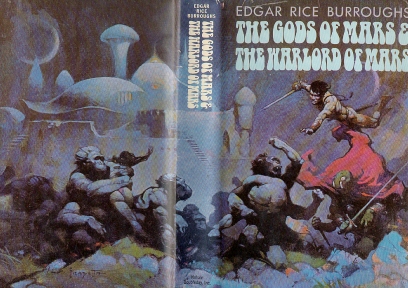
The Gods of Mars (The Barsoom Series #2, 1913 serial, 1918 book)

Art by Frank Frazetta
By Edgar Rice Burroughs

Picking up the Dynamite Warlord of Mars comic book series inspired me to take back up with the original prose series. I read them all many years ago, at least twice that I know of. First in the Ballantine paperbacks with the Gino d'Achille covers, then in the Science Fiction Book Club edition of the 1970s with the great Frank Frazetta covers and interior art – which is the very copy I'm reading now, the second volume in that edition, containing both the first and second stories, a copy I acquired (according to my note on the inside front cover) on 6 September 1977. I had actually started rereading the series early last year, 2010, with the first story, A Princess of Mars, via the Kindle app on my iPod Touch, but finished it about the time we headed off for a family vacation/historical tour of England and Scotland (June 2010) which meant I was wanting to read something more British – so I set The Gods of Mars aside at that time after only a chapter or so in favor of Sherlock Holmes stories during those few times I had a little while to actually read during that very busy couple of weeks. So a couple of weeks ago I picked Gods up again.

Art by Gino d'Achille
There are so many places you can find good synopses, reviews, and the like for this monumental and foundational series of “planetary romance” (so I've seen the genre called) that I'm not going to go into a lot of detail. Wikipedia gives a pretty good overview. Basically, in this story Burroughs' fictional persona and framing narrator discovers that his “granduncle” John Carter, believed dead for the last dozen years, had instead been back adventuring on the red planet, discovering that the strange religion of the Martian or “Barsoomian” peoples was based on a great lie from which he himself manages to escape – discovering his son Carthoris along the way. But John Carter then discovers that his princess, Dejah Thoris, after ten years of grief for her vanished prince, had herself fallen captive in the hellish Barsoomian “paradise,” and he leads a coalition of the red and green Martians to rescue her and expose the great deception for all to see. However, in the end John Carter and Dejah Thoris are reunited for only moments before treachery rips her from him, consigning her to a prison which is only accessible on one day per Barsoomian year. His last glimpse is of a fellow prisoner, madly jealous for “love” of John Carter, plunging a dagger toward the breast of Dejah Thoris, while a third prisoner, who no less loves John Carter but recognises that his heart beats only for his princess, makes to cast herself between the attacker and her victim. As the chamber closes, John Carter hears a scream, and must wonder in whose fair bosom the dagger had found its mark.

Interior art by Frank Frazetta
What a cliffhanger! This story and the next, Warlord of Mars, are the two most integrally connected of the Barsoom novels, essentially continuing right one from the other. 34 years since my last reading, I remember very few details of the story, only the broad strokes, and am consequently enjoying it all anew. Among other things, I had forgotten that Thuvia, Maid of Mars (the title and central character of the fourth novel in the series) had actually made her first appearance in this story.

Scanning the IMDB entry for the upcoming John Carter movie reveals that other characters who only make their appearance in this second novel (e.g. Matai Shang) are part of the cast of characters. I guess that movie is incorporating characters and story elements from more than just A Princess of Mars. I'm not sure how I feel about that. It seems to me that that novel alone has plenty of material for an epic film, which could be the beginning of a great series of films. I hope they don't try to cram too much in and end up with a confused mess. This is of course, a movie I will approach with my usual cautious, hopeful hesitance. Never underestimate Hollywood's ability to screw up a great story – which seems to happen all too often in this kind of adaptation.

Like the story, I'll be proceeding directly into Warlord of Mars.

Kaor!

DCU to DCnU: Vale atque Ave!

I don't usually reblog, but I do particularly like this bit of perspective on the DC Relaunch that hit today.  Cheers!

Tuesday, August 23

Fall of Eagles, Disk 4 (1974)

Created by John Elliott

This disk has only the thirteenth, final episode as well as three interviews with members of the cast and crew – Charles Kay (Nicholas), Gayle Hunnicutt (Alexandra), and David Cunliffe (who directed three of the episodes). See my comments on Disk 1, Disk 2, and Disk 3.

“End Game”

By August 1918, the ultimate outcome of the War is pretty clear to all but the deluded Emperor Wilhelm, especially now that the Americans have been provoked into the War. By this time the Russian imperial family has been murdered by the Bolsheviks and the new Austrian Emperor is suing the allies for a separate peace. Insincere pleas by the Germans for an armistice (during which they plan to regroup for a renewed fight) are rebuffed even as the once-mighty German army crumbles. Wilhelm's ministers urge democratic reforms on him, but it's all ultimately too late. Although a faltering assault on Germany by its enemies emboldens some among the military leadership, desertions mount as riots and uprisings spread across the country and it becomes clear that the only way out of the debacle is for the Emperor to abdicate – which is announced preemptively without the Emperor's consent. Initially vowing to fight to the last bullet in his “cottage,” Wilhelm finally quietly boards a train and seeks refuge in Holland. Field Marshall Hindenberg throws his support behind the social democratic government to preserve what's left of the army and save Germany from Bolshevism, which has spread rapidly from Russia. And he hopes for “favorable terms from the peace treaty.” As he arrives in Germany, Wilhelm learns that the Austrian Emperor has fled. It is “the end of an epoch” as he retires for … “a cup of good English tea.”
* * *
Well, I made it. I can't say that this was the most engrossing docudrama I ever saw. It's not for a lack of good actors – in fact a few of them deliver quite good performances. Patrick Stewart as Lenin comes most readily to mind, but especially in this final episode Barry Foster as Wilhelm II manages to convey very effectively just how little of a grasp on reality the German Emperor really had. How he commanded the loyalty that he did among some of his senior military officers who knew long before he did that Germany was spiraling down into defeat I'll never know. But beyond the main characters, I need to qualify what I wrote just above – many of the secondary characters' performances were pretty wooden. For those main characters, however, I think this series does one thing very well, bringing to some measure of life the human side of these last generations of autocratic, all-but-absolutist rulers utterly convinced of their divine right to their positions and with an overweening pride that blinded them to all reality. Wilhelm is the poster child for that phenomenon, but Nicholas of Russia comes in a close second.

As far as other production values … Well, some of the sets looked pretty good, but nothing spectacular. And as I mentioned in my blog on the first disk, the interspersing of original, grainy, jerky, black and white newsreel footage with scenes from what were for all intents and purposes a stage play made for some odd dissonance. It was downright annoying at times. I have no idea what kind of budget this had or what that amounted to in 1974, but the effect (barring the newsreel stuff) was reminiscent of other English productions of the period that I remember – or even have seen recently, such as the great British spy series The Sandbaggers, “the best damned television show you never saw,” from just a few years later, although the overall result there was much more pleasing. I've read some reviews of Fall of Eagles online that are very critical of the production values, but I think some of them go a little overboard. It is what it is, and for telling the basic story and – as I indicate above – getting at the very flawed humanity driving some of the most momentous events of the end of the 19th, early 20th centuries, it does all right. I think it could have been better, though.

As to the history, well, I have a better than average but hardly a specialist's knowledge of the period, and one that's been largely dormant for over a decade. I didn't pick up on anything that was obviously wrong. It seemed pretty on-target for the most part, and I think I'm coming away with a somewhat better understanding of certain aspects of the period. It's been a long time since I studied it, and even then it was largely “book-l'arnin',” and there is nothing like seeing events come to (even if somewhat stilted) life. So would I recommend this? If you're really interested in the period, yes. If you're expecting to be – to use the word I started this commentary on – engrossed and drawn into the events … no. I am glad I finally got around to watching this through, however.

By the way, I did not bother watching the interviews. I'm just not that interested, although perhaps the issue of the production values is addressed, perhaps by Cunliffe. I don't want to find out badly enough, though.

Cheers!

Teen Titans #97 and Justice League of America #59 (Sep 2011)


“A Call to Arms”

The multi-part story of the Titans vs. demons straight out of Hindu mythology comes to its end in an issue that I enjoyed a bit more than the ones leading up to it. I can't say exactly why other than it seemed more straight-forward. Most of the issue is a straight-up fight that culminates, as it kind of has to, with the new hero Solstice saving the day. I mean, it seems like this story was basically about introducing this new character into the book. Too bad she's coming in just in time to be wiped away after next month.

Along the way we do get some good character moments, such as between Connor and Rose, between Gar and Raven – and the latter's seeming betrayal of their new teammate with whom she seems to have had some kind of problem from the beginning. Raven swears she didn't intentionally leave her behind when “portalling” the others back into the real world – but the only one who overtly accepts her word is Tim. I'm pretty sure we won't get to see this stuff play out, though.

“Next Issue... The Titanic Return of Superboy-Prime.” Sigh. Not him again. One benefit (hopefully) of the Relaunch that's coming up is that maybe we can be done with this guy. Since his “turn to the dark side” in Infinite Crisis he has had few appearances that I haven't found annoying as all get out. He was okay as the Big Bad in Final Crisis: Legion of Three Worlds, and his appearance in the two-part Adventure Comics end of Blackest Night had its moments, but other than that.... I wonder if the ending of that Blackest Night story will even be taken into account here.

“Eclipso Rising, Part Six”

Blue Lantern Saint Walker, empowered by his proximity to Alan Scott Green Lantern and Mikaal Tomas Starman, is able to go beyond showing Eclipso his heart's desire to make him believe he has actually attained it. Such as killing Donna Troy. That's right – her death at the end of last issue didn't really happen except in Eclipso's mind. Where it's just the beginning of his ultimate conquest of the universe and the eradication of all life so that only himself – and Bruce Gordon's mind – are left. Really, it's all to keep him distracted by his “success” as Donna keeps whaling at him, and the others continue to fight, as Atom and Starman fight to free The Shade from Eclipso's control. When they succeed in that, it likewise breaks his control of all the others, bringing Alan and Jade and all the rest back into the fray on the side of light. When the light fades, Bruce Gordon is left in his own native form.

But the crisis is only half-averted – the moon must now be put back together before the effects of its shattering wreak irrecoverable harm to the Earth. Supergirl – absent for most of this arc, shows up just in time to help out (a note places this after the “Reign of the Doomsdays” story going on in Action Comics) and the deed is accomplished. The adventure ends on a high note, with the Atom Ray Palmer essentially giving his blessing (as an old-time member of the “classic” Justice League) to this most recent, sometimes dismissed as “B-list,” Justice League….

… a high note that falls flat when you turn the page and see that, five weeks later, Dick Grayson Batman is formally adjourning, “[f]or us, for our version anyway … the last ever meeting of the JUSTICE LEAGUE OF AMERICA.” “Well, I must say this is a surprise,” Bill the Congorilla speaks for us all. That something has happened to bring this sudden decline in fortunes about is obvious, not just from the passage of time, but from whatever injury Starman has suffered to put his arm in a sling. He seems okay the just previous page. “... To Be Concluded.”

I do wonder if we'll find out in the next – the last – issue of this run of Justice League of America. Without looking the solicitation up, from what I remember it's some kind of “crisis of confidence” issue, but is it the events leading up to Batman's statement, or the fallout? I've read “rumblings” on the internet, while avoiding any outright spoilers, that there's a good bit of metatextual commentary in that last issue by James Robinson on the difficult conditions that have been imposed on all the writers of this run from the beginning. Rather than being the center, the flagship, of the DC Universe as it arguably ought to be, too often the writers have had to accommodate their stories to whatever other big events were going on, with characters being jerked out of their title with little notice, with the League itself seemingly being jerked all around, to the detriment of any writer really being able to develop any kind of story momentum. Perhaps most famously, a couple of years ago his public complaining about that is what led to the late, great Dwayne McDuffie being sacked from this book. One would think that a writer of Robinson's stature would have been able to control his own book's destiny rather than having all those other tails wagging the big dog back and forth, but especially in the early part of his run it sure didn't seem to be so. Heck, even in this arc, witness Supergirl's absence and her explicit statement that she had to be elsewhere – in Action Comics. Really, trying to coordinate “continuity” at that level, where characters are pulled here, there, and yonder and interfering with good stories elsewhere, is just ridiculous. Apparently Robinson has some choice, albeit veiled, words on the subject. I am so looking forward to seeing just what people are talking about here.

Sunday, August 21

Superman #713 (Sep 2011)


“Grounded, Part Eleven”

Oh my. And I mean this in a totally different way than I did at the beginning of my previous post. There it was good. Here, not so much.

Since I get my comics pretty much all at once in a shipment at the end of the month due to the lack of a local comic shop in the town where I live (and the regular almost weekly trips to my home town a hundred miles away where there is one are not a normal occurrence), I am always behind most of fandom in reading each month's adventures. I generally try to avoid reviews and spoilers for what I'm going to be reading, but sometimes the hue and cry on the 'net is so raucous it's unavoidable. As it was this time. I'd heard that this issue is pretty bad. I'd heard right.

Actually, as a reaffirmation of the need and value of Superman in today's world it's not so bad, except in its execution, mainly in the total mischaracterization of the hero that makes that reaffirmation necessary. What's worse is how out of nowhere it comes, given the major redirection that Chris Roberson had brought about in the story arc since he had J. M. Straczynski's plot and outlines to run “Grounded” given to him about halfway through. And making it even worse is how obviously we are missing part of the story. Remember that there was controversy surrounding the previous issue, how a solicited story that apparently had as a plot point a Muslim super-hero was replaced at the last minute by a file story about Krypto set several years in the past. Well, whatever happened in that untold chapter must have affected Clark deeply, because at the beginning of this story he announces to a dumbstruck Connor and Kara that he's throwing in the towel, abandoning the Superman identity in favor of returning to a life of secrecy, helping people and doing his heroic deeds in anonymity – to put things inevitably in Smallville terms, going back to being “The Blur.” And he all but commands Superboy and Supergirl to do the same – as he changes clothes right in front of them.
(There's been much made of Kara's "facepalm" at the bottom of page three – which would be an appropriate reaction, to be sure – but I'm not sure that's what we're seeing. For one thing, I do a facepalm with the palm to my forehead and fingers pointing up – and a bit more forcefully. Second, look at the overall context: I think she's covering her eyes because Cousin Kal has stripped down to his tighty-whiteys right in front of his teen-age girl cousin … Waitaminute – Superman wears his underwear on the outside, right? (For now, at least!) – Oh, my! – No wonder Kara's demurely shielding her eyes!)

Anyway, Clark goes off morosely to a coffee shop in Portland, Oregon, where he begins work on an article, “Must There Be a Superman?” on his laptop. 
A fellow patron sees what he's up to and the rest of the issue is that patron basically trying to convince him that he's wrong – finding person after person to counter Clark's whining that “People are scared of Superman”; “People are envious of his powers;” “People don't trust Superman”; and so forth – until the last couple of pages where they see a news story of the mysterious New-Kryptonite-powered woman who's been stalking Superman now holding Lois captive in Seattle and threatening to kill her if he doesn't come to her. WHOOSH. “To be concluded...”

The most interesting thing about all that is that the coffee-shop patron who's arguing with him is, according to the internet consensus although he's not named as such in-story, none other than Bronze-Age Superman writer Elliot S! Maggin (no, that's not a typo), writer of a story entitled … “Must There Be a Superman?” (Superman #247, Jan 1972).

Anyway, when I saw the furor raised by this issue a month or so ago, I couldn't resist peeking at Anj's review on Supergirl Comic Box Commentary, and here was my comment at that time: “I haven't read the issue, being on a monthly mail order service, but based on your description my gut reaction is that this HAS to be an issue more heavily 'plotted' by JMS and mandated as 'crucial' to the 'Grounded' story arc. I bet the next is the same and that pre-Flashpoint Superman will go out with a whimper rather than a bang.” My basic assessment hasn't changed. What a shame. Chris Roberson should have insisted that his work on this issue be attributed to “Justin Thyme.”  (By the way, it was that comment-thread that clued me in that Coffee-Shop Guy was meant to be Maggin.  I suspected it was someone, but had forgotten about that forty-years-gone story and didn't make the connection.)

I do hope I'm wrong about next issue, however. (If it's out, I've managed to avoid seeing any spoilers.)