Wednesday, September 28

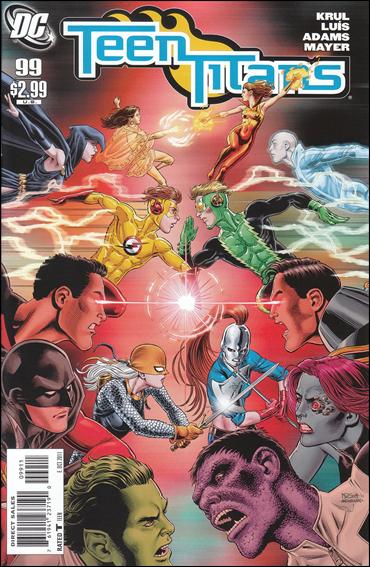
Teen Titans #99 (E. Oct 2011) and Red Robin #26 (Oct 2011)

Hmmm... There doesn't seem to be a title for this issue, and The Comic Book Database doesn't give it one either, which seems to be a rarity these days. Oh well.

The multiple alternate copies of Superboy brought as a small army by Superboy-Prime are in part due to Tim's grief-stricken efforts to clone his dead clone best friend after Connor was killed in Infinite Crisis. Not a bad touch, that. Otherwise, this issue is basically just one long battle in which Krul is allowed to explore some of the individuals among the Titans through interior monologues. There are some interesting personality developments – such as Tim's chagrin when he realizes he has partially caused this, such as Bart realizing that the new Inertia's attitude likening the mayhem he's causing to a game is uncomfortably like his own recent indulgence in virtual reality “training.” Prime has the idea that the Titans are “some kind of bizarre beacon pulling me here from my universe – from my reality. … Destroying them [and “that stupid tower”] might be the only way for me to get back home.” So he and his minions unleash an assault directly on Titans Tower – but now he finds himself facing a small army of former Teen Titans. 
“Next Issue … Titans Together!” That's right – Teen Titans also gets two issue this month (and last month) to finish out the pre-Flashpoint universe.

I was hoping that some reference would be made to the immediately previous appearance of Prime, back in the Blackest Night issue of Adventure Comics #7 (Apr 2010), but I guess we'll never know the significance of his dead girlfriend Lori seemingly about to “Black Lantern” Prime in the very last panel way back when.

“What Goes Around”

… “comes around,” like a boomerang – get it?

I approached this issue with trepidation, not really sure where the confrontation between Tim Drake and his father's Blackest Night-resurrected murderer Captain Boomerang would take this character that has been through so much in his short life. Where it took us was to an excellent climax to the Old DCU story of Robin-become-Red Robin that highlights both the strengths and the flaws in the characters not just of Tim himself but also of his mentor Bruce Wayne. Briefly, Tim set up a complex scenario to lure Boomerang to his death at the hands of Mister Freeze – a sequence of decision points on Boomerang's part in which any single right decision on the part of the villain would have forstalled that outcome. Tim is, of course, expert enough in reading human nature that he knows Boomerang will consistently make the wrong choice. In the end, however, he can't live with the bit of sophistry that would supposedly absolve him of blame in Boomerang's fate. He initially frames it to himself that he can't let his father's murderer be killed by someone else, but then discovers that neither can he do the deed himself.

The whole outcome is appropriately ambiguous. When Dick, who along with Damian, got to the scene at the very end, praises him – “That took a lot of courage, Red Robin. The temptation … you could've taken the easy way out” – Tim wonders if it would have in fact been “too easy.” He knows Bruce is also there, saw the whole thing: “No praise coming from you, I take it.” – “I know what you did, Tim.” Yes, Tim made the right decision – after making many, many wrong ones. “This is me, Bruce. For good and bad, because of what you taught me and what my dad did – because of the things I think you've done poorly and the things you've done well. This is me now.” He stands at a crossroads, figuratively speaking – “So many choices … but what will be my decision ...” “End.”

I have a response to Fabian Nicieza's adieu – Thanks for giving us this to read, Mr. Nicieza! This has been a wonderful run for the past couple of years, especially since you came on as writer.

Going forward, I still have trepidation, however. It seems that the only place Tim will be appearing in the DCnU is in a Teen Titans that doesn't look very appealing. No Red Robin title. And Tim will not be in Nicieza's hands. I'm not sure whether the character development that we have just seen will be followed up at all. Which is disappointing. Tim is a character with a large fan-following, and I can't believe DC is throwing them to the curb as it seems they are.

Not that I ever liked the name “Red Robin,” however!

Thanks for reading – Cheers!

Batman #713 (Oct 2011)

“Storybook Endings”

This is a nice recap of the career of the Batman “family” as it stands right now – which will supposedly change minimally, for the most part, with the New 52 (in the sense that the continuity of this little corner of the DCU will remain largely intact in the DCnU) – interestingly told from the perspective of Damian to three boys (Bob [Kane], Jerry [Robinson], and Bill [Finger] – a nice homage to the three most important creators in the foundation of the character) during Wayne Foundation's “Quake Survivors' Benefit.” That it is Damian telling the story is revealed only at the end, but it is hinted at earlier – most obviously in his assessment of Tim Drake's story: “A young man who uncovered Batman and Nightwing's secret identities became the third Robin. Some consider his assumption of the role a tragedy as well … or at least a tragic mistake ...” Who else but Damian would characterize Tim in such a way! Oh, yeah, the “sibling rivalry” of Tim and Damian is still there, at least for this one last time (hopefully going forward as well; psychologically it makes sense).

But from that point on the strong suspicion that this is Damian's viewpoint renders his assessment of Dick and Damian's relationship as the most recent Batman and Robin quite touching: “Through it all, for [Batman] it was still an adventure. And the new Robin, who had been too focused – unrelenting, so … unforgiving … slowly found himself … learning … from his new mentor – his new … friend. And being his friend was … an honor. Robin would never tell him that, but it was how he felt. … So whereas when they first became partners, Robin might have taken umbrage at being told what to do – or been embarrassed to make a mistake – now, he's accepted it all as part of the process of learning.”

It all ends with Dick and Damian being called away from the benefit by Alfred – and changing in the limousine (“We need something that changes our clothes automatically – like a pole or something.” – “That is ridiculous.” – “No, seriously, we slide down and – ” – “Watch your elbow ...”) – as the three boys marvel through a window at the sight of the Bat-Signal above the skyline.

Actually, as the ending blurb says, it's “Never the End...”

Thanks for reading - Cheers!

Tuesday, September 27

Adventure Comics #529 (Oct 2011)

“The End”

… well, not quite, at least for the story-arc overall, but yes, for this narrative strand of it. Having defeated the Academy teachers, Cosmic King now faces the cadets in two waves but is prevented from wiping them all out by the courageous self-sacrifice of Variable Lad. Which brings a dose of reality to the cadets' visions of heroism – especially Gravity Kid. Although all the cadets' bravery means that, as Bouncing Boy put it, their “odds of making the big team went way up tonight,” Grav declares, “Life's too short for me to worry about that, Teach. … The Science Police have a trailing spouse spot for my on Takron-Galtos. And I'm going to join Jedidiah … I can do some good there … and I'll be where I'm supposed to be … with him. … I only hope the rest of you find your destinies, too … and don't end up like Oaa.” The others are speechless as he turns his back and trudges off, except Comet Queen: “Uh, 'bye … I guess ...”

While "same-sex marriage" is not part of my morality system, remember that the Legion stories are set a thousand years in the future.  For good or ill, it does seem to be the way society is trending, and it is quite believable for the world portrayed here.

Of course from announcements made already it's clear that a couple of the cadets will quickly join “the big team.” But I've liked Adveture Comics' recent focus on the Legion Academy and am sorry to see it – and one of DC's foundational titles, only recently returned to publication after far too long – end.

Thanks for reading.

Monday, September 26

Superman #714 and Superboy #10 (Oct 2011)

“Grounded: Finale”

Well, as an end to a multipart issue, this was okay … or would have been if that epic were six or so issues rather than twelve to fourteen depending on how you count them.

Basically, we discover that Clark's depression up to and including his announcement of abandoning the Superman identity was, while rooted in authentic feelings, amplified by a psychic bond formed near the beginning of the arc between himself and a schoolteacher by her exposure to an artifact from destroyed New Krypton, an “Interrogation Sunstone.” It has also given her Kryptonian powers in addition to tormenting her with his depression. To overcome her and the psychic assault she's maintained on him in turn ever since, Superman essentially just has to think happy thoughts. No kidding. There doesn't seem to be any realistic addressing of the real issues (in contrast to, in my opinion, a much better treatment of Kara's similar depression in her own title months ago), which seems to me to be a bit of a cop-out. I do like the fact that those happy thoughts include “Truth. Justice. The American Way.” The Interrogation Sunstone is destroyed by the psychic feedback – and Clark now accepts that there must be a Superman – “And there always will.” He and Lois reunite. He sets up what appears to be a Superman equivalent of “Batman Incorporated” – the “Supermen of America” – in which each representative has a Jimmy Olsen-style signal watch (another nice touch). And all was right in the Superman Universe. “The End.”

I'm not going to belabor the shortcomings of “Grounded” overall. This issue brings the story of DCU Superman to its end on an appropriate high point, but as a whole it has not been a very consistent or pleasant ride getting to that point via “Grounded” – especially the previous couple of issues. Again, neither of them were that bad overall – in fact I found the Krypto story in #712 quite charming; okay, #713 with its so-out-of-character announcement and boudeing (my wife is Cajun French) was pretty hard to take – but in the overall context … Despite Chris Roberson's valiant efforts overall in the latter half, overall this was just not that good. And the glaring substitution of the Krypto story in #712 … I wonder if we'll ever see what should have been #712 and whatever drove the Man of Steel to such a low state, such depths of his manipulated despair? As it is, the beginning of #713 just comes out of nowhere. I'm reminded of Dan Didio's comments regarding Legion of Super-Heroes ("threeboot")  #50 a couple of years ago – "We finished and cancelled it and put the book out the door."  When DC itself doesn't really care that much about what it's putting out, why should we?

"Rise of the Hollow Men, Part Three: Time and Tannarak”

We basically find out that the Big Bad of this story, Tannarak, is a sorcerous enemy of Arion, Lord of Atlantis, from 45,000 who has been striving ever since to build (literally) his army via mystical clones of various heroic figures – and who has been opposed all along by The Phantom Stranger. I guess The Stranger is not  the Wandering Jew, or perhaps as The Phantom Stranger he is no longer bound by time. That actually makes some sense given the power levels he's occasionally been shown with. Anyway, this issue is a series of vignettes – each by a different artist – working from the deep Atlantean past to the present. Along the way we see the Viking Prince as well as how the Tooks of Smallville were seduced to the sorceror's cause, but basically this issue simply tells the history of the villain without otherwise advancing the plot. It basically sets up “Next: The Last Blast!”

Yes, in common with a couple of other titles, Superboy gets two issues this month, to finish up the old DCU in August.

Thanks for reading, and Cheers!

Batman: Gates of Gotham #4 of 5 (E. Oct 2011)

“Part Four: The Gotham City Massacre”

Finally, I'm into the last month of the old DCU.  That's how far behind I am in my reading and blogging. Anyway....

The murder of his brother by the Kane family, and Alan Wayne's callous refusal to help him seek justice, show Nicholas Gate that he is indeed, as Wayne puts it, “[not] one of us – and you never will be.” So, clad in the diving suit, he begins his own war of revenge against the Kanes that comes to a swift end with his own capture, but not before he kills Robert Kane (– ? – Bob Kane? – the creator of Batman? – there's some kind of metacommentary going on here, I'm sure!). In the present, the Bats deduce that The Architect's plan is to drown Gotham City by destroying the Kane Bridge which is integral to a retaining wall extending along the entire East Side. As they race along in the Batboat, Dick examines Nicholas' journal, recovered from the Elliots' newspaper archives, and he and Cassandra have an interesting conversation born in his ruminations on the nature of Gotham: “Like it or not, Gotham has royalty and they stretch back to the origins of this city. She protects her own – but if you don't belong here, she'll never keep you.” She doesn't buy it: “Everyone experiences tragedy. Tim, Bruce … you and me. … It's not about the city. It's about how you choose to see the world.” Something either in what he reads or what Cass says inspires Dick to announce, “I know how to stop him … By proving everything he believes is a lie.” – “Next: The Architect Revealed.”

One thing we still don't have: Confirmation – or refutal – of the implication that The Architect is indeed Nicholas Gate, along with the mystery of how he would have survived over a century if that is the case. Personally, I suspect that The Architect will turn out to be a descendant or someone else connected to the Gates, but that's not the implication so far.

It is interesting that Snyder and Higgins are taking the tack that there were no really "good guys" among the founding families of Gotham.  When pressed, Alan Wayne lines up in solidarity with Cobblepott and Kane.

Thanks for reading - Cheers!

Saturday, September 24

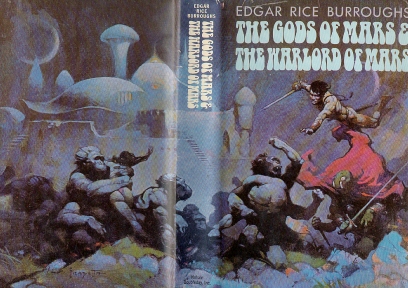
The Warlord of Mars (The Barsoom Series #3, 1913-1914 serial, 1919 book)

Art by Frank Frazetta
By Edgar Rice Burroughs

I have now finished my latter-day "threereading" of the opening “trilogy” of ERB's first, and I believe to be, better series of novels. I put “trilogy” in quotation marks because the first novel, A Princess of Mars, could arguably have stood on its own as a book, but the second and third, The Gods of Mars and The Warlord of Mars, are clearly one long story that, when taken with Princess, complete the story of the great impact the displaced Virginian Confederate soldier has made on what has become his adopted world. That theme is in fact made explicit near the end of the story. John Carter has brought the various and historically hostile races of Barsoom together:

Art by Frank Frazetta
“Red men from Helium and Ptarth, yellow men of the north, rubbing elbows with the blacks of the First Born who had come under my friend Xodar to help in the search for me and my princess. There were savage, green warriors from the dead sea bottoms of the south, and a handful of white-skinned therns who had renounced their religion and sworn allegiance to Xodar. ...

“Of all the strange scenes [the silent and empty throne of Okar] must have witnessed since that long-dead age that had first seen a Jeddak of Jeddaks take his seat upon it, none might compare with that upon which it now looked down, and as I pondered the past and future of that long-buried race of black-bearded yellow men I thought that I saw a brighter and more useful existence for them among the great family of friendly nations that now stretched from the south pole almost to their very doors.

“Twenty-two years before I had been cast, naked and a stranger, into this strange and savage world. The hand of every race and nation was raised in continual strife and warring against the men of every other land and color. Today, by the might of my sword and the loyalty of the friends my sword had made for me, black man and white, red man and green, rubbed shoulders in peace and good-fellowship. All the nations of Barsoom were not yet as one, but a great stride forward toward that goal had been taken, and now if I could but cement the fierce yellow race into this sodality of nations I should feel that I had rounded out a great lifework, and repaid to Mars at least a portion of the immense debt of gratitude I owed her for having given me my Dejah Thoris” (1971 Doubleday-Science Fiction Book Club edition of Gods and Warlord, pp. 330-331)

Art by Gino d'Achille
Again, there's no real need to summarize this story – far better if you read it for yourself, from the beginning of Princess to the end of Warlord. Suffice it to say that from the cliffhanger ending of Gods the action takes up virtually immediately, and ranges from pole to pole of the red planet. Gods of Mars took place entirely in the false paradise of that lay at the south pole, but in Warlord we travel from that Valley Dor, the land of the white and black men of Mars to the icy north polar cap land of Okar, home of the yellow men (who truly have skin that is yellow like that of a lemon, like the coal-black skin of the First Born). We encounter new and even fiercer Martian beasts such as the six-limbed yeti-like apt and some kind of gigantic bumblebee-like-thing the name of which escapes me. And ERB manages to convey a driving suspense even when the reader clearly knows more than the hero himself what is really going on – much like the interminable teasing we were subjected to in Gods wondering when in the heck John Carter was going to realize that his new young red Martian comrade was in fact his own son, Carthoris. Not that we had been told such – it was just obvious. Particularly sticking with me here was how John Carter fought on and on and on thinking that Dejah Thoris, with whom he had finally been reunited, was still safely behind him though he could not spare even a glance over his shoulder when we the readers know – again without being told – that she had been abducted yet again! And then there's the final scene when something of a mock resumption of John Carter's “heresy” trial suspended from Gods has him baffled and increasingly enraged, only to end, of course, with his sudden (and not any at all unexpected) acclamation by representatives of all those races of Mars as “Jeddak of Jeddaks – Warlord of Barsoom!” (p. 335).

I do intend to continue rereading this series at some time in the future – I have fond memories of at least the next two stories (Thuvia, Maid of Mars, and The Chessmen of Mars), as well as a couple of the later offerings. But, as may be obvious in the title of Thuvia, which centers around a relatively minor character introduced in Gods who barely even appears in Warlord, the focus shifts away from John Carter with that next volume. Thuvia tells the story of that princess of Ptarth and Carthoris, while Chessmen stars an as-yet-unhatched (!) daughter of John Carter and Dejah Thoris named Tara of Helium (I think). And then other characters still take center stage before John Carter returns as protagonist in the eighth or ninth volume, I think. That resumption of John Carter's own story is an improvement, as I recall, from somewhat lacking stories after Chessmen, so I may skip those this go'round. In any case, I'm not heading directly into Thuvia anyway. I seldom read more than a couple or three volumes in any particular series before taking a break from it for some time with something else – I always have so much that I want to read, far more than I can. In fact, I have a couple of things still hanging from a couple months back that I read, and do want to blog about, but at this remove I feel like I've got to go back and at least skim-read in order to do them justice. So many books – so little time!

And, with the Dynamite franchise of Warlord of Mars comics, I'll be getting a roughly monthly dose of Barsoomian action to keep it on my mind, so I'm sure I'll get back to the red planet sooner rather than later.

'Til then, Kaor!

Thursday, September 22

Warlord of Mars: Fall of Barsoom #2 of 5 (Dynamite Comics 2011)

“Book Two: When Hell Broke Loose”

Well, it does turn out that this is a five-issue miniseries rather than an ongoing. It's probably for the best. I'm not sure the demand is really there for three ongoing series set on Edgar Rice Burroughs' world of Barsoom – especially since in the coming months there are also going to be series appearing from Marvel Comics in conjunction with the movie coming next year from parent company Disney in conjunction with Pixar. I'm not getting those, however.

How is it that two different companies are publishing comics based on the same licensed material? As I understand it, the first five of the Barsoom novels are in public domain because they were published prior to 1923, so anyone can publish them or derivative works based on the setting, characters, and ideas that appeared in them.

This second book telling the story of the latter days of the transformation of Barsoom into the nearly dead world known to John Carter a hundred thousand years later begins with the Orovar scientist Tak Nan Lee's desperate efforts to create large-scale atmosphere manufacture failing yet again. He has brought the injured red woman to the Atmosphere Plant near Korad since the climax of the first issue; she has now awakened and they get off to a bit of a rocky beginning. Meanwhile, Orovar General Van Tun Bor leads his men in a desperate defence of Thark against an attacking horde of green men to give the people of Thark a chance to escape to Horz – where it seems they will not be welcomed. The Jeddak of Horz refuses to send more help to escort the refugees, then he consults with a really creepy looking and seemingly cannibalistic mad scientist figure about some experiment that is nearing completion. The Jeddak also orders the Atmosphere Plant to be secured against the greens' attack – which seems likely as Van Tun Bor's army has been routed, the general himself stabbed through from behind by a giant green warrior. “To be continued.”

Another good issue, although a bit scattered.  That's kind of the nature of the middle parts of a multipart story, though.

Getting my comics by mail as I do gives me no control over which of the various covers I get, which can be a bit annoying. Pretty much following the odds I usually get whatever the main cover is – but in this case not. Instead I got the one-in-ten Francesco Francavilla “pulpy” cover – which I like in and of itself, don't get me wrong, but I would have preferred to get the Joe Jusko cover that stylistically matched my first issue. Oh well. I do appreciate Dynamite's practice, at least for the Warlord of Mars series, of illustrating all the variants and incentive covers inside the back cover. Note: As far as I can tell, only the Jusko cover tells the reader the individual title of this part, “When Hell Broke Loose.”

Kaor!

Wednesday, September 14

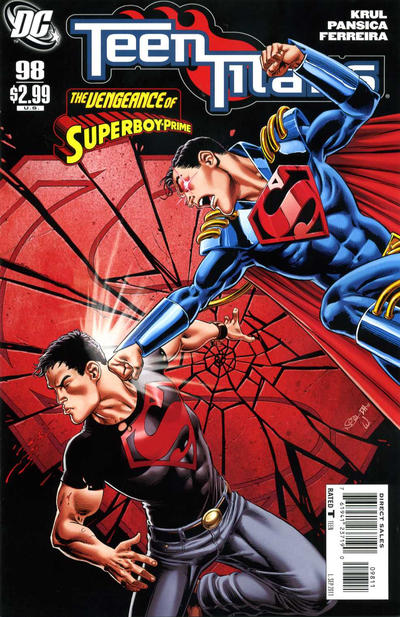
Justice Society of America #53 (Sep 2011) and Teen Titans #98 (L. Sep 2011)

“The Secret History of Monument Point, Chapter Three: Strange Adventures”

I wonder how many various issues of DC Comics over the years have had issue titles of “Strange Adventures” in the logo of the old science-fiction title starring Adam Strange?

I will say this: It is pleasant to see Jerry Ordway's art on this book for a change. Solid, heroic, traditional – as the Justice Society itself ought to be.

Even as Alan Scott Green Lantern and Wildcat Sr. interrogate a prisoner at Belle Reve Federal Prison in my own state of Louisiana finding out many of the secrets under Monument Point, the team that has descended into the depths below the city along with the Challengers of the Unknown find their powers mysteriously nullified. That is, until Jesse Quick (whom Ace wants to call “Flash Girl” – but we also discover that his name is really “Leslie,” hence his obsession with code names) impulsively destroys a “consecratorial structure” (translate “altar”) that seems to be the center of a power-nullification field – and thereby she sets in motion the fulfillment of the “prophecy” that had been haunting her, pronounced by time-traveller Per Degaton, that “What's going to happen to the world … It'll be your doing.” In another juxtaposition of narratives, GL and Wildcat find out that some kind of dark god named “D'Arken” (sorry, it's lame) feeds off metahumans' powers – and had been kept in a kind of stasis beneath the city by that nullification field – that's now gone, unleashing him. “That's why Eagin (a government official that has opposed the JSA's presence in Monument Point) wanted all of us out … We're like power batteries to him.” The JSA has unwittingly “made D'Arken more powerful than a thousand gods.” “To be concluded.”

“Prime Numbers”

Somehow Superboy-Prime inflicts his presence on the DC Universe yet again – yawn – with a mad on for Connor Kent Superboy. So somehow he gathers an entourage of villains that have previously faced the Titans and attacks them – Headcase, Sun Girl, Indigo, Inertia, Persuador, and Zookeeper. But that's not all – by the end of the issue a series of other Connors appear as well – the punk one with the jacket and glasses, the bald one who tried to kill them at the behest of one of his two dads Lex Luthor, and another one in some kind of futuristic costume that I can't quite place. “Next Issue … There Can Be Only One! Or Can There?!?” Can't say I really care.

Actually, yes I do.  I have developed quite a dislike for Superboy-Prime stories. Only some of them written by Geoff Johns, who created the character (well, sort of - he took the heroic, self-sacrificing youth of Crisis on Infinite Earths and "developed" him into the petulant continuity-shattering villain of Infinite Crisis), are of any interest whatsoever, and frankly I just find myself annoyed when he shows up. One good thing I hope comes of the DCnU – no more Superboy-Prime stories. If he shows up there, I will not be responsible for my own actions!

Really, the character bits in this issue are more interesting than the overall story – things like Bart's seemingly unhealthy “addiction” to his virtual reality “training” chamber; Connor and Cassie's interaction (Connor's interior monologue: “Those with experience rarely tell you that breaking up is never done in one shot. It's a series of conversations. Each more difficult than the last. The longer the relationship, the more loose ends”) as he takes a box with “his things” in it, which leads to him and Rose having a brief encounter; Raven is feeling more and more isolated, literally driven further into the darkness by the light of new member Solstice; and Gar has a date that's interrupted by Superboy-Prime and company.

I had some high hopes when J. T. Krul became the new Teen Titans writer about ten issues back now, based on my first exposure to him which was the Blackest Night: Titans miniseries – top-notch. He's been kind of hit and miss on other things, both that I've read (JLA: Rise and Fall) and that I've only read about (Green Arrow). This run of Teen Titans just really hasn't done it for me. And I don't have a lot of hope for what's been announced for the Relaunch, either.

And with that, at least a couple of weeks late, I'm finished with my July-released comics, received all at the beginning of August.  Next up:  The last month of the old DCU.

Cheers.  Or maybe not.

Tuesday, September 13

Batman: The Dark Knight #4, Detective Comics #880, and Gotham City Sirens #25 (Sep 2011)


“Golden Dawn, Part Four”

Well, contrary to what I thought, this long-delayed story is not ending with #4. There is one more issue after this. What do we find out now? Well, we find out that the mystery girl who previously engaged in Grand Theft Batmobile has made her way home – where her father is being threatened by some ruffians. When she sneaks into her room, she discovers she left something … in the Batmobile. D'oh! We also find that Etrigan seems to have definitely gone bad – I guess demons are prone to that kind of thing. He ends up enthralled to the demoness (?) Blaze, whom I seem to remember. Didn't she put the fire-hurt on the Martian Manhunter a few years ago in a JLA story arc? Not that that has anything to do with this. Bruce Wayne Batman and Dawn Golden, another of his childhood girl friends who seem to pop up all the time in recent years, have a heart to heart and she tells the story of how her life has sucked since a childhood when she was raised by her father basically to be a human sacrifice. Commissioner Gordon finds himself put on administrative leave while he's investigated for corruption. Finally, the cliffhanger ending has things about to get much worse for Batman and Dawn, as they unwittingly stand on a balcony of a building that is being scaled by a horde of gargoyle-like demons. “Next: The Final Battle.”

“My Dark Architect”

For creep factor, nobody beats Scott Snyder. With the Joker on the loose - with a history of targeting his family - Commissioner Gordon (obviously in the middle of a story arc that takes place discontemporaneously with what's going on in Dark Knight)  is warning his ex-wife “Barbara Sr.” (never actually seen that suffix used with a woman's name), and is horrified to be listening even as she is attacked. Racing to her hotel, he finds her infected with Joker Toxin. He gets her medical help in time to save her life. Dick Grayson Batman tracks the Joker to where he's hiding in a crypt beneath Water Street Trinity Church. Joker is babbling about the fact that he's figured out this is not the real Batman – and that only the real one can really hurt him. “Maybe so … but I'm about to get an 'A' for effort.” When Dick announces, “No more hurting the Gordons,” the truth comes out – “wasn't me, wasn't me, wasn't me ...,” cackles the Joker – which explains why the toxin afflicting Barbara Sr. is a very old concoction. “Oh no,” realizes Dick. Simultaneously, Barbara Sr. comes out of her coma, clutches Jim to her, crying, “Jim! Jim, he was so crazy. It was him!” And, simultaneously, Barbara “Jr's” scouring of surveillance video pays off – but too late – her brother is there with her. “Hi there, sis. Aren't you happy to see me?” I take it from her “AAAAGH!” as a small image seems to show him choking her that the answer is “no.” “To be continued.”

“FriEnds, Part Three”

Oops, this story didn't conclude last issue. Here's the aftermath of Selina's betrayal of Ivy and Harley. Harley is broken out of Arkham by someone who is basically hiring her to kill Catwoman – which she's all too happy to do at this point. On her way out, she confronts Harley, whom she's got a mad on for also – but gives her a choice. Even as we see Ivy's intriguing meditation on their relationship – “Oh, Harley. The only human I've ever called a friend. To what lengths will I go? What are my own limits? She is the Strangler Fig. And I am the tree, choking underneath. Without me, she could never grow. But without her, I would fall if I grew too tall” – she gives Harley a choice: “I'm going to kill [Selina]. Come with me.” Turns out it's Penguin putting the hit on Catwoman. The issue ends with the three Sirens atop a building – “Are you prepared to die, Catwoman” – “Are you, Poison Ivy?” – “Yes.” – “Me, too.” “To be concluded in Gotham City Sirens #26: Swan Song”

Cheers!

Action Comics #903 (Sep 2011)

“Reign of the Doomsdays, Part 3”

Hmpf. Well, it seems that my impatient jumping-the-gun to read the new Action Comics #1 led to this interesting situation … I still have yet to blog about the last issues of the previous series. Oh well. This is going to be quick – no reflection meant on the quality of the story, which I'm quite enjoying. It's just that I'm so backed up I'm going to really really make an effort to keep things short.

In this issue we discover that the Eradicator, when his body was destroyed a couple of issues back, transferred his (its?) “consciousness”/programming/whatever into some of the alien tech that Luthor attached to Doomsday in order to clone it. He's now learned how to control the monster … more or less … and he joins up with the “Super-family” and their allies (including Titans and Leaguers) in defending Earth from the other Doomsday clones. Meanwhile, Superman has himself literally shot into Doomslayer's pocket universe ship. Even though I question the whole idea of Superman needing a cannon to boost his velocity to breach the pocket universe – especially since he's apparently still flying slow enough for onlookers to be able to see him as he goes in – there is a cool shot of him floating himself into the barrel feet-first atop the S.T.A.R. Labs building. Anyway, once in, Doomslayer blusters at him even as he makes his way to the engine core – then pushes the “informational engines” to maximum, sucking Superman into them with a great “YARRGHHH!” “Next: It's the Final Countdown.”

I must say briefly that although certain aspects of Kenneth Rocafort's art grew on me the last couple of issues, I did prefer Alex GimĂ©nez's this go'round.  Rocafort did the cover, though.  Do Superman and Superboy look oddly stiff to anyone else?

Cheers!

Monday, September 12

Please consider donating to this worthy cause

Fr. Paul Glynn's book about Takashi Nagai, A Song for Nagasaki, was my Lenten reading project earlier this year.  It is a powerful and moving story, and deserves to be more widely known.  Please consider helping the filmmakers bring this documentary film project to fruition:  http://www.indiegogo.com/All-That-Remains.  All they are asking for is a total of $24,000.

Their promotional trailer can be viewed at that website.

Thanks.

Sunday, September 11

The Long and Short of It

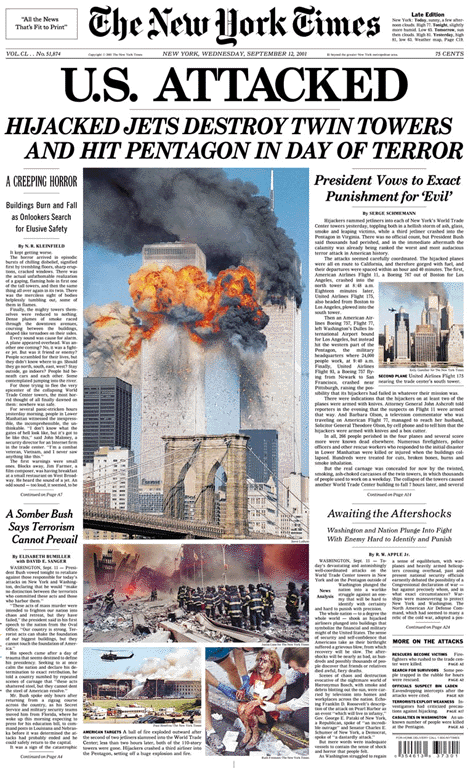
As everyone knows, this is the tenth anniversary of the Islamic terrorist attacks on the United States, "9/11," a date that has indelibly impressed itself upon the psyche of every American. In some ways it seems as if it happened yesterday, so clearly do I remember exactly where I was and what I was doing when news of a plane hitting the World Trade Center started trickling to me that Tuesday morning soon after I arrived at my office for what seemed like just another day of teaching.  In other ways it seems a lifetime ago, so radically did the world seem to change.  It was about a fifth of my own lifetime ago; but my fifteen-year son has lived two-thirds of his lifetime thus far in the shadow of that day.  But did the world really change on that September day ten years ago, or did some of us at least simply wake up to a new reality that already existed?

As a historian, one of the things I teach my students is how we periodize history.  Division of history into various "ages" and "periods" is, of course, a product of the human mind's need to impose order on chaos, to organize information into easily comprehensible form.  It is always retrospective, an attempt to understand the past, to establish periods that have some common theme that set them apart from what went before and what came afterward.  Although my own specialty of study is the so-called "Middle Ages" or "Dark Ages," of necessity since I have at times had to teach much wider spans of time, basically from the beginning to the present day, I have given some thought to the matter of periodizing modern history.  As of yet I have remained uncertain exactly what is the significance of 9/11 in that context.

Commonly, "Modern History" is considered (or at least I consider it) to be the period from 1789, the French Revolution, to the present.  Before that, basically back to ca. 1650, is "the Early Modern Period."  (You can use "history," "period," and "age" somewhat interchangeably in these terminologies; e.g. "the Middle Ages" vs. "Medieval History" vs. "the medieval period.")  Of course, you can always subdivide periods.  A common division of the Modern Age is to count 1789 to 1914 as "the Long 19th Century," because the French Revolutionary Period and the Napoleonic Wars that followed finally reached an equilibrium ca. 1815 that established a balance that would endure more or less until it shattered in the beginning of World War I.  The assassination of Archduke Franz Ferdinand on 28 June 1914 sparked a conflagration that through not one but two World Wars would quickly destroy that world of the 19th century with its great European Empires essentially dominating the globe and by 1945 leave the United States and Russia in the form of the Soviet Union as opposing forces for most of the next half century -- the "Cold War."  But, of course, between 1989, the Fall of the Berlin Wall, and 1991, the dissolution of the Soviet Union, that new balance that waxed and waned in favor of one or the other side finally was itself ended.  Usually, on the big "Periodization of History" sheet that I give my students even in the Early World Civ survey as a tool of orientation, I count 1914 to 1989 as "the (Short) 20th Century," followed by 1989 to ? as "the 21st Century."  I first concocted that term in the 1990s at the beginning of my teaching career, informing my students for the first few years that they were already living in a very different world from that of their parents.  What exactly would be the nature of that world, I said, remained to be seen.  Since 11 September 2001, however, I have added a parenthetical note to that "21st Century":  "The Significance of 9/11?"

Basically, the question would be, was 9/11 itself a demarcation point in history that is of such significance that it literally brought a changing of the ages, or was it "simply" the defining moment in a new age that was already in progress?  My money would be on the latter.  I think it was at that moment that the nature of the new post-Cold War world became clear.  Islamic terrorism was already rising in the 1990s in the wake of the fall of the Soviet Union as well as the first US action in Iraq, the Persian Gulf War of 1990-1991, in a somewhat under-recognized crescendo that would culminate in the attacks of 9/11.  It was, in my opinion, only then that some recognized that the United States was already in a war that had been raging for a decade or more.  Many, however, to this day refuse to recognize that fact.

I have some profound differences in political ideology from President George W. Bush, but one thing I give him credit for is that, however imperfectly he might have framed and prosecuted the subsequent "War on Terror," President Bush more than just about any other leader of the day -- indeed almost alone among them -- recognized that reality and took action whatever the consequences to his own political fortunes.  Because the reality is that there are people out there who want to kill us.  Whether we want to admit it or not.  And furthermore, whether we would prefer to frame it in such terms or not, from their perspective the conflict is at least framed as a religious war.  I personally believe they are largely sincere in that conviction.  Sure there are cynics among their ranks willing to use believers' faith as a tool for their own ambitions, but there are a lot of those believers who become willing tools.  That fact gives our enemy a clarity of purpose that is unfortunately lacking in our own resistance.  A few years ago, in an article that appeared in our local newspaper (The Natchitoches Times, 28 January 2005) about the recent publication of a couple of my scholarly publications (to be found here and here if you're interested in a peek at my professional life), I said this:

"Both of the just-published articles focus on the 10th century, the period in which notions of Christian service and sacrifice crystalized in a desperate defense of Christian Anglo-Saxon civilization against pagan Viking invaders.  Similar ideas, a century and more later, would motivate the first crusaders in their efforts to retake the Holy Land from the Muslims.

"Faith has always been a powerful motivating force.  Throughout history, religion has always provided one of the essential foundations for societies and states, and conflict against other societies and states has often been framed in religious terms when religion was not the outright cause for such conflict.  In the modern context, we need look only at the clarity of purpose displayed by Islamic terrorists who conceive theirs as a conflict against a western society that they identify as Christian.

"To draw a parallel, the 10th-century Anglo-Saxons knew against whom they were fighting, and why; Osama bin Laden knows against whom he is fighting, and why; in the war against terror, do we know against whom we are fighting, and why?"

To this day, I'm still not sure if as a nation we really know.  And if we don't figure it out, this may be the last days of Western Civilization regardless of whether they began in 1989 or 2001.  For my part, I believe that our hope, perhaps our only hope, is in recognizing, embracing, and defending our civilization's traditional self-identification as a Christian civilization.

Thanks for reading.