Saturday, July 2

Batman Incorporated #7 (7/11) and Booster Gold #45 (8/11)

“Medicine Soldiers”

Bruce Wayne Batman's expansion of the “Batman Incorporated” franchise in preparation for a looming conflict with “Leviathan” takes him to an American Indian reservation where one of the heroes he has inspired by his example, Chief Man-of-Bats – a character who dates all the way back to Batman #86 in 1954 and was brought into the modern mythos (along with all the other members of the “Batmen of All Nations”) by Grant Morrison a few years back in the “Island of Mister Mayhew” trilogy (Batman #667-668 in 2007) – has been captured by an agent of Leviathan. Batman and Man-of-Bats' son and sidekick Little Raven to the rescue!

That's pretty much the plot, against which we see another corner of the DCU as envisioned by Morrison who brings everything ever published into a vast meta-continuity. Nothing is out of bounds, no matter how goofy it may appear on the surface. Everything can be and must be made to fit in some way. This is great stuff! Along with some great commentary on the generally poverty-wracked conditions that prevail on many of the reservations with attendant social and crime problems, we also get a great view of what Bruce refers to as “Batman on a budget.” In context it doesn't come off as condescending as that seems when I wrote it. Bruce is actually admiring the ingenuity of Man-of-Bats and Raven. “It doesn't have to take millions, does it? The idea works.” The idea of “Batman Incorporated.”

“Turbulence, Part Two”

Taking up immediately from last issue, Booster is having a rough time of it defending himself against the monster that had cleaned his clock years ago and gone on to kill Superman – Doomsday – whom he discovers is not a mindless beast in this world. Well, he is, but under the mind control of General Nathaniel Adam (whose DCU counterpart is Booster's JLI teammate Captain Atom). Booster manages to get away, but in the process rescues a young refugee from the Flashpoint-universe's Greece, Alexandra Gianopoulos – who unknown to him is herself some kind of metahuman. While hiding, Booster manages to hack into a computer system and get more or less up to speed on the nature of the world in which he finds himself. He realizes that it is the doing of Flash's enemy Professor Zoom. Detecting some trace of chronal anomaly at Wayne Manor, he heads there, only to be attacked once again by General Adams Doomsday. Alexandra has followed Booster and disrupts the link between Adams and Doomsday – uh oh! Booster now faces a mindless killing machine!

For some reason the name "Alexandra Gianopoulos" sounded familiar to me, but apparently she is a totally new character introduced in this issue.  I'm sure this is not a throwaway character.

Batman and the Outsiders #40 (7/11)

“Land's End”

I received my June comics yesterday. This one had been delayed from its scheduled release during the previous month. Honestly I don't know why. It's not like a whole lot of work was put into it. It is a very lame final issue for a series that should have been put out of its misery a while back. I stopped buying it months ago, only picking this one up because of the Batman connection. Only this last issue is actually titled “Batman and the Outsiders,” and supposedly it was to tie into the ongoing Batman Incorporated story.

Quick history: This is a title (or rather series of titles – it's been canceled and restarted Lord knows how many times) that just has never worked for me except for a brief period a couple years ago. I bought the very first Batman and the Outsiders comic thirty-odd years ago when it replaced the great Batman team-up title Brave and the Bold. I didn't stick with it long then, not really finding any of the characters that interesting, nor the concept, one of the earlier examples of Bruce Wayne being a bit of an ass and giving up on the Justice League, breaking off to form his own team that he could dominate. I only picked up occasional issues as part of crossovers and the like until a couple of years ago when the latest series was retooled in the wake of Bruce's apparent death. Following instructions left by Bruce, Alfred recruited basically the original Outsiders who together, it was argued, combined aspects of the “mix” of talents and characteristics of Bruce himself in a team. And that worked, at least for a while, under the pen of a really good writer, Peter Tomasi. It didn't really garner great sales, however, so they tried something new yet again. And for me, the wheels spun off really quick.

The last year or so has, if I understand it correctly since I only read the first couple of issues, the team fractured and fighting against itself, against the backdrop of a now-megalomaniacal Geo-Force who is also the king of the little DCU Balkan country of Markovia. Apparently that led to a major confrontation last issue that culminated in Batman somehow having to step in and interdict a US nuclear strike against the kingdom (!). Not that, I gather, that last bit was even told in the pages of the previous issue – I'm not certain because, again, I didn't read it, but my impression is that we only find that out in Batman's inner monologue and memories. And from there this issue basically comprises a series of double-page spreads as Batman reminisces about the history of “his” team, until a final confrontation where he takes back over the team and puts Geo-Force in his place simply by the weight of his personality. And he takes “his” team and goes home, leaving Geo-Force to mull over the ruins of his country in a few pages that are obviously written to draw out some sympathy for the super-hero king. Talk about going out with a whimper. It falls flat, probably because I have nothing invested in the character. It could well be Didio's writing. Who knows. I don't want to pile on the “hate Didio” bandwagon, but I've honestly been unimpressed with his tenure as muckety-muck at DC, and what few examples I've seen of his writing have seemed pedestrian at best. I'll say no more. I've given way too much time to writing the blog entry for this issue as it is.

I take that back - in one area Dan Didio
has impressed me, or at least entertained me.  As a high-placed "muckety-muck at DC," he has over the past few years conducted a number of sessions at various conventions, including the big San Diego and New York Comic Cons, where if nothing else his sheer love of comics and of DC in particular shines brightly.  So I think his heart's in the right place even if the execution of projects he heads or oversees often fall short.  Sure, he's got a rep for not quite being straight with the fans, playing it a bit too coy and clever, but he seems better suited ultimately in a cheerleading role than as a creator.  Just my humble opinion.  Or not so humble.  Whatever.

And I do want to identify a couple of positives with this issue, as well.  First, there's the cover, which is a bit of an homage to the very first, original Batman and the Outsiders #1 cover by the great Jim Aparo.  Second, there's the exchange near the beginning between Batman and government agent Amanda Waller after he stopped the nuclear attack:  "I'm guessing you hacked into our system."  Silence from Batman.  "Heh, always knew you had a back door into NORAD."  Then, after a bit more repartee, her parting shot is, "[w]hile you do, I'll close that back door you found."  The screen goes dark - as Batman mutters, "Good luck finding the rest of them."

Friday, July 1

Superman Earth One (2010)

Let me begin by stating right up front that I am not a big fan of J. Michael Straczynski. To be sure, I consider Babylon 5 to have been a brilliant television series marred in its ultimate execution only by forces beyond Straczynski's control (the uncertainty surrounding whether he would be allowed a fifth season as his story structure demanded compelling him to wrap up the major driving plot-lines at the end of the fourth season before finding out that the series would get that fifth year). And I have read other things by him that I have greatly enjoyed – the first two of three volumes of Rising Stars (the third, however, so ruining the series as a whole for me that I gave all three away), some of the issues of the six-year run of Spider-Man that he did. But far too often I've found that JMS, in my opinion, gets a little too carried away with his own importance and lapses into preachiness to the detriment of the story he's trying to tell. He also has – Spider-Man notwithstanding – a notorious tendency to leave projects unfinished for extended periods. Rising Stars was one such delayed project, and when he returned to it after several years his vision had obviously changed – such that the last volume became nothing more than a left-wing anti-George Bush diatribe, even to the extent of changing certain story elements that had been established earlier rendering the end inconsistent and basically incomprehensible. Few books have actually made me angry upon completion, but that was the case with Rising Stars volume three. I have not read his current Wonder Woman stuff; I have read his current run on Superman and found the earlier issues (which he plotted and wrote) far too self-important and yes, “preachy,” while the later issues (resulting from another of his instances of not sticking with a project, in this case necessitating a shift in writer because you can't just leave Superman with an extensive gap in publication!) in which the scripting duties were taken over by Chris Roberson (based to some unknown degree on JMS's plot) have been far superior, recapturing some of the magic of the greatest superhero of all. Basically, my practice has been that if JMS takes over a title that I read I will at least give it a chance – I don't just reject it out of hand – but conversely his name on a project is not in itself going to be a draw for me. (That's exactly why I was reading the current JMS Superman run but not Wonder Woman – I was already reading Superman but not Wonder Woman.)

Having said all of which, when Superman Earth One, an out-of-continuity “reimagining” of the Superman legend, was published with great hoopla last year, I passed on it. I figured I would get it sooner or later. I did hear all kinds of good things about it. Well, “sooner or later” is here. One of the things I like about the Science Fiction Book Club is various deals and specials that are occasionally offered, such as a couple weeks ago “Buy 2 at Regular Club Price and Get the 3rd for $1.99.” And for a lot of these kinds of items the “Book Club Editions” are indistinguishable from the Publisher's Edition. So I pre-ordered the latest Dresden Files novel, Ghost Story (to be published next – err, I guess it's later this month now – July), along with Alex Ross's Project Superpowers vol. 1 from Dynamite Comics – and Superman Earth One. I got the two graphic novels a couple days ago.

Straight up: I really liked Superman Earth One. Here we have a very realistic portrayal of a 21st-century Superman, how the self-centered youth culture of the past couple of generations conflicts with the sacrificing ethos of the Kents that so famously formed Clark Kent into a hero. It was not inevitable. This Clark is a young man unsure what to do with his life. He is somewhat emotionally scarred by his ever-present sense of being different and isolated since a very young age, now tempted to focus his powers on being happy. No, it's not the easy contrast of a diametrically opposite character from what we're used to. This Clark was raised by the Kents, after all. He is a good person.  But other influences and the effects of a lifetime in hiding, of self-denial, have also gone into his formation. In the end, of course, when necessity arises in the form of an alien invasion, he does make the right choice and takes up the mantle of hero.

There are many nice touches throughout this story, showing that JMS has given a lifetime of thought to a rationale for the idea of Superman. My favorite was Clark's exchange with his mother, when she presents him with the costume she has fashioned for him from the red, blue, and yellow blankets: “Isn't it a bit too … I dunno … colorful?” he asks. - “I tried every dye I could,” she answers. “But the material from the ship doesn't change colors. In the long run, it's a good thing … People will be looking at the colors instead of your face.” - “Wouldn't it be easier if I had a mask or something?” - “Yes, it would … But you can't ever wear a mask.” - “Why not?” - “When people see what you can do, when they see how powerful you are, they're going to be terrified. A mask would only add to that. They'll need to see your face, so they can see that there's no evil in it … to see the gentleness and decency in you … and know that they have nothing to fear. The mask – the mask is what you'll have to wear the rest of the time.” There are other such gems and character pieces throughout.

I don't have any idea if such was the intent, or how much this graphic novel will influence the movie that is currently in production, but this story as presented would make a perfectly good Superman movie … in most respects. The weakest element is the villain, not so much in concept, (highlight the following to see spoiler) that his people destroyed Krypton and he is here to finish the job, but rather in design. Although Shane Davis' pencils as inked by Sandra Hope are very nice, at times beautiful, the design of “Tyrell” (not that hot a name, either) is pretty bad and would come off looking downright stupid in live action. I've seen him referred to as a combination of the DC anti-hero (actually, I'm not sure he's even that much a “hero”) Lobo with the members of the rock band Kiss. But my first thought was that it was a male version of the DC villainess Silver Banshee. Either way – FAIL. And that wasn't quite the only artistic faux pas. Sometimes certain pages were just too static, looking more like posed pin-up shots than natural snapshots of action. I'm thinking first of when we first see Superman “standing” in the sky in full costumed glory; then when he has just re-energized after being rescued from red sun radiation by Lois and Jim (not Jimmy, not in this book). Otherwise, however,“beautiful” as I described it above applies very well, not least because of the superb coloring work of Barbara Ciardo – generally muted, natural, but with a decent pop when appropriate.

Although I'm very interested to see what Grant Morrison has in mind for Action Comics #1 come September, which will apparently tell the new origin of Superman and hence the beginning of the age of super-heroes for the new post-Flashpoint “DcnU,” part of me almost wishes that this were that story. It does lay a perfectly good foundation that begs to be followed up. (It shows that a good "tweaking" of the iconic costume is possible without the somewhat radical redesign seen in the early images for September.  [I'm rather conflicted about the red Speedos - they are both essential to that iconic appearance and perhaps the most ridiculed element.  Personally, I would prefer they stay, for Superman alone.])  Reportedly JMS and Shane Davis are hard at work on a sequel – that was in fact the purported reason given when the writer bailed on the regular Superman title as well as Wonder Woman, to allow him to focus his energies on volume two. And there are obviously unanswered questions to be resolved – (highlight the following to see spoilers) Why did the unnamed enemy who gave the Dherons the means to destroy Krypton do so? - Why was there the condition that the Dherons should let no single Kryptonian survive, compelling Tyrell's long hunt that led him to Earth? I have a theory – the one time we see that enemy, in silhouette, although we can't see the top of his head I bet it's bald.... In any case, I'm pretty sure I'll be getting Superman Earth One, Volume Two, “sooner” rather than “later.”  J. Michael Straczynski has, to a degree, redeemed himself in my eyes. There's no doubt he can be a great writer.  I still have my doubts as to whether he can really stick with a regularly scheduled project to the end, and I sincerely hope he doesn't try to turn later volumes into a forum for some “message,” but for now I'm looking forward to seeing how this story will progress.

Cheers!

Thursday, June 30

Fall of Eagles, Disk 1 (1974)

By John Elliott

I've been working my way through this old BBC “docudrama.” It's something I should have tracked down and watched years ago, given my fascination with the Habsburgs even to focusing on Austrian history as one of my doctoral minors. I've had a book of the same name by C. L. Sulzberger for years; I thought it was published to accompany the series but apparently not. I only got around to the miniseries recently, and now thanks to Netflix.

It is an experience. It's not quite like any docudrama I've ever seen. Objectively, it's a bit boring in its execution. A good bit of narration; typically it is like watching a filmed version of a stage play; any large vistas and scenes such as of battle are conveyed by means of panning across paintings. Decent history, just saps it of vitality. I'm going to persevere, I'm sure – seldom do I start something like this without trudging on to the end, and it's only thirteen episodes, I think.

The “eagles” are symbolic of the three great imperial dynasties of late 19th-early 20th-century Europe: Austria under the Habsburgs, Germany under the Hohenzollerns, and Russia under the Romanovs. These three ancient divine-right absolutist states (the German Empire may only have been formed in the course of this series, ca. 1870, but it was built on the militarism of the Hohenzollerns who had ruled expanding Prussia for centuries) did not adapt well at all to the changes that were coming to European society through the 19th century, and ultimately failed in the conflagration of World War I – shattering old Europe in the process, with consequences that echoed through the 20th century.

There are four episodes on this first disk: Briefly, they are:

“Death Waltz,” which sets the scene for the entire pre-World War I era by telling the story of the ill-fated love- (infatuation-) match of Emperor Franz Joseph of Austria and Empress Elisabeth (“Sisi”), the Princess Diana of the 19th century. I'm not the first to make that comparison – a quick Google search found multiple references in book descriptions, reviews, and message board postings, including this by Manuel on 10 August 2009 at the Goodreads forum which sums it up pretty succinctly: “Both were incredibly young beautiful women who married emotionally distant husbands. Both had a hard time fitting into court life. Both found a niche in the public eye and bothwere known for extended vacations through Europe and beyond. Both died tragically while traveling away from home.” The way I saw it in the mid-90s (prior to Diana's death) was that both Sisi and Di were absolutely unsuited to the public role they attempted to take up. Luckily Diana's sons seem to have turned out better than Elisabeth's did (as seen in the fourth episode on this disk, see below). “Death Waltz” refers to the upper crust and rulers of Europe dancing their way toward tragedy, oblivious to the societal forces that were making their way of life obsolete.

“The English Princess” continues the theme, somewhat, focusing on Queen Victoria's daughter of the same name, “Vicky,” marrying Prince Frederick “Fritz” of Prussia. Her – and his – more British liberal-constitutional view of monarchy clashes with the aggressive, militaristic “Blood and Iron” philosophy of rising Prussia.

“The Honest Broker” continues the story of Prussia, detailing the career of the Iron Chancellor Otto von Bismarck, who more than any other man built the German Empire of 1871. We also get to see the accession first of liberally-minded Frederick – who had been barred from any leadership role while his father ruled under Bismarck's thumb until an advanced age, but who already when he came to the throne suffered from a throat cancer that would cut his reign short after a matter of three short months – as well as that of Fritz and Vicky's son Wilhelm II – blustering and bellicose, overcompensating for a crippled left arm – whose first act of state virtually is to dismiss Bismarck.

“Requiem for a Crown Prince” returns to Austria for a snapshot of a single scandalous event in the inexorable collapse of the monarchy – the murder-suicide of Crown Prince Rudolf and his lover Mary Vetsera in January 1889, and the royal cover-up at the highest levels that follows. Whatever was the cause, Rudolf was one odd bird, very much caught up in a contemporary Viennese fascination with death, manifested in such things as elaborate ceremonies surrounding All Souls' Day, the lionizing of actress Sarah Bernhardt who “could perish more beautifully before the footlights than anyone else” (Frederic Morton, A Nervous Splendor: Vienna 1888/1889 [1979] – which I read long ago as part of that Habsburg minor – p. 151), but above all in a horrendous suicide rate. Rudolf paid morbid attention to the press accounts of suicides. According to Leonard Wolf (ed., The Essential Dracula: The Definitive Annotated Edition of Bram Stoker's Classic Novel [1993], p. 211 n. 9), there was a “late nineteenth-century cult of female invalidism … [which] culminate[d] in the notion that a dead woman is more beautiful than a living one.” Maybe this is the reason Rudolf needed a female companion in death? - because he had actively sought such a companion among other lovers as well as his wife. They all refused. And after he shot Mary in the evening, he sat with her body through the night, writing letters, before blowing his own brains out. None of this would be consonant with the divine-right Catholic monarchy of the Habsburgs, hence the scramble to cover up the tragedy.

And so the “death waltz” continued....


* * *
Note:  Yes, that is Patrick Stewart at top right.  He played Lenin in the later portion of this series.

Wednesday, June 29

Flashpoint: Kid Flash Lost #1 of 3 (8/11)

“Kid Flash Lost, Part One”

As described here, I decided a bit belatedly to pick up this ancillary miniseries to the Flashpoint event because it's centered on a denizen of the “real” DCU somehow transported into the Flashpoint universe – like Booster Gold in his series and Barry Allen Flash in the main Flashpoint mini. Kid Flash is Bart Allen, the grandson of Barry Allen, born in the 30th century but for reasons I've never been entirely clear on because I've never read his early stuff as “Impulse” resident in the present. Just go with it. He's been “Kid Flash” I think since the opening of the current Teen Titans series about a decade ago, after a decade when he went by “Impulse.” The consensus is that he seems to be the Kid Flash that will be featured in the post-Flashpoint Teen Titans title. (Where does that leave Wally West, the first Kid Flash, for a long time the Flash? That's not been answered. Some see an ominous hint in the solicitation copy for the new Flash #1: “The Flash knows he can’t be everywhere at once, but what happens when he faces an all-new villain who really can! As if that’s not bad enough, this villain is a close friend!” [my emphasis] I hope not.)

In this three-issue series Bart somehow finds himself in his native future era, now the 31st century, held captive by Brainiac, who in the Flashpoint universe has ruled over Earth for several years. He breaks free, but finds that he cannot access the Speed Force and is effectively powerless. He's rescued by a now-female Hot Pursuit (!), but then finds himself starting to fade from existence: “[W]e've got to … get back home fast … we're not supposed to be here … because I saw this movie with Cassie [fellow Teen Titan Wonder Girl] … if we don't get hit with some Speed Force lightning … I'm history.” I think the movie is Back to the Future.

Sterling Gates performed an admirable job the past couple of years taking a somewhat unlikeable and pointless character in Supergirl and quickly developing her into a likeable and heroic young lady (DC apparently erasing that achievement is probably the most egregiously wrong-headed aspect of the coming relaunch/reboot – it's said here much better than I can). I consider him one of DC's better writers and he does a solid job on this issue. Not sure where this story is going to go or how relevant it will be to the overall event, but I'll stick with it. The art by Oliver Nome and Trevor Scott is not really to my liking, but passable. It reminds me a lot of my first exposure to Olivier Coipel's art when he took over Legion of Super-Heroes in the “Legion of the Damned” arc about a decade ago – which I didn't like at all. The figures often look distorted, their features almost bestial – the example that jumps at me here is in the last panel of the next-to-last page where Bart's face is horse-like with a nose about three sizes too big!  (Note:  The cover above is by Francis Manapul.)

Cheers!

Monday, June 27

The Spider vs. the Empire State, Book Two: The Spider at Bay (2009)

By Norvell Page (writing as Grant Stockbridge). Second book of “The Black Police Trilogy,” originally published in The Spider #61 (October, 1938).  See first book here.

Original magazine cover
It is now three months since tyranny descended on New York. Richard Wentworth has continued leading a resistance from his camp hidden in caves in the Catskill Mountains. But a mysterious new plague like leprosy has begun striking those opposed to the criminal regime, sapping their will. Wentworth makes a desperate and dangerous dash for Washington, DC, where he finds the President in sympathy with the people of New York but powerless to intervene as long as the elected state government adheres to the forms of law. He is, however, able to call a special election. Wentworth works tirelessly and at great personal risk to try to get the people out to vote. Ultimately this leads to his capture, show trial, and condemnation to a horrific death - and the election is stolen.  Wentworth's execution is interdicted at the last minute by deposed NYPD Commissioner Stanley Kirkpatrick leading a rescue – in the guise of The Spider! Together, Wentworth and Kirkpatrick lead a raid back into New York City to capture a supply of antitoxin for the plague which the Black Police have been spreading among their foes, and to take back police headquarters, and ultimately to lead a mass uprising by the people marching on City Hall to the tune of The Battle Hymn of the Republic. But the Master eludes Wentworth's grasp once again ....

One of the running conceits of the Spider series is that Stanley Kirkpatrick, while a superb police commissioner in so many ways and a tacit ally of Richard Wentworth, is a man of absolute integrity sworn to bring the Spider to justice and certain execution. Time after time he must overlook the obvious connection between Wentworth and the outlaw vigilante. Always some plot twist allows Kirkpatrick to seize onto some shred of doubt. At times, this makes him seem somewhat obtuse. Really, there is no doubt that Kirkpatrick knows – but as is stated time and again, only with irrefutable proof will he admit it, even to himself. Should that proof come, however, it is clear that he will unflinchingly do his duty.

In these stories especially it seems that the game is up. All but openly Wentworth comes out as the Spider in this time of need, becoming a symbol around whom the people of New York, even Kirkpatrick, can rally against the Black Police. But always Wentworth maintains the facade that he is acting merely as an agent of the Spider. A prime example comes early in this middle book of the trilogy, pp. 191-4. Wentworth leads a daring raid to rescue a captured Kirkpatrick. In the commissioner's presence, to the commissioner's fellow captives he identifies himself - “The Spider has come to rescue you!” (p. 191). Having penetrated their prison in normal garb, to lead the breakout he adopts the guise of the Spider - “Wentworth turned to find men staring at him with wide, half-frightened eyes. He sent the flat, mocking laughter of the Spider at them, abruptly switched to his normal tone of voice. 'You'd almost think I was the Spider, wouldn't you,' he laughed” (p. 192). … “'Charge!' Wentworth shouted. 'Death to the Black Police! The Spider leads you!'” (p. 193). In the first story he had set this up, proclaiming that others too would be given the Spider ring to leave the tell-tale crimson seal on dead criminals.

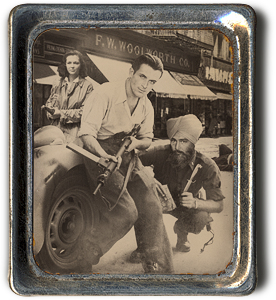
I discovered a wonderful website designed to accompany the publication of this book, taking the form of a memorial “to the brave men and women who gave their lives during the New York rebellion of 1938” - Fight the Empire State. Several pages proceed to tell the story of this “neglected chapter in U.S. History” in mock documentary form, including a series of period photographs. One of those, although identified only tentatively as such, obviously purports to show Richard Wentworth along with Nita van Sloane and the faithful Ram Singh. 

Friday, June 24

Flashpoint #2 (of 5), Superboy #8, and Adventure Comics #527 (8/11)

Usually, I get my box of comics within a few days of the last Wednesday of each month – Wednesday being the weekly on-sale day for new comics. But through my mail-order service that monthly shipment may be delayed to accommodate an occasionally late-shipping issue of Previews, the monthly pre-order catalog from Diamond Distribution. And so it was last month since Previews didn't hit until the following Wednesday. When that happens sometimes I get two issues of those comics that customarily come out that first Wednesday of the month – such as these three titles.

“Flashpoint: Chapter Two of Five”

I gave a very short gist of the first issue as part of this post. As I explained there, this is going to be the first such DC “event” that I'm not all in for, that I'm just getting the main miniseries plus a couple of the ancillaries. It will be interesting to see how it holds up.

Briefly, the Flashpoint-universe version of Slade Wilson, a.k.a. Deathstroke the Terminator, who seems to be the leader of a band of pirates, strays too far into flooded northern Europe and encounters Aquaman. It looks like he's going to regret it. Meanwhile, Thomas Wayne Batman is not reacting well to Barry Allen's invasion of the Batcave. And we discover that Barry's memories are slowly changing to reflect the Flashpoint “reality.” But Barry's convinced that his old enemy Eobard Thawne (“What kind of name is 'Eobard'?” Thomas asks - “One from the future.” And that's not the only good line Thomas Wayne gets on that page – when he has seen a Flash-costume expand out of Barry's ring, he mutters, “[H]ow the hell does it even fit in there?”), a.k.a. Professor Zoom, the Reverse-Flash, has changed history. And he manages to convince Thomas Wayne – whose first question is, “What about Bruce?” - his son whom he had seen brutally killed, whose death launched him on his war against crime. “If you're telling the truth, can you change this? Can you change it back so that … I died and Bruce lived?” Barry needs his speed back – but their attempt to recreate the lab accident that gave Barry his speed goes horribly wrong. Lastly, Wonder Woman and the Amazons in London, now “New Themiscyra,” capture an American agent, Steve Trevor, and by means of her lasso of Truth force from him the news that there is a spy embedded within the ranks of the Amazons – journalist Lois Lane.

I really don't have much to comment on here. It's too soon. Story and art are both good as I expect from these creators. Any more than that will just have to wait until I can see the story as a whole.

“Rise of the Hollow Men, Part One: Into the Broken Silo”

The cover blurb says it - “The Secrets of Smallville.” That's been the subplot being established by this series ever since the first issue, and now Jeff Lemire starts bringing little hints into play and the set-up starts to pay off. Not that we get any real answers just yet. In fact, there appears to be more of a mystery than I was aware surrounding the new character of “Psionic Lad.” Who is “the Prime Hunter”? I'm still not sure whether Simon Valentine is going to end up on the side of the angels or the devils or what. The Phantom Stranger makes a couple more appearances, freaking Krypto out – well, Connor as well – and Lori Luthor* makes a disappearance. But we learn that the mystery underlying the “quiet little town” of Smallville has roots going back a century and a half, all the way back to when the Kent family first showed up – and were associated with the Valentines. What's it all going to add up to?

* Random thought:  Lori is Lex Luthor's niece.  She's got the hots for Connor.  Connor is a clone in which the Kryptonian DNA of Superman was stabilized by the human DNA of Lex Luthor; therefore he's in a sense Lex Luthor's son - I figure that would be the closest analogy since an offspring genetically gets half its DNA from each parent (a clone strictly speaking would genetically be equivalent to an identical twin).  So, wouldn't Connor and Lori be effectively first cousins?  Can first cousins marry in Kansas?

“A Comet's Tale”

What happens when a super-hero groupie decides to go out and duplicate the kind of accident that gave her idols powers? Well in Flashpoint #2 we saw that doesn't necessarily go well even when the hero tries to duplicate his own accident! But in Grava of the Extal Colony's case, you too get super-powers! (I'm sure there have been stories where such an attempt met with tragedy, but none comes to mind right now - BUT KIDS, DON'T TRY THIS AT HOME!) This is basically a stand-alone tale where Comet Queen relates her story (with a lot of 31st-century slang thrown in) to fellow Legion Academy cadet Glorith. There are also interspersed some scenes of the cadets in training. The main thing that we learn is that the “tragic origin” blurbed on the cover is really more about what happened later. This is actually Comet Queen's “do-over” through the Academy – she had previously graduated, not into the Legion of Super-Heroes itself, but rather into the Legion of Substitute Heroes; then, called into duty during the Titanfall Catastrophe that opened the current Legion series, she encountered Saturn Queen – and was essentially mind-wiped back to her childhood. Tellus had managed over time to recover most of her memories, but not all, so here she is, keeping on keeping on. When she asks Glorith in turn what her story is – Glorith reveals that she doesn't know, obviously leaving us wanting to know more....

This is good stuff. It's Legion. It's Levitz. Thank heaven by all accounts the main series is coming through the September relaunch basically unscathed. Unfortunately Adventure Comics with the tales of the Legion Academy won't be part of that, although it will be part of the recent continuity and it looks like at least one of the current cadets will make the jump to the big leagues.

Spiritual Meaning in Speculative Fiction

I don't intend to make a practice of using this blog simply as a referral service, but this is just so well put I have to share it.  Playing off a quotation from Disney's Beauty and the Beast, Chawna Schroeder has written a wonderful elucidation of the spiritual meaning that can be found in fantasy, science fiction, heroic fiction, what have you.  Follow this link to go to that post, or this link to go to the Speculative Faith blog in general.

Cheers!

Thursday, June 23

Gotham City Sirens #23 and Justice Society of America #51 (7/11)

“Friends”

As this title winds down to be essentially replaced by a new Catwoman solo series come September, we get to witness the Sirens (another “unofficial” name, for the trio/uneasy alliance between Batman "villains" Harley Quinn, Poison Ivy, and Catwoman) spinning apart. A plot throughout this series has been the other two trying to break Harley of her seriously disturbed codependent relationship with her “Puddin',” the Joker. She's seriously fallen off the wagon in this issue, which even though it's a “Part One” comes directly on the heels of the previous issue which showed her using her psychoanalytical skills and intelligence – remember, Harleen Quinn is Doctor Quinzell, criminal psychiatrist; she's nutty as a fruitcake, but by no means stupid - to penetrate Arkham Asylum and spark a riot to free “Mr. J.” Catwoman had previously had enough of this nonsense, causing a rift between herself and Ivy when she refused to accompany the latter in an effort to save Harley from herself, and at the beginning of this issue is engaged in her own caper when Batman Dick Grayson approaches her to give her a heads up that he's about to put the escalating situation at Arkham down – hard – and “Anyone I find in there … I'm going to make sure they stay there.” Catwoman's inner monologue: “You want me to save Harley from one of her 'I'm in love with Mr. J' episodes, and stop Ivy from ripping Arkham apart.” She initially refuses, but Selina Kyle is consistently played as basically a good person albeit a thief, essentially an anti-hero, and guilt gets the better of her. They did, after all, help her to get back on her feet at the beginning of this series. By the end, she's shown up, to find not Dick, but Bruce, leading to a funny exchange: “You knew I was coming?” “Who do you think you're talking to?” “I was expecting Dick.” “Anything involving the Joker, I take care of personally.” “That right? Or did you show up because you knew I was coming?” But there's an undercurrent in her exchanges with both Batmen (that just looks weird). She knows of something Dick did before he won the cowl....

Anyway, meanwhile, as Arkham explodes in chaos around them, Harley and Joker are reunited and set about having one of their “Game Nights” - which involve a great bit of sick, twisted humor and torture – only to be interrupted first by former director now inmate Jeremiah Arkham taking up his guise as Black Mask and working to put down Joker before Batman can show up and ruin all his own carefully-laid plans, then by Poison Ivy, who gives Harley an ultimatum - “I saved you from him – and from yourself – too many times. I'm sick of it. So what's it gonna be? Him? Or me?”

I have really enjoyed this series, from its beginning under Paul Dini, through the present writer Peter Calloway's tenure. It's generally been a fairly lighthearted romp. It's been a bit darker for the past couple of issues as Harley has basically decompensated before our eyes. But still a well-told story. I do miss the art of Guillem March on interiors (he provided the cover), but Guinaldo and Ruggiero are passable. I'll be sort of sorry to see it go, but always did like the Catwoman solo series that preceded this title, and hopefully she will continue to be the bad-girl anti-hero ally of Batman.

“The Secret History of Monument Point, Chapter One: Weird Worlds”

This is a followup to Marc Guggenheim's first story arc which culminated in the big anniversary issue #50. There are two story threads going. The cover puts the attention on the resolution of a loose end from what's gone before – that team-member Lightning, the daughter of Black Lightning, is dead. Well, actually only mostly dead. Team mystic Dr. Fate somehow preserved her soul in another dimension long enough for Dr. Midnite to repair her body, and now it's time to bring them back together. It's a pretty standard story where a small team heads off into that dimension but ultimately their job seems to be to convince Lightning's soul that it has the will to make the journey back on its own. Meanwhile, the original “Golden Age” Flash Jay Garrick is getting a dose of political reality now that he's consented to be the mayor of some city we'd never heard of a half-dozen issues ago but that is purportedly very important in the DCU, Monument Point, mainly taking charge by “not being a politician” (which is all mildly amusing, but ho-hum), then is taken by his aide to be shown “The Secret History of Monument Point.” This is one of those times when the annoying habit they sometimes have of putting off the issue title and credits to the very end I guess was necessary, because there just wasn't much about any such “Secret History” until that cliffhanger ending. It certainly didn't feel so much like a “Chapter One” as a “Prologue.”

Frankly, I've been left increasingly unsatisfied by the Justice Society's flagship title over the past few issues. I didn't like Scott Kolins' art on the previous story arc, and Tom Derenick's is not much of an improvement. Both of them are way too “gritty” and dark for this team. Story-wise, Guggenheim's first arc “Supertown” which introduced Monument Point didn't succeed in demonstrating its alleged importance to me, and didn't leave me hungering to know more about its “Secret History” as I guess I was supposed to. I miss Geoff Johns on this title! Or even Bill Willingham (Guggenheim's predecessor), who did a pretty good job. Well, as I commented re the last issue of JSA All-Stars, as unsatisfying as these titles have been lately, come the post-Flashpoint era I might be looking back to now as “the good old days.” Because I really do like these characters. I say again – I hope DC does have some worthy plan for its elder ranks of heroes.

Wednesday, June 22

Detective Comics #877 (7/11)

“Hungry City, Part Two of Three”

Over the past several months, Scott Snyder, better known as the author of the DC-Vertigo title American Vampire (which I don't read), has been doing a stupendous job writing Detective Comics. Featuring Dick Grayson Batman, his first story arc here began before DC's beginning of the year reduction of price and page-count from $3.99/30 pages with a lead and “co-” feature to $2.99/20 pages single feature title, juggling what were parallel stories of Batman and Commissioner Gordon that converged into one. It was masterfully pulled off and brought a long unused but (it turns out) very creepy part of the extended cast back to the fore – James Gordon, Jr. - with ramifications that remain to be worked out. Snyder has been one of the earlier and more forthcoming DC creator reassuring the fans after the announcement of the September relaunch that his stories would still be in continuity, part of the history of the characters going forward, even though he will from September on be writing the adventures of Bruce Wayne as the only Batman in the title of that name. The present issue is the middle part of his second story arc, bringing Dick Grayson face-to-face with a shadow from his own past – the daughter of crime boss Anthony Zucco who murdered the Flying Graysons and thereby launched him on his career as the Boy Wonder all those years ago. So far she seems to be an innocent trying to escape the stigma of being Boss Zucco's daughter (she changed her name), but the past is catching up with her. And there does seem to be some inadvertent spark between her and Dick (he even gets a little good-natured ribbing from Tim about it) – so this looks to be an interesting relationship.... I'm sure that cover has all kinds of symbolism.

Cover aside, I'm not sure if I like Jock's art or not … and I've been in the same undecided state for well over a year since I first noticed it on a much earlier issue of Detective Comics. His figures seem to be an odd combination of chunky and gangly. It does set a very appropriate mood for Batman. It is easy to see the more lithe, athletic, acrobat Dick Grayson in that role as drawn by Jock. And yet something that I can't quite put my finger on bugs me. Oh well, at the very least it works....

Bronze New World (The Bronze Saga #6, 2006)

By Mark Eidemiller. Available as a free download here.

In this sixth offering in the fan-fiction epic “Christian Adventures of Doc Savage,” the action gets a bit more fantastic. That Eidemiller envisions Doc, or “Clark Dent,” as sharing a world with other figures from pulp and adventure fiction has been apparent from the very beginning, when Lamont Cranston, a.k.a. The Shadow, appeared albeit somewhat ambiguously in the “pages” of Bronze Refined as Silver. In the fourth adventure one of the literary prototypes for Superman appeared as an integral part of the story – Hugo Danner from Philip Wylie's Gladiator. (Doc Savage himself is, of course, another inspiration for the Last Son of Krypton.) Now 1960s sci-fi television gets into the act, providing the very springboard for this adventure – Irwin Allen's The Time Tunnel. I must admit that I have only the haziest of memories of this show. I was just too young to get into it, and I never encountered it in later years in afternoon reruns where I saw both Lost in Space and Voyage to the Bottom of the Sea. Nevertheless, a little research on the internet gave me the gist – two scientists lost in time, bouncing from year to year in past and future, able to be observed from the present but unable to be retrieved to their own time – enough to be able to envision the characters and appreciate the story.

Doug Phillips, Ann McGregor, and Tony Newman
A quick overview of the plot of Bronze New World: Taking up very quickly from The Bronze Battlefield, we are guests first at Clark and Bonnie's wedding then aboard a yacht where the wedding party accompanies the newlyweds on a cruise to the Mediterranean. Suddenly a man falls out of the sky – Doug Phillips, who had been lost in time along with fellow scientist Tony Newman ever since the 1960s. In an effort to rescue Newman, who remains stuck in the past, Clark and his new companions track down the retired Dr. Ann McGregor and assemble a new team to infiltrate and reactivate Project Tic-Toc, which had been shut down in 1975. But a miscalculation in retrieving Newman results in a change in the time-line – and Clark and Perry Liston find themselves in a world where Doc Savage is President of the USA and Perry Liston is a hunted terrorist. And that's only the beginning of the differences.... Their efforts to get back to the Time Tunnel and home allow Eidemiller to explore this “Bronze New World” that resulted from Doc Savage not being trapped in suspended animation for fifty years, with some consideration given to philosophical questions surrounding the nature of God, multiple time-lines, and so forth. It makes for an interesting story and I don't want to go much more depth into the details so as not to spoil it.

I do want to make a few comments, however. Eidemiller is not shy about including some unexpected plot elements. Key to the plot and the way history had developed in his alernate timeline is the impact of Christian terrorism. Now, for all that the political left feigns as much fear of “religious extremism” on the part of Christians as of Muslims (e.g., just this past week) in total contravention to observed reality, the fact is that under different circumstances the darker side of humanity could well be provoked and unleashed among Christians. It is part of the fallen human condition. Facing that fact head-on is, in my opinion, a brave choice for a writer of Christian fiction.

Similarly (and I'm going to be intentionally vague so as to avoid a spoiler here), I thought his depiction of his Christian characters nonetheless giving thought to suicide at one point, given the circumstances that they faced, was quite realistic. It's easy to idealistically state that suicide is “wrong in the eyes of God” (Clark's words) – in traditional parlance a “mortal sin” – but to give it serious consideration when facing the horrific kind of death that at that point in the story seemed certain would be only human.

I thought about getting into a discussion of time travel, the possibility of multiple time-lines, etc., as to how those relate to God, His omniscience vs. His omnipotence, predestination vs. free will, and so forth, but frankly it all gives me a pounding headache. Without going into any depth or justification, let me just baldly state that while I have a pretty well-developed ability to suspend my disbelief for a good story, even seeing a lot of value in speculative fiction and “what-if” scenarios, nevertheless just as I don't really believe there are any extraterrestrial intelligences out there, nor do I believe that there are any such things as time travel or alternate time-lines. I readily admit I could be absolutely wrong about any or all of that – but that's my opinion for a variety of reasons. Specifically with regard to alternate time-lines, my position would be that taking the extreme proposition that some do, that each decision point in history (of which there would be an infinite number) gives birth to an alternate time-line (therefore an infinite number), and accepting that all things work according to God's plan, would that not mean that God has an infinite number of plans for the universe (multiverse? Infiniverse?), which effectively would mean that He has no plan. If all things are, without distinction, then what is? So the angel's (yes, for the second time in this series there is an angelic character) answer to Perry's (the “real” Perry's) question, “[W]hich is the real timeline to God?” that “They all are …. Remember, God is unlimited,” seems to me to be effectively meaningless. Reword it as “Which timeline is in accordance with God's plan? … They all are ….” What then is a “plan”? (<The Prof reaches for the Tylenol again.>)

Whatever – it's just a story, and it is a good story. Sure, radical conversion seems to come just a bit too readily to be realistic, but that's to be expected in this genre, I guess. I am left with one final question, however, that seems to go unaddressed – How does the final resolution at the end of this story itself change the history that seems to stand at the beginning?

One point I can't let pass: Pope Archibald XIV? Sure, Eidemiller's not Catholic, but simple reference to an encyclopedia would seem to have been warranted here, especially when positing a Papal name with such an advanced number! If the point of departure between the “Bronze Saga-universe” and the “Bronze New World-universe” is only 55 years in the past, that's hardly time for there to have been thirteen prior Pope Archibalds. Perhaps the “Bronze Saga-universe” itself is more radically different in that respect from our own world – because although there was a medieval Scottish bishop of that name, there's never been a Pope Archibald.

Next up in “The Bronze Saga” … “Up, up, and away!...”

Cheers!

Tuesday, June 21

Perry Rhodan #2600!

I was just surfing the 'net and came across this bit of news that had slipped past me.  The original German Perry Rhodan series published issue #2600 last Friday, 17 June 2011.  Wow!  What an achievement!
The Thanatos Program by Uwe Anton
Cheers! ... and Ad Astra!