Showing posts with label politics. Show all posts

Wednesday, November 9

Election 2016

Well, yesterday was Election Day. I did not intend to watch any of the returns last night. I voted weeks ago. I had basically my last word the day before yesterday, in a Facebook post which pretty much said it all – actually a repost of what I wrote four years ago, with current commentary. So, first the post from back then, in 2012:

Eyes wide open. That's how America has collectively chosen to take on four more years of Obama. No longer can we take solace in the notion that we fell victim to the charisma of a masterful campaigner who promised to take us past the divisions of the past into a brave new world. Having seen how well that has worked out for the past four years, we (as a nation, by the slimmest of popular vote margins, by a wider margin in the Electoral College, but that is our system for better or worse) have chosen four more years. I fear it will be much longer than that, because whereas I believe there was a chance to turn back from the brink now, I believe that four more years will entrench such radical change to the very nature of our country that there will be no going back. Perhaps the saddest thing to me is that slightly more than half of our people are perfectly fine with, even desirous of, that. This is what they want. ... No, really the saddest thing to me is that the slightly LESS than half of our people must now live under the same deteriorating conditions that they strove to avert. But that is our system, for better or worse. God bless America, for we surely need it.

Monday, April 11

Great News for America: The Constitution, Freedom and Prosperity are Coming Back! (2016)

By Gerard Francis Lameiro, Ph.D.

This book was recently reviewed [LINK] on a website I follow, Maccabee Society: A Journal and Community for Men [LINK] (“Men” should have “Conservative Christian” in front of it; the site is kind of like The Art of Manliness [LINK] with a specifically Christian slant). The author purports to analyse American history and predicts, based on historical cycles and so forth, that we’re about to experience a conservative groundswell/landslide in the upcoming elections that will transform the United States for a generation, resetting American government back to what the Founding Fathers intended.

Needing a little good news in what seems like a constant barrage of bad news on just about every front, I grabbed this book on Kindle and read it over the next few evenings after the aforementioned review appeared, then gave myself a couple days to digest it. Unfortunately, my initial impression did not change upon reflection. I found this book to be so unrealistically optimistic (as well as extremely poorly written and edited) as to be laughable – and no encouragement whatsoever. It is a great exercise in wishful thinking and nothing more. Besides ignoring how deeply entrenched the entitlement culture is in our society, Lameiro does not deal with the fact that there really is no viable conservative candidate still in the 2016 race that he sees as the key “inflexion point.” Trump certainly is not "conservative" no matter how he tries to sell himself as such today. Cruz is still in it, of course, but despite my personal preference for him among the announced candidates almost from the beginning of the '16 campaign, the sad fact is that he polarizes so greatly that I think having him as the nominee – which is unlikely given the current delegate numbers unless the Republicans blow up the convention to keep Trump out, which would be a disaster because Trump would then go rogue third party and split the vote – would assure a Democrat victory. The same is true, although perhaps to a lesser extent, if the Republicans put up someone else (Ryan? -- based on some of Lameiro’s recent posts at his book-centered blog [LINK], he seems to lean that way) which would, I think, end up losing at least some of Cruz's support from sheer pissed-offness. Without naming names, Lameiro seems to attempt to address those possibilities in the abstract, but not convincingly.

I just do not see an upsurge of truly conservative values-based governance – or a demand for such from the American people – coming. Maybe I'm wrong. I hope I'm wrong – and it would please me greatly to be able to revisit this post in eight months or so and eat crow – but I don't think it's going to happen. I really think our country passed the tipping point with the 2012 re-election of Obama (who had already proven himself the worst President we'd ever had, and has since descended even deeper into partisan disgrace), as I said then in my blog-commentary, "eyes wide open" [LINK].

Thanks for reading.

Friday, March 20

Names for the Islamic State

From Wikipedia
If you’ve paid attention to my occasional references, both here and on Facebook,  to the monstrosity that has appeared of late in the Middle East as the latest manifestation of the madness of Islamic terrorism, you may have noticed that I most often simply call it “The Islamic State.”  I briefly explained the reason in the past:

I refuse to call it “ISIS” or “ISIL” (“Islamic State of Iraq and Syria/the Levant”) because the geographical limitation implied by either is not in accord with Islamic ambitions, and anyone who thinks that Islam will be content with either and not total world submission is a fool; better to recognize it for what it is, Dar al’Islam, the “House of Islam,” that conceives itself in a neverending war with Dar al’Harb, the “House of War,” i.e., anything outside Dar al’Islam …. [LINK]

I would like here to expand somewhat on why I think “ISIS” and “ISIL” are less appropriate terms.

Saturday, March 7

“A Day with G. K. Chesterton,” 2015 Louisiana Chesterton Conference, Chesterton Square and Banquet Hall, Ponchatoula, Louisiana, Saturday 07 March

The Chesterton Society of Baton Rouge

I heard about this several months ago, I believe through the American Chesterton Society Facebook feed.  I signed up for it immediately and have been looking forward to it ever since.  I was not disappointed – well, not by anything that could be controlled by the sponsors, mainly Mrs. Karen Hornsby and the Chesterton Society of Baton Rouge which she organized a few years ago.  They did a fantastic job – everything else was wonderful.  And the venue was outstanding.  Who would have ever thought that a “Chesterton Square and Banquet Hall” would be near the center of little Ponchatoula, Louisiana, right across the street from the old railroad station, complete with the world’s only life-size statue of G. K. Chesterton?  That is, apparently, thanks to the efforts of a devout fan of the man, Dr. Robert Benson.  Ponchatoula – Louisiana! – has thus become something of a pilgrimage destination for fans of G. K. Chesterton. Wow! 

Saturday, March 29

A Step Farther Out (2011)

By Jerry Pournelle

This is actually a somewhat annotated and updated reissuing of a book I remember reading many, many years ago, but thoroughly enjoyed revisiting. After at least thirty, probably closer to 35 years – it was first published in book form in 1979 according to the copyright page, and it is furthermore an edited compilation of monthly columns Pournelle initially presented in the pages of Galaxy magazine as early as 1974 – I had few specific memories of much of it. My clearest recollections, in fact, are of the section on “Building The Mote in God's Eye,” which novel I remember reading in high school (so, late 1970s), probably the second book by Jerry Pournelle (actually co-written with Larry Niven) (the first had been the novelization of Escape from the Planet of the Apes a few years earlier) that I read and the one that made me a life-long fan of his writings. I actually had the glow-in-the-dark "UFO" reissue of the plastic space-ship model Leif Ericson that Pournelle describes using as a template for designing the I.N.S.S. MacArthur, and I remember holding it and rereading parts of Mote with that visualization in mind.

Thursday, September 26

Caliphate (2008)

By Tom Kratman

I'll put up a warning for those who perhaps would prefer to read no further. This post will probably be accounted, as has been the book, as “Islamophobic.” So be it. As, I believe, may be inferred from my long-ago post commemorating the tenth anniversary of the terrorist attacks of 11 September 2001 [link], I have some pretty strong views regarding how pathetically weak has been our reaction as a civilization to what became obvious that day is a ongoing war between two largely incompatible cultures. It is a conflict that we have little hope of surviving without recognizing the reality of the situation. After the initial shock of that day wore off, and our subsequent national rallying petered out into partisan bickering, our chances have diminished, and continue to do so at an alarming rate. I wish it were not so.

Wednesday, November 7

Eyes Wide Open

Eyes wide open. That's how America has collectively chosen to take on four more years of Obama. No longer can we take solace in the notion that we fell victim to the charisma of a masterful campaigner who promised to take us past the divisions of the past into a brave new world. Having seen how well that has worked out for the past four years, we (as a nation, by the slimmest of popular vote margins, by a wider margin in the Electoral College, but that is our system for better or worse) have chosen four more years. I fear it will be much longer than that, because whereas I believe there was a chance to turn back from the brink now, I believe that four more years will entrench such radical change to the very nature of our country that there will be no going back. Perhaps the saddest thing to me is that slightly more than half of our people are perfectly fine with, even desirous of, that. This is what they want. ... No, really the saddest thing to me is that the slightly LESS than half of our people who recognise the disastrous path we are on must now live under the same deteriorating conditions that their fellows have embraced. But that is our system, for better or worse. 

God bless America, for we surely need it.

Tuesday, September 11

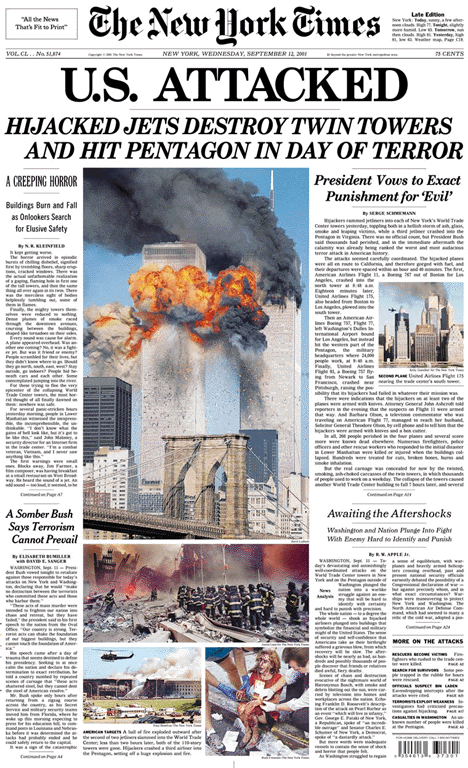
We Must Remember, and Take Heed

Before I republish my post of last year musing on the tenth anniversary of 9/11, let me also call your attention to blogger Wolf Howling's post of yesterday, "9-11 Its Aftermath, Eleven Years On."  He frames things much more starkly, and it's well worth a read although I give former President Bush more credit.

My own comments have not changed in substance.
* * *
The Long and Short of It

As everyone knows, this is the tenth anniversary of the Islamic terrorist attacks on the United States, "9/11," a date that has indelibly impressed itself upon the psyche of every American. In some ways it seems as if it happened yesterday, so clearly do I remember exactly where I was and what I was doing when news of a plane hitting the World Trade Center started trickling to me that Tuesday morning soon after I arrived at my office for what seemed like just another day of teaching.  In other ways it seems a lifetime ago, so radically did the world seem to change.  It was about a fifth of my own lifetime ago; but my fifteen-year son has lived two-thirds of his lifetime thus far in the shadow of that day.  But did the world really change on that September day ten years ago, or did some of us at least simply wake up to a new reality that already existed?

As a historian, one of the things I teach my students is how we periodize history.  Division of history into various "ages" and "periods" is, of course, a product of the human mind's need to impose order on chaos, to organize information into easily comprehensible form.  It is always retrospective, an attempt to understand the past, to establish periods that have some common theme that set them apart from what went before and what came afterward.  Although my own specialty of study is the so-called "Middle Ages" or "Dark Ages," of necessity since I have at times had to teach much wider spans of time, basically from the beginning to the present day, I have given some thought to the matter of periodizing modern history.  As of yet I have remained uncertain exactly what is the significance of 9/11 in that context.

Commonly, "Modern History" is considered (or at least I consider it) to be the period from 1789, the French Revolution, to the present.  Before that, basically back to ca. 1650, is "the Early Modern Period."  (You can use "history," "period," and "age" somewhat interchangeably in these terminologies; e.g. "the Middle Ages" vs. "Medieval History" vs. "the medieval period.")  Of course, you can always subdivide periods.  A common division of the Modern Age is to count 1789 to 1914 as "the Long 19th Century," because the French Revolutionary Period and the Napoleonic Wars that followed finally reached an equilibrium ca. 1815 that established a balance that would endure more or less until it shattered in the beginning of World War I.  The assassination of Archduke Franz Ferdinand on 28 June 1914 sparked a conflagration that through not one but two World Wars would quickly destroy that world of the 19th century with its great European Empires essentially dominating the globe and by 1945 leave the United States and Russia in the form of the Soviet Union as opposing forces for most of the next half century -- the "Cold War."  But, of course, between 1989, the Fall of the Berlin Wall, and 1991, the dissolution of the Soviet Union, that new balance that waxed and waned in favor of one or the other side finally was itself ended.  Usually, on the big "Periodization of History" sheet that I give my students even in the Early World Civ survey as a tool of orientation, I count 1914 to 1989 as "the (Short) 20th Century," followed by 1989 to ? as "the 21st Century."  I first concocted that periodization in the 1990s at the beginning of my teaching career, informing my students for the first few years that they were already living in a very different world from that of their parents.  What exactly would be the nature of that world, I said, remained to be seen.  Since 11 September 2001, however, I have added a parenthetical note to that "21st Century":  "The Significance of 9/11?"

Basically, the question would be, was 9/11 itself a demarcation point in history that is of such significance that it literally brought a changing of the ages, or was it "simply" the defining moment in a new age that was already in progress?  My money would be on the latter.  I think it was at that moment that the nature of the new post-Cold War world became clear.  Islamic terrorism was already rising in the 1990s in the wake of the fall of the Soviet Union as well as the first US action in Iraq, the Persian Gulf War of 1990-1991, in a somewhat under-recognized crescendo that would culminate in the attacks of 9/11.  It was, in my opinion, only then that some recognized that the United States was already in a war that had been raging for a decade or more.  Many, however, to this day refuse to recognize that fact.

I have some profound differences in political ideology from President George W. Bush, but one thing I give him credit for is that, however imperfectly he might have framed and prosecuted the subsequent "War on Terror," President Bush more than just about any other leader of the day -- indeed almost alone among them -- recognized that reality and took action whatever the consequences to his own political fortunes.  Because the reality is that there are people out there who want to kill us.  Whether we want to admit it or not.  And furthermore, whether we would prefer to frame it in such terms or not, from their perspective the conflict is at least framed as a religious war.  I personally believe they are largely sincere in that conviction.  Sure there are cynics among their ranks willing to use believers' faith as a tool for their own ambitions, but there are a lot of those believers who become willing tools.  That fact gives our enemy a clarity of purpose that is unfortunately lacking in our own resistance.  A few years ago, in an article that appeared in our local newspaper (The Natchitoches Times, 28 January 2005) about the recent publication of a couple of my scholarly publications (to be found here and here if you're interested in a peek at my professional life), I said this:

"Both of the just-published articles focus on the 10th century, the period in which notions of Christian service and sacrifice crystalized in a desperate defense of Christian Anglo-Saxon civilization against pagan Viking invaders.  Similar ideas, a century and more later, would motivate the first crusaders in their efforts to retake the Holy Land from the Muslims.

"Faith has always been a powerful motivating force.  Throughout history, religion has always provided one of the essential foundations for societies and states, and conflict against other societies and states has often been framed in religious terms when religion was not the outright cause for such conflict.  In the modern context, we need look only at the clarity of purpose displayed by Islamic terrorists who conceive theirs as a conflict against a western society that they identify as Christian.

"To draw a parallel, the 10th-century Anglo-Saxons knew against whom they were fighting, and why; Osama bin Laden knows against whom he is fighting, and why; in the war against terror, do we know against whom we are fighting, and why?"

To this day, I'm still not sure if as a nation we really know.  And if we don't figure it out, this may be the last days of Western Civilization regardless of whether they began in 1989 or 2001.  For my part, I believe that our hope, perhaps our only hope, is in recognizing, embracing, and defending our civilization's traditional self-identification as a Christian civilization.
11 September 2011

Thanks for reading.  We must remember, and take heed.