Tuesday, August 9

Warlord of Mars: Dejah Thoris #1 – 5 (Dynamite 2011)

“Colossus of Mars”

This is the second ongoing title in Dynamite Entertainment's growing family of series based on Edgar Rice Burroughs' first creation, John Carter of Mars. Dejah Thoris is the eponymous princess of the first book in that series, A Princess of Mars, an "enhanced adaptation" of which is currently nearing its conclusion in the main series, Warlord of Mars – see my comments on the first eight issues here. The story recounted in this second series, in its first five-issue arc, takes place five hundred years in the past – Burroughs' Martians, red or green, are extremely long-lived.

The inside front cover of the first issue is a text piece written in the voice of ERB himself, telling how work being done on the upstate home of his “Uncle Jack,” John Carter, had brought to light a strongbox containing manuscript pages recounting more of Carter's memoirs from his life on the red planet. The story told here is as related to him by his princess regarding her own adventures during her long life before he first came to Mars. (Subsequent interior covers provide recaps for those readers picking up the series late.)

Briefly, five centuries ago the twin cities of Greater and Lesser Helium were at war. Dejah Thoris was the granddaughter of the Jed (king) of Lesser Helium, Tardos Mors. Her father Mors Kajak also appears. Both are as hale and hearty as is the young princess herself (how young? – well, five hundred years younger than when Carter meets her!). But both cities are vassal states of the powerful Jeddak (emperor?) of Yorn – who steps in even as Lesser Helium gains the upper hand in the conflict and announces his intention that Dejah Thoris be wed to his son, Dor Valian, an oddity among the red Martians in that he is a scholar rather than a warrior, and not the typical perfect specimen of manhood. Pudgy and clumsy, awkward in speaking to his beautiful intended bride – frankly he reminds me a lot of me. But it turns out that Yorn has been playing the twin cities against each other to his own advantage until now, when he has decided to assume direct control of them. He of course has an even further ulterior motive – unearthing and reviving an ancient gigantic green humanoid war machine buried deep below Lesser Helium that his son's research into ancient records had discovered.

That's the gist of the first issue. Over the course of the subsequent four issues, Yorn of course succeeds in activating the Colossus – and almost immediately is himself seized and incorporated into it. If he wasn't insane before, well.... As Lesser Helium comes under siege by a horde of green martians, Dor Valian frees Dejah Thoris; she fights her way to her father and grandfather, frees them, and convinces them that they must ally themselves with the Jed of Greater Helium, their bitter enemy. She had indeed, during the betrothal feast immediately before Yorn's perfidy was revealed, made an impassioned speech that now was the time for the two cities to put aside their differences and come together.

By the end of the tale, of course, Yorn's ambitions have come to naught – and in fact the crisis has left the twin cities of Helium united under Tardos Mors as Jeddak. Dor Valian has proven himself a hero despite his martial shortcomings, his scholarship proving key to defeating his father and destroying the Colossus. The prince of Yorn has indeed won the affection if not the love of his intended princess. The climax of issue #4, on the eve of the battle, drives this point home in an exchange between the two that any geeky guy can doubtless relate to: “I – I love you, Dejah Thoris,” Dor Valian proclaims. “I have since the moment I first saw you.” To which she replies devastatingly, “I think you're very sweet, Valian. Some day you'll make someone very happy.” Ouch. [Spoiler: highlight to see] And yet, in the end Dejah Thoris truly grieves for Valian Dor when he is killed in the climactic battle. [End spoiler]

Overall, the story is quite good, although it is not directly based on ERB himself. It is an interesting tale of an earlier age in the history of Barsoom in which we get to see glimpses of the world and even characters that John Carter will later encounter. Except for the first novel, which I reread just last year, I haven't read any of the Mars novels in twenty or thirty years. I don't remember if Tardos Mors or Mors Kajak ever really came on-stage – if so, I didn't retain any mental image of them as I did of John Carter, Dejah Thoris, or Tars Tarkas. It is therefore interesting seeing them as major characters in their own right. We also get to see the Zodangans being typically treacherous. And we briefly get to see another beautiful princess who will be a major character in one of ERB's novels: Thuvia of Ptarth (#4, Thuvia, Maid of Mars).  At the very least, writer Arvid Nelson proves his ability to truly expand on ERB's mythos.

It's going to be interesting to see what elements of ERB's Barsoom novels make their way into these Dynamite series as they go forward. As I understand it, the first five are in public domain and therefore anything introduced in them is fair game for anyone to republish or adapt into other media. That's why even as Dynamite is putting out its Warlord of Mars series Marvel Comics has also announced its own comic adaptation of A Princess of Mars to begin in a couple of months, as well as a prequel series to the upcoming feature film. Disney (which owns Marvel and is, with Pixar, producing the movie) has indeed licensed the rights to the series from the Burroughs estate, but that gives them exclusive rights only to books six through eleven. So I'm guessing we won't be meeting Ulysses Paxton or Llana of Gathol, characters introduced in those later books, in Dynamite publications.

I stated my views on the art in these Dynamite series before – here. No need to beat that dead thoat. I will just say that it's going to make putting up cover images for this series … interesting. Whenever a comic is published with variant covers, I like to use as my illustration whichever one I purchased. For this post reviewing the first five issues of Dejah Thoris, the cover I got for issue #1 and pictured above is the one in which she is wearing the most clothes. Some of the others from this sequence, however…. When I picked up #5 at the comic shop in my home town last week, the proprietor always bags and boards the comics you buy and then slides them all into a larger magazine-size bag … which is similarly clear. And so this image, eye-popping as it is, was facing out. I paused, pulled that comic out and turned it facing inward, explaining, “I've got my mum in the car with me.” (We were on our way back to her house from an eye doctor appointment.) He just grinned.  Yeah, it coulda been awkward....

Kaor!

Monday, August 8

Mystery Men #1 – 3 (Marvel, Aug-Sep 2011)


This five-issue limited series first came to my attention via a posting on the AllPulp blog. That short review and interview with the writer, David Liss, piqued my interest enough that when I was next in the comic shop in my home town I picked up the third issue and asked the proprietor if he had the first two. Sure enough, he did, and I walked away with all three.

The story is definitely set within the Marvel Universe – New York City, the Daily Bugle is the newspaper whose headlines we see – but none of the familiar faces have appeared (so far). I thought I had heard somewhere that a very young J. Jonah Jameson makes his appearance, but so far not that I've seen. On the one hand, if he did that would make him about ninety years old or so, because this story is very specifically set in 1932 – but we are talking about comic book time here, and he does appear as a young man in the first chapter of Busiek and Ross's Marvels, which is set right at the end of the 1930s, beginning of the '40s, so it could have happened. But so far none other, although a Daily Bugle headline near the end of #3 announces, “Another Child Missing: Son of Stark Vanishes.” But I'm not terribly well steeped in Marvel lore so maybe I've missed something.

Anyway, I've really liked what I've seen so far. The story and the art evoke very well the mood of the 1930s pulp magazines, filtered into the Marvel Universe at a point in time just before the first wave of “Marvels” (to use Busiek and Ross's term) exploded onto the scene ca. 1940. Judging by the dimly shown figures appearing on the cover of issue #1, by the end of #3 I think we've been introduced to our main characters. They are, in order of appearance (as “mystery men”): The Operator, a “Robin Hood” character who, in the midst of the Great Depression, although he comes from the rich upper class steals from the rich to give to the poor; The Revenant, a white-cloaked and -hooded black man who appears and disappears in clouds of smoke; The Aviatrix, sort of a winged female “Rocketeer”; Achilles, a rather milquetoast young archaeologist who possesses an ancient amulet that gives him the skill and stamina of that greatest hero of the ancient Greeks; and The Surgeon, basically a horribly scarred doctor who teeters right on the edge of sanity, it seems, taking to using his scalpels and syringes to attack the ills of society.

Without giving too much away, the Big Bad of the story is a rather gruesome looking chap called The General, who has entered into a pact with some kind of demonic force (a “fear lord” – does it have anything to do with that current Marvel Event called “Fear Itself”? – I'm not reading it so I don't know) and who controls the city as well as seemingly the country and maybe even the world through a group of men called “The Board,” which meets in the Empire State Building. From issue #2: “If you turn to page 46 of the Prospectus, you will see that it remains in our best interest to maintain a climate of economic depression for another four to five years. These conditions will allow us the maximum potential to expand our holdings. At that time we can best alter the market dynamics by coaxing the nation into a large-scale military operation. Both Germany and Japan appear suited to our purposes. By 1937, this nation will be fully allied with those powers and ramping up our military by aiding them in their expansion.” Of course, The General has his own agenda along with the fear lord and I doubt things are going to turn out the way the members of the Board expect it to for them.

Whatever The General is going to have the demon do for him requires various human sacrifices, and that's where the story essentially begins – with the slaying of The Operator's lover, which results in The Operator being on the run because naturally he (in his civilian identity) is the prime suspect. And I'll leave off the summary there other than to say that in short order his search for her real killer has brought him into reluctant alliance with the other “mystery men,” has led to revelation of The Operator's own relationship with The General, and has brought us to the cliffhanger ending of #3 that bodes ill for a large number of abducted children (including Stark's son).

Each issue includes a text page along with development sketches for the characters, in which Liss discusses the genesis of the project and what he hopes to accomplish, mainly to build the story out of some of the central issues of the period – “race and gender inequality, poverty and greed, unfair labor practices, and many other gritty realities of the Depression” (#1). Those are are indeed present.

This has been a good read so far and I'm looking forward to the two concluding issues. Perhaps it will even become an ongoing and I might actually be buying a Marvel comic on a monthly basis.
* * *
One interesting sidenote. “Serendipity”: “the occurrence or development of events by chance in a happy or beneficial way” (per the Google search “define serendipity”). In issue #2, the archaeologist who is going to end up becoming Achilles is picked up at Curtiss Airfield in Queens, NY. Soon after leaving the airfield, the car in which he is riding is stopped at a red-green traffic light. There's no middle yellow caution light – just stop-go. It was a happy coincidence that just before reading these, over the weekend I was looking at John Olsen's rather extensive commentary on the Shadow novel I blogged about recently, Partners of Peril, where he writes: “Another point of interest is that apparently in Theodore Tinsley's version of 1936 New York, the street lights had no yellow. It's mentioned that a taxi and a sedan pass a green traffic light which immediately turns to red. [However,] Manhattan had completed the switchover to three-color lights by the mid-1920s.” Ah-ha! I thought – I just caught the creators of Mystery Men in a goof! Not so, however ... a quick internet search found this: “A shot of the last remaining red-green traffic lights out in Rockaway, Queens, New York City ….”


The point is not that I caught the creators in any kind of error – I didn't, and that's fine – but rather that you can learn all kinds of cool things writing and researching for a blog! I never knew there was ever such a thing as red-green traffic lights.

Cheers!

Saturday, August 6

World of Flashpoint #3 of 3 (Oct 2011)

"This is the World We Hope For”

In this climax issue, Traci 13, finding herself at a magical impasse with her formerly magic-hating father, Doctor Thirteen, who is hell-bent on slaughtering both the Atlantean and the Themysciran races, whose war had resulted in the deaths of his wife and children except for Traci, literally throws herself into the line of fire. “You want to kill 118 million people?” she asks. “Fine … Count me as one of them. Bye, Dad,” as she teleports away right into the midst of the raging three-way battle in New Themyscira (formerly England) – the heroes of the World of Flashpoint vs. both the Atlanteans and the Themyscirans. That is not what he wants. He follows her, implores her to relent – those people deserve to die! Traci finally gets through to him. He's trying to fix the world for her, but it will be a world she cannot bring herself to live in because of what doing so will do to him. He relents. But then a stray lance impales Traci right before his eyes, throwing her father back into a berserker rage. Traci is dying, but the World itself heals its champion. Doctor Thirteen is too far gone in his grief-stricken rage, however. The words of Circe (so that's who the prisoner in Antarctica was) come back to Traci, as well as what Fr. Todd had been telling her (see previous issue) – and she realizes she must show her father that along with great evil in the World of Flashpoint there is also great good. She does so magically, tying him into the “planetary consciousness” of the World. She pulls her father back from the brink of madness yet again. It's time to avert the genocide with only moments left. But they can't go together – Traci is exhausted after hours of teleportation hopping hither and yon, followed by the mystical battles with her own father, being brought back from the very point of death, and finally the latest effort. He heads off alone to sacrifice himself to block the death ray even as it fires from the satellite. The satellite is destroyed, but Doctor Thirteen is left floating unprotected in space – at peace with himself. But then Traci blinks briefly into view, grabs him, and teleports them both back to the surface – using up the very last of her magical abilities to do so. Both have used up forever their magic; she has sacrificed the life of the Homo magi but has her father back.

I'm still not sure what relevance this is going to have to the overall story. Mainly we got to see in the second issue various corners of the World of Flashpoint that I presume are not touched on in the various other miniseries and specials (Buddhist Guy Gardner! Fr. Jason Todd!), which is interesting in itself (perhaps even moreso for those who are all in for the multi-series event and maybe wonder about these various other corners). The first issue was basically set-up for that. In this third, however, we see the true heroism of a young girl, motivated by her basic goodness of heart and love for her father, prevailing in the end, and at least one Flashpoint series has a happy ending. I've never read anything about either one of these characters (Doctor Thirteen or his daughter Traci), but I really like her in particular and hope there's a place for her somewhere in the “DCnU.”

Cheers!

Friday, August 5

The Shadow vol. 9 (b), Partners of Peril (July 2007)

By Theodore Tinsley writing as Maxwell Grant (originally published in The Shadow Magazine, 1 November 1936)

Partners in an industrial chemical manufacturing plant seal a secret deal to allow one of them to buy the others out. One – then a second – is murdered! Safes are broken into in search of unknown documents. A mysterious black-cloaked figure contronts a perpetrator on a rooftop above one of the crime-scenes. In a climax, one of the business partners is trapped beneath a clear glass dome to be gassed to death – but the black-cloaked crimefighter saves him by jumping under the dome with him and stuffing cloth into the gas tube to block the poison's entry. It turns out that the mastermind of the murders was the partner who was already buying his fellows' interest out – but who would rather have the business scott free and not pay up!

Sound familiar? If you've read the very first Batman story from Detective Comics #27 (May 1939), it's called “The Case of the Chemical Syndicate.” But two and a half years earlier the very same plot elements had first appeared in the 1 November 1936 issue of The Shadow Magazine. As the the two text pages included in this ninth volume of the Shadow reprint series – “The Shadowy Origins of Batman” by Will Murray and “Spotlight on The Shadow: Foreshadowing The Batman” by Anthony Tollin – demonstrate, when Bill Finger wrote the very first of what would become many exploits of “The Bat-Man” (as he was styled in that story) – he depended so heavily on Partners of Peril as to constitute plagiarism. Neither Murray and Tollin, nor Finger's peer, comic book artist Jerry Robinson who provides the foreword to this volume, put it so bluntly, and in doing so I don't mean to sound impertinent and disrespectful of one of the many comic book creators of the early years who for one reason or another never got due recognition and reward for their accomplishment during their own lifetime. Finger would in 1974 die poor and unacknowledged for his great contribution to the creation of one of the icons of twentieth-century pop culture, which far outstripped that of the “Bob Kane” who to this very day still gets sole creator billing for Batman. “I'm astounded to learn how much Bill's first Batman script borrowed from that novel,” wrote Robinson (p. 4). There are mitigating circumstances (although my students better not ever try using what I'm about to write against me!). For one thing, as Robinson continued, “Of course, at the time, Bill was just beginning his career, and struggling to shift from humor to adventure strips …” (p. 4). Moreover, in those heady days when superhero comics were just being born, there was no way that anyone could know that Batman would become one of the most popular comic book – cultural – heroes ever. Sure, they were hoping to duplicate the sensation caused by the appearance a year before of Superman in Action Comics #1 – but so was every other writer and artist and their uncle and literally the janitor down the hall as the comic book business exploded, and there was no way to know that this particular story would not become just more forgotten detritus such as was appearing and disappearing as quickly as the presses could churn them out. And even if they hit paydirt, comics (as were the pulps themselves) were considered disposable entertaintment – bought for a dime, read, and discarded. Why put a whole lot of original effort into what could have been a one-off six-page story, soon forgotten? But it wasn't. And to his credit, Finger, who would go on to write many, many, many other comic book stories, sharing in the creation of such heroes as the original Green Lantern and Wildcat and developing a reputation as “the most inventive scriptwriter in comics” (Robinson, p. 4), “freely admitted that his 'first script was a take-off on a Shadow story'” (Tollin, p. 132).

Of course, there is a lot more to this adventure of The Shadow than what I described above. We are, after all, talking about a sixty-odd-page story in prose as opposed to a six-page comic book story. I would venture to say that I have more words in the preceding paragraph than are contained in the whole of “The Case of the Chemical Syndicate.” There are many more characters making their appearance – both among The Shadow's allies (including Detective Joe Cardona who is a major participant, along with the seemingly everpresent Harry Vincent; Commissioner Ralph Weston appears briefly along with The Shadow in his guise of playboy Lamont Cranston in a scene near the beginning that somewhat parallels our introduction to Commissioner James Gordon and playboy Bruce Wayne in that first Batman tale) and among the bad guys. Indeed there is a whole separate plot involving a separate group of villains engaging in espionage that adds to the difficulty of the investigators in getting to the root of the mysterious deaths of the former business partners, and elaboration of those partners' problematic relationships that casts further confusion as to who's doing what and for what motivation. The true climax of the story is not the ingenuous glass-bell gas-chamber – in fact in the Shadow story that ends up being a refuge for the hero and the intended victims (one of the partners and his son) when all outside the chamber are gassed – but the story continues to an explosive end with an overly elaborate deathtrap scene that The Shadow barely, for all his swiftness, rescues Cardona and a damsel in distress from. “Overly elaborate”? – The explosives depended on a photoelectric cell above the door to a warehouse being struck by a searchlight wielded by the mastermind. The Shadow was fully aware of this as he ran right by the cell and into the building. I'm sure readers 75 years ago were just like me – “Why doesn't he just hang his cloak over the sensor?!” – Let's all repeat, “It's pulp!” (Actually, I generally don't like that “excuse” when dealing with comic book snafus, but I've quickly found that if you're going to read pulp fiction on its own terms and enjoy it [ahem! – The Spider! – ahem!], you just gotta keep that mantra going.)

Besides the connection to the birth of the Batman, this particular Shadow novel is significant for another reason. It is the first that was not written by Walter B. Gibson. After several years churning out two adventures a month, Gibson needed a bit of relief. So the publishers hired another pulp writer, Theodore Tinsley, to contribute a few each year. He would eventually write 27 stories. He did a masterful job of reproducing Gibson's style. Frankly, had I not known this was a different writer going in I never would have detected it. Apparently there are little “tells,” but overall this story read just like a Shadow story should, and Gibson himself praised the result.

Tinsley also wrote one of the other stories included in this volume. Yes, Gibson wrote the “lead” reprint, which I've not yet read – Lingo, from the 1 April 1935 issue, which is included because in this story The Shadow makes use of a boomerang weapon that is seen as being the prototype for the Batarang – but at the very end is a non-Shadow short story originally published in another Street and Smith publication, The Whisperer of July 1937, entitled “The Grim Joker.” Yes. That Joker. Sort of. “[A] white-faced crime boss,” although “there is no concrete evidence to suggest … [direct influence in the development] of DC Comics' Joker” (Tollin, p. 133). But Tinsley used similar playing-cards-based motifs for both villains and plot devices in other pulp stories, so I'd be surprised if there is no connection.

As do those of the comic books themselves, the roots of the Batman go back to the pulps, indeed to the most popular pulp hero of them all, The Shadow.

Cheers!

The Shadow vol. 49(a), The Shadow Laughs (2011)

Vol. 49
By Walter Gibson writing as Maxwell Grant (originally published in The Shadow Magazine, October 1931)

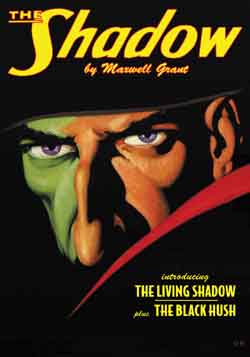
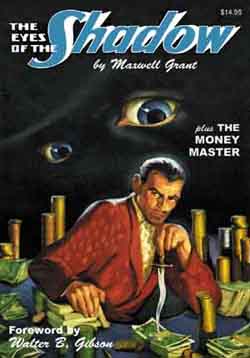
This is the third-ever Shadow novel. Celebrating the eightieth anniversary year of the Shadow's first appearance in print, the Sanctum Press “double-novel” reprint series has now completed republication of the first three pulp novels in order as the first story in volumes 47, 48, and 49 respectively. And I have read those three stories – The Living Shadow, Eyes of the Shadow, and now The Shadow Laughs – in order over the past three months. I began my current immersion in the world of pulp fiction a few months ago with a couple of the later-written novels, but when the publisher announced the release of the original “trilogy” (only in the sense that it's three stories – there's little connection between what are really just the first three of over three hundred stories) I determined to read these as they became available.

Vol. 47, containing the first Shadow story
As of this third offering, obviously some kinks were still being ironed out, but from the beginning the familiar elements that would be part of the saga were all there – the mysterious black-cloaked figure himself, his blazing .45s, his band of aides and allies none of whom know his identity, the fear that he inspires in the criminal underworld, and so forth. Of course, not all the aides and allies are here yet – more would be added in the future – but these three stories have introduced Harry Vincent (in the very first scene of The Living Shadow), Claude Fellows, Burbank (did he ever get a first name?), and Vic Marquette. The Shadow's “true identity” of Lamont Cranston made its first appearance in the second book – then we find that it's not really his “true identity” but rather a ruse in this third book when we meet the real Lamont Cranston – who finds his identity basically stolen by this mysterious figure. (He goes along with it at first because he basically has to; later he too would become a willing ally of The Shadow. And we would ultimately find out The Shadow's real true identity … or would we...?) The familiar girasol ring, the slouch hat, the master of disguise – that's all here. But since this is early, there are some jarring notes as well – such as reference in this third story to The Shadow's black silk mask – which I don't think ever appeared again.

Vol. 48, containing the second Shadow story
It's an oft-told story how The Shadow Magazine came to be. First there was the radio program – simply an anthology show in which various short radio plays were introduced by a mysterious voice calling itself “The Shadow.” The stories were said to be based on stories in Street and Smith's Detective Story Magazine. But then newstands reported a surge of people coming and wanting to read “that 'Shadow' magazine” – so Street and Smith hastily put out such a title to meet that demand. It quickly went from quarterly to monthly to ultimately twice-a-month publication as it would remain for most of its long run. Luckily Walter Gibson was an amazingly fast writer – he was able to keep up the pace for the most part, writing almost three hundred of the stories that were published over almost twenty years. Only a handful of stories would come from the typewriters of others. The Shadow as a pulp-literary figure came first – The Shadow as a radio hero himself in his own adventures as opposed to his original role as simply the host would come only later.

Interestingly, just as he professed (under the pen name of “Maxwell Grant”) to simply be recording stories as told to him “from the Private Annals of The Shadow” (on the title page of each adventure), Gibson also included the radio show element of the hero's origin into his stories from the beginning. In the radio studio there exists a small room with a hidden access, from which The Shadow would play his role as described above – and in so doing pass coded messages to his aides! No one ever saw him enter or leave that room. Nevertheless, unlike the radio-version that would ultimately follow (and would indeed be written by Gibson himself), The Shadow of the pulps had no supernatural powers beyond great intelligence, physical prowess, speed, and the black garb that allowed him to seem to melt into any available pool of shadow – no mysterious Eastern ability “to cloud men's minds” and literally become invisible. I've heard a number of the radio shows and they're good. The literary Shadow is better.

The Shadow's cultural significance cannot be overstated. “Who knows what evil lurks in the hearts of men?” Those who've neither heard a radio show nor read a pulp novel know that “The Shadow knows! Hahahahahah....!” The appearance of The Shadow Magazine and its quick popularity pretty much gave birth to the explosion of hero pulps during the early 1930s – his own fellow Street and Smith character Doc Savage, rival Popular Publication's The Spider, and too many more to list. In a way, the pulps begat comic books – and in a forthcoming post I'll write about how The Shadow begat The Batman. He is truly an icon.

The plot of this third story, in a nutshell: A counterfeiting plot gives rise to murder – including that of a police detective – putting both The Shadow and his agents and Secret Service Agent Vic Marquette onto the chase. Harry Vincent is assigned to guard the brother of the supposed killer, bringing him into the midst of a group of suspicious men among whom he must discern who is part of the plot, while The Shadow scours the city for the real murderer and his cohorts. And it turns out the mastermind is an old foe of The Shadow, from the previous adventure. Plot twists abound before it all comes together in a blaze of gunfire in the end. It's great stuff!

Since this is the first of the Shadow volumes I'm blogging about, I want to say a couple words about the presentation. Even though they are from separate publishers, The Shadow reprint series and The Spider reprint series are superficially similar in format. Both include two stories together under one cover – both doing so not in original publication order (that's a drawback – why not republish them ino order?). They are pretty much the same dimensions and thickness. Both reset the type for easier reading, but otherwise closely follow the page format of the original pulp magazines, including the interior line illustrations as far as I can tell in their appropriate locations. Both use the cover painting from one of the original stories for the front cover, while reproducing the actual covers for both as thumbnails on the back cover. However, The Shadow series has a couple of features over the other. First, maybe not always, but at least sometimes the stories are paired together with purpose, while The Spider stories seem truly to be thrown together at random. 
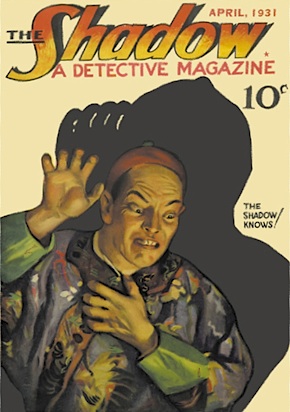
The Shadow Magazine #1
That's not really apparent with this current volume 49, but for instance volume 47's stories were chosen so as to be able to use as the cover the iconic image of The Shadow from the 1 August 1933 issue (The Black Hush) rather than the actual cover - to save money they re-used a cover from an old issue of another magazine!  (Yes, there is a Chinese character in the first Shadow adventure, and he casts a shadow on the cover, but it's not The Shadow!)  One volume of The Shadow reprints has two stories that take the hero out of his normal haunts, across the sea to Great Britain: Vol. 8, The London Crimes and Castle of Doom. Another – the next that I'll blog about – contains two stories that each directly contributed elements to the creation of Batman (along with another non-Shadow story that also played a hand, so to speak). Secondly, each volume contains several text pages of commentary generally by series editor Anthony Tollin as well as pulp historian Will Murray (and sometimes others – for instance, “the Batman volume” has an introduction by Jerry Robinson, the man who created The Joker and drew many of the Batman's early exploits). Girasol Publication's The Spider reprint series has no such commentary – just the stories themselves, which are great to be sure, but it's always nice to get a little discussion and context.

Cheers!

Justice Society of America #52 (Aug 2011), Flashpoint: Kid Flash Lost #2 of 3 and World of Flashpoint #2 of 3 (Sep 2011)

This may be the first of some shorter entries in an attempt to catch up with where my reading really is by now.*

“The Secret History of Monument Point, Chapter Two: Weird Mystery Tales”

There are two narrative threads going on here. In one, confronted with a mysterious, ancient, and locked doorway far below the city as well as the mysterious death of his political opponent who had done all in his power to keep him from even knowing there was such a secret, Mayor Jay Garrick a.k.a. The (Golden Age) Flash, consults with his JSA teammates, who decide to bring in some real specialists – the Challengers of the Unknown. They end up picking the lock (no kidding – it's Dr. Mid-nite's idea) and a mixed team heads into the unknown. Evading certain “antediluvian counter-measures” otherwise known as “Booby traps!” they discover what seems to be an underground city. Secondly, we have what looks to be the climax of the subplot surrounding Mr. Terrific's declining intelligect. Briefly, several issues ago he realized that he was losing all the knowledge he had accumulated over his lifetime – not his memories, per se, as I understand it, but rather his ability to read as well as his understanding of any complex concepts and the like. It's not entirely clear to me – but whatever. Anyway, it's the doing not of some super-villain, but rather of one Richard Lusk, an obsessed fan of the original (Golden Age) Mr. Terrific who believes that Michael Holt sullies the legacy of Terry Sloane. There's an element of racism in his attitude toward “the dark-skinned poser who stole his legacy.” In order to complete his vengeance and deprive Michael of any chance of reversing it, Lusk destroys all records of how he had destroyed the hero's intellect, including his own brain by committing suicide, leaving a DVD along with his hanged body. “I guess I just hate you that much.” Whoa. But Lusk hasn't counted on one thing – Michael Holt's determination. Here's Mr. Terrific's monologue from the last page: “I wasn't born smart. At least I don't believe I was. And no matter what brains I started off with … I only managed to … What's the word? Enhance. I enhanced them through hard work. You can't take hard work away. You can take away the results, but you can't take away the drive. That's who I am. It's who I'll always be. So … Let's get to work.” And he starts a DVD: “Hi, kids! I'm Captain Carrot! And me and my amazing Zoo Crew are going to teach you how to read! … Doesn't that sound exciting?” Wow!

What, now, a couple issues before the end, things finally start getting interesting with the main plot, even as the Mr. Terrific sub-plot finally comes to a moving end that I quite frankly hadn't expected?! I've not really been impressed with this creative team's earlier issues, but if this is a taste of what could have been to come, dang I'm disappointed that the JSA is nowhere to be found after August except for some unconfirmed rumors.

“Kid Flash Lost, Part Two”

I didn't find the art quite so bad in this second issue, although I've not directly compared it with the first to see just what the difference is. Oh well. My only specific complaint is how they illustrate Bart's progressive fading from reality – he looks more like he's zombifying than fading away. The story, however, continues to be outstanding – I like Sterling Gates!

Briefly, Bart – staying true to his own somewhat happy-go-lucky (not sure that's the right way to put it, but it's what comes to mind) character even in a truly dystopian hell of a Flashpoint future – realizes that he had possessed his speed while in the virtual reality in which Brainiac had held him captive. That's how he had basically out-thought Brainiac's computer and freed himself. So he taunts Brainiac into recapturing him and putting him back! “HEY! Yoo-hooooo! Nerd-iiiac! Nyyyyaaaaaa!” Who else but Bart Allen would dare talk to Brainiac like that? Once back in, he uses his “super-speed-enabled brain to rewrite” the programs before breaking out again – “Haxxored and pwned, noob!” (Not sure what "haxxor'd" is, but "pwned" I get!)  Rewriting Brainiac's security programs allowed Hot Pursuit to break in and join him – then tragedy! – she is impaled by one of Brainiac's weapons. But before she dies, Patty Spivot releases the Speed Force energy that had been contained in the tank of her bike, giving Bart his speed again. And away he dashes, determined to save her by pre-empting the future – “All I have to do is find The Flash. Even if it kills me.” Ominously: “Next: The Death of Kid Flash?”

"This is the World We Made"

Basically, in this middle part, we get the grand tour of the “World of Flashpoint.” Determined to thwart her father's genocidal plans to end the war by wiping out both the Themyscirans and the Atlanteans, Traci 13 teleports hither and yon in search of allies – fruitlessly. She first finds Madame Xanadu dying in New York City. The mystic can only give the girl her tarot cards as guidance – which then direct her jumps to Tokyo, where a half-built Red Tornado android is keeping lonely vigil waiting for his creator to awaken and finish him – T. O. Morrow is a dessicated corpse, long dead; to Brazil, where in the middle of a war against the Nazis, Natasha Irons can't understand why Traci would want to stop her father; to Namibia, where Changling saves her by betraying his murderous human-slaughtering gorilla master (is that Grodd?) in a pretty “disgusting” way (Traci's word) – changing to a bug, flying into the ape's mouth, then changing back to normal – “SKRRITCH—BOOMPTH” – but Traci recognizes that he's needed there; in Queensland, she finds a now-Buddhist Guy Gardner uninterested in fighting (but he does hit on her – then backtracks when he finds she's only sixteen). Confused at this “wild-good chase” that Madame Xanadu has put her on, maybe she gets a little insight from the lady she frees from chains in Antarctica – whom I don't recognize but who tells her, “No one cares about anything more than what benefits or hurts them. All these champions, both good and bad, are all driven by their own selfish motives. Each is caught up in his or her little drama. And each of them wants nothing more than to mold this world into the image of what they consider right. But who is truly right? It's all a matter of perspective... I suppose only the gods know better...” In Gotham City, she gets a pep talk from Fr. Jason Todd, who maybe sheds some further light on Xanadu's purpose – not to give Traci allies but rather insight: “Maybe you were just supposed to learn something....” Then the Magician card leads her back to her father - “the most infamous hater of magic” – who seems to have taken a bit of a liking to it.... “To be concluded.”
* * *
* I should really know better by now not to begin an entry by saying it will be “shorter.” Try as I might, it just never is. But, just to set out the backlog that I'm facing:

I finished reading Perry Rhodan #14, Venus in Danger, over a month ago, just before I began a series of several trips hither and yon for various purposes – family vacation, dealing with issues for my elderly mother, and so forth – that haven't left me the luxury of a fairly extended block of distraction-free time to compose what has become, for my other blog, pretty intensive entries summarizing and commenting on each issue. At this point, I think I may have to go back and reread the story before undertaking that task! It is, after all, the beginning of a new “mini-cycle” in the series.

Bronze-Tempered Steel, the next installment in The Bronze Saga or “The Christian Adventures of Doc Savage,” which I finished during the aforementioned vacation. For various reasons I want to give this a fairly intensive treatment as well, both because of the particular story which brings together two of my favorite characters and because over the summer I've stricken up a long-distance friendship with the co-author. With various distractions (see above) I've not set myself down to cranking out something and have let enough time pass I'm wondering if I need to reread it too in order to do it right.

The Shadow #49 (a), The Shadow Laughs, and #9 (b), Partners in Peril. The first of these I finished on vacation as well; the second just last night. These will probably get fairly short shrift, unfortunately.

Warlord of Mars: Dejah Thoris #1 – 5 and Warlord of Mars: Fall of Barsoom #1, read over the past few days, getting me completely up to date on the Dynamite series I blogged about earlier this week.

And the shipment containing my July comics is (according to the UPS website) on the truck and out for delivery today (but I'm not home, alas – I'm a hundred miles away at my mum's), so I'm about to have a whole new box of stuff to go through!

Incidentally, I just started reading the newest Dresden Files novel, Ghost Story. I'm always reading something, usually several somethings.

Of course I have blogged some in the meantime – when I finished or saw something I just couldn't wait to comment on, or upon which it was fairly easy to write something up. So I'm obviously not striving to do things in precisely the order I've read them - nor will I probably do the things I've listed in the order above.  But I have this nagging pressure to catch up and blog them all.  I'm OCD enough that if I'm going to do this I don't want to leave anything out.

Oh, the millstones we take upon ourselves! It's not all fun and games!

Blogging is hard work!

Enough wasting time.

Tuesday, August 2

Warlord of Mars #1 – #8 (Dynamite, Oct 2010-Jul 2011)

Adapted from A Princess of Mars by Edgar Rice Burroughs

I decided recently to pick up this series, a few months into its run, which necessitated searching out the first half-dozen or so issues on-line. I got them in a couple weeks ago, and acquired the current issues directly from comic shops, and have now read through them.

I don't think there's any need to introduce or summarize the basic story, which is now almost a century old. A Princess of Mars was actually the first published work by the creator of Tarzan of the Apes, Edgar Rice Burroughs, being initially published under a pen-name “Norman Bean” and the title, Under the Moons of Mars, in serial form beginning with the February 1912 issue of All-Story Magazine. Published in book form under Burroughs' real name and the current title in 1917, it became the first of what would ultimately be a series of eleven novels set on a fantastic, romantic version of the planet Mars that the inhabitants called “Barsoom.” The series is called variously the “Barsoom Series” or the “John Carter of Mars” series, and it is finally, after a century, going to become a major motion picture next year, under the title John Carter.


Although the popularity of Burroughs' second creation would quickly outstrip that of his first, for many fans including myself the tales of the red planet and its varied denizens are really dearer to our hearts than those of the lord of the jungle.

This is not the first comic adaptation of the story, but it is perhaps the most ambitious. Dynamite Entertainment as of last week has not just one but rather a total of three Warlord of Mars series going – the one under consideration now, joined a few months later by Warlord of Mars: Dejah Thoris (up to issue #5, I believe) and most recently by Warlord of Mars: Fall of Barsoom. I'll get to those latter two later.

As of issue #8 of the main series, we are most of the way through an adaptation that is an odd “enhancement” or “expansion” of the story told in A Princess of Mars. (Next issue, #9, is billed as the climax of that story although the series continues on.) A lot of work is clearly being put into it – I don't think Dynamite does much of anything by halves! The number of series in the “franchise” is one example – paralleled by the deluge of Green Hornet series that came out over the past couple of years. And they look good … maybe a little too good, but more about that in a bit. The story is being adapted by Arvid Nelson, adopting the “voice” of “ERB,” signed as such in a number of text pages such as the previous issues' recaps, notes on various aspects of Barsoomian history, society, and technology, and even in a few explanatory notes within the pages of the story itself. As I can see it, the “enhancement” part of the current adaptation seems to take place mainly within the first two issues, the only two that appear to have their own individual titles, “A Tale of Two Planets,” Parts One and Two. Here we learn a bit more about the background of John Carter and the green Martian who becomes his friend, Tars Tarkas. Carter does not actually make his “transition” from the cave in Arizona to the planet of the god of war until the end of issue #2, waking up there at the beginning of issue #3. From that point, the basic narrative so far follows pretty closely that of the novel. Maybe a little annoyingly, even though most of the first two issues consist of material added to the story, I've already noticed now by the end of issue #8 that some elements of the original novel have been passed over – most glaringly and disappointing because I always liked the character, the meeting of John Carter and the red Martian Kantos Kan. (I think when I was a kid one reason I liked him was his name and its similarity to my own.) Nevertheless, overall it is a pretty good retelling of the basic story.

The art, in the first two issues by Stephen Sadowski, thereafter by Lui Antonio is generally clean and attractive. I prefer Sadowski's, both in style and because his renditions of the green men of Mars seem to be slightly more in line with Burroughs' original descriptions, but Antonio's is quite able. “Slightly more in line with Burroughs'” renditions of the green men – neither Sadowski nor Antonio actually get them right, mainly in the arrangement of their features: bulging eyes widely set on the sides of their heads, able to move independently and look backward and forward at the same time (I bet that's useful in battle!); magnificent tusks jutting out of their massive lower jaw, extending up as far as the eyes; antennae-like ears protruding from the forehead or just above the eyes. I don't think I've ever seen an entirely accurate sketch. (And the film apparently doesn't get it quite right, either – but those are some magnificent tusks!) Most drawings and paintings render them more human-looking in their appearance but for somewhat reduced tusks and the olive-green skin. And their middle set of limbs are usually simply depicted as a second set of arms rather than something literally between arms and legs that can and do function as either. But those are relatively minor criticisms and not unique to this series.

Another aspect of the art that I have to comment on, however, is the depiction of the red Martian women – most notably Dejah Thoris, the Princess of the first book. The artists, both in the interiors and on the covers – each issue has a number of variant covers by some really big names including Alex Ross, Joe Jusko, J. Scott Campbell, and others (one thing I really like about Dynamite is that for this series at least, the interior of the back cover gives thumbnails of all the covers for that issue so no matter which one you pick up you're not deprived of having at least small images of the others) – come just about as close as possible to depicting the Martians, including the beautiful women, as Burroughs himself described them and still have a marketable comic book! To quote the Encyclopedia Barsoomia wiki's disclaimer, “Burroughs described the Martian people as being scantily clad, 'undisfigured' by 'strange, unsightly pieces of cloth,' as Burroughs put it.  ... [Thus] some of the images [on the wiki are] ... mildly erotic ....” Generally the Martians' only accoutrements were said to be martial ornamentation as well as harnesses to carry their various swords and other weapons. (Note:  It can be argued that Burroughs did not mean literal nudity here - that in the immediately post-Victorian world in which wrote "naked" meant simply bare arms and legs - but I think the common understanding is indeed nude rather than half-clothed.)  In previous comic book adaptations the men generally wore in addition in addition to the functional outfitting loincloths (as they usually do in this series), while the women wore loincloths plus ornamental jewelry and breastplates – more or less like the slave-girl get-up Princess Leia wore in Star Wars VI: Return of the Jedi (which I've heard was directly swiped from a paperback book cover for Burroughs' Mars series).  In this series, let's just say they wear a little less than that – mainly in that the “breastplates” are reduced to little more than small (tiny!) coverings for the nipples that must be attached by static electricity or something! (And some “dealer incentive” and “exclusive” covers for the Dejah Thoris series have less than that – what they call “risquĂ© nude” versions of one of the other variants.) Tellingly, from issue #4 on (when Dejah Thoris makes her advent), the publisher added a “Rated Mature” notation.   I'm not sure how I feel about this. Sure, I like looking at good-looking women as much as the next guy, but traditionally the entry-level reader for Burroughs' fiction is early-teen years or even younger.  I once read that if you don't discover Burroughs by the time you're fourteen, it's too late - you'll never get it.  But even though I intend to give A Princess of Mars to my thirteen-year-old nephew sometime soon (I gave him Tarzan of the Apes last Christmas – trying to do my part to introduce him to some good reading!) … um, there's no way I could pass this particular comic book adaptation of that novel on to him. His mom, my sister-in-law, would kill me! Yes, it comes closer to what Burroughs described, but reading the description in prose is different than seeing the typically over-endowed ladies generally drawn by modern comic-book artists in basically the altogether! Balancing authenticity with practicality – or rather marketability – is, I'm sure, something that the designers of the upcoming film wrestled with. I had a short email exchange regarding this with an email “pen-pal” a few weeks ago before the trailer was released that began with me whimsically asking “if they show the Martian women as Burroughs described them, do you think our wives will let us go see the movie?” You can see their choice in the trailer above. John Carter's clothes apparently even made the journey with him to Barsoom!  But as for Dynamite's comic series, I have mixed feelings about rendering their appropriateness for adolescent readers problematic at the very least.

Even so, I am enjoying this series, and looking forward both to the issues that follow the next which promise continue the enhancement by following the adventures of Dejah Thoris and her people once John Carter is mysteriously transported back to Earth at the end of the first book, as well as seeing the expansion of the story in Dejah Thoris' own series – set five hundred years in the past (Martians are extremely long-lived) – as well as Fall of Barsoom, which is set even further in the past, thousands of years ago when a once lush, green world was beginning to dry up and die the long death which ultimately created the world in which John Carter found himself.

Kaor!  (Literally a Barsoomian greeting, but what the hey, I'll use it to sign off.)

Monday, August 1

Fall of Eagles, Disk 2 (1974) (plus a rant about Netflix)

By John Elliott

Just (finally*) watched the last episode on this second DVD (see what I had to say about the first here), which puts me about two-thirds through the series. Four more episodes, all focussing on Russia:

“The Last Tsar” will be, of course, Tsar Nicholas II, whose father the reactionary Alexander III considers to be hopelessly weak-willed. Father is right. Nevertheless, we see Nicholas' marriage to Alexandra, a German princess, and then his succession – as well as the story of the rise of Lenin.

“Absolute Beginners”: This episode is framed by sequences in which the dilettante Tsar Nicholas is far more concerned with his crow-shooting skills than with the growing danger of revolution. The main story focusses on the rise of “Vladimir Ilyanov” (Lenin) and his struggle for power in what will become the Bolshevik party. We also meet Leon Trotsky.

“Dearest Nicky” is basically the story of how Nicholas allows his cousin the Kaiser Wilhelm II (they – as well as half the royalty and nobility of Europe during the early twentieth century – are grandchildren of Queen Victoria) to goad him into what one of his own ministers promises to be a “short, victorious war” against “the yellow peril” in the East – Japan. It's neither short nor victorious. Nicholas is further distracted by the hemophilia of his son, Alexei, as revolutionary fires smolder and burst into flame in St. Petersburg – leading to one of the several “Bloody Sunday” massacres that appear in the history of the twentieth century.

“The Appointment”: “We're coming out of the Dark Ages. Civilization is almost upon us,” says Pyotr Rachkovsky, whose appointment in this episode as the police chief of St. Petersburg in the wake of the assassination of the Tsar's uncle the Grand Duke Sergei symbolizes the flailing and countervailing movements within the Russian government that just makes the chaos worse. (The statement itself is debateable, given the history of the twentieth century – was it really that much more “civilized” than what went before?) Rachkovsky ends up provoking a full-scale revolution in Russia, which he then puts down with ruthlessness and bloodshed – leading to a few years of deceptive peace as the fires that will engulf all of Europe continue to smolder.
***
Note: Calling attention to Patrick Stewart in my post for the first disk meant that I identified one of the five pivotal figures of the pre-World War I world, Lenin. The others portrayed on the DVD packaging are, from left to right: Austro-Hungarian Emperor Franz Joseph I, Tsar Nicholas II of Russia and his Tsarina, Alexandra, and Kaiser Wilhelm II of Germany.

The three heraldic eagles symbolize the three empires.  I think the double-headed eagles represent Russia and the Austro-Hungarian Empire, while the single-headed eagle represents Germany.  I could be wrong about that.  I read something about it long ago, but don't have access to that book right now and can't find anything definitive with the resources I have at hand.
* * *
* Note: It seems that even in the summer, at least this summer, even the break between semesters hasn't been allowing me to watch a whole lot of material. Admittedly, this summer is a bit different, for reasons I don't want to get into. But I'm doing quite a bit more running back and forth across the state from my home to my mother's home. It's a mess, but the long and short is that it's cut into my watching and reading time that I usually have during the summer.

Then a couple weeks ago came Netflix's big announcement splitting off the DVD mail rental program from the streaming program and almost doubling the price for someone who wants both. Long and short, I guess I'm playing right into their plan (which seems to be to get more people into the streaming side of things because it costs Netflix less) because I'm dropping the DVD program as soon as I finish watching this series, which I intend to do before the 1 September shift. Maybe next summer or over the Christmas holidays I'll re-up that side, but for the foreseeable future I'm going to be a streaming-only customer. I just wish their selection on that side of it were better – and that you could depend on something you seeing up for streaming this week will still be there next week. I'm going to be right pissed if I start a series only to see it disappear before I get to the end!

And I am investigating alternatives. Here's an interesting article, “How to Ditch Netflix and Still Watch (Almost) Everything You Want.”

Dosvidanya!

Sunday, July 31

Batman: Gates of Gotham #2 of 5, Detective Comics #878, and Gotham City Sirens #24 (Aug 2011)

“Part Two: The Four Families of Gotham”

At the end of the previous issue, in which bridges named after the Waynes, the Cobblepotts, and the Elliots were blown, I noted the title of this the next issue. Here we find that the fourth family is indeed named “Gates” – nineteenth-century stepbrothers who were the architects and builders of the eponymous bridges. The narrative jumps back and forth from the past to the present, telling the story of the brothers and the origins of Gotham City as well as the Bat-family – Dick and Tim in one team, Damian and Cassandra in another – dealing with the current threat. And it generally works well, giving the story a good bit of depth. I like this incorporation of a sense of history into the story – which will by all accounts continue into Snyder's coming run on the relaunched Batman title. There's some good interaction between typically obnoxious Damian and laconic Cass, as well as between her and Tim. And Dick is forced to make a choice between saving the Wayne Tower and saving arch-enemy Tommy “Hush” Elliot – a choice that leads to the startling revelation of the final page.

“Hungry City, Part Three of Three”

Dick Grayson Batman manages to survive his confrontation with the villainous Tiger Shark – who attempts to feed him to a killer whale (is it supposed to be a tiger shark? If so, it's drawn incorrectly) while telling him of his own heritage as an heir to the Sea Peoples of antiquity. The bad guy gets away – to return in the future, I'm sure. Dick manages to make his appointment with his old friend James Gordon Jr. – an appointment made at the behest of James' father the commissioner who still has his doubts about his son. A little reminiscing recalls a bully, Ben Wolff, who had tormented James when they were younger – but who James now reports is a pharmaceutical rep and “nice as could be.” But something he says clicks in Dick's mind regarding his confrontation with the Tiger Shark, bringing Batman into a final confrontation with Sonia Branch, who it turns out had manipulated the investigation of her friend's death to pit him against her own enemies first, who were harrassing her to launder money for them.  This is a new kind of criminal very different from her own gangster family in the past she is indeed, it appears, trying to put behind her - against whom, she believes, normal law enforcement would be no help.  Dick berates her for misleading him - but I think Snyder means us to see that there's some truth in what she says.  They part rather awkwardly:  “Goodnight, Ms. Zucco.” “It's Ms. Branch.” “That's what I said.” I think we'll see her again.

Running through the story is Dick's inner dialogue recalling a high-diver in Haley's Circus, who had emphasized that the situation much be judged before taking action – whose one lapse in such judgment had led to his own death. That revelation opens the bombshell of the last two pages, where we find out that James Gordon Sr.'s instincts about his son are horrifyingly on target – and that Dick won't be seeing Ben Wolff ever again – or if he does Wolff won't have it all together at least.

I am so glad Snyder is helming the Batman title come September ... I just hope the plot elements concerning Dick are followed up in Nightwing as well.

“Friends”

Very apt title – the “end” of the “friendship” between the sirens – Catwoman, Harley Quinn, and Poison Ivy. Calloway continues to emphasize that, as goofy as she may be, Harely Quinn is herself an insane genius to be reckoned with, as she continues a skillful psychological manipulation of her opponent, in this case Poison Ivy, taking her out. But then Harley and “Mistah J” go against Bruce Wayne Batman and Catwoman – and lose. As Harley and Joker are being taken back to their cells, Bruce and Selina have an interesting exchange: “I know she has to be here,” Selina tells him. “She's made progress in the past,” Bruce replies. “She'll make it again.” “Still … she was never the problematic one,” Selina muses. A few moments later, Bruce thanks her for helping out and says, “I might make a true hero out of you yet.” She scoffs, “Don't hold your breath. I've still got a few treacherous acts up my sleeve.” Which sets up her confrontation with Ivy, who has apparently been out cold since Harley put her down: “I could let you go,” Selina tells her. “I could let you escape down these tunnels. But I won't. You are a mass murderer. A cold-blooded killer. But that's not why I've doing what I'm about to do. I'm doing it for revenge.” Selina recalls when Ivy, back at the beginning of this series, was tortured by Ivy in an attempt to get the identity of Batman: “A long time ago, you tried to steal something from me, take it by force. Did you think I'd forgotten? That I'd forgiven? ... Goodbye, Ivy. Enjoy your stay at Arkham.” Wow!

What a way to end the series! – But it's not the end. I think there are two more issues – I guess they'll essentially be Catwoman stories. Oh well – this was a great issue nonetheless, with a lot of good dialogue as well as artistic flourishes, particularly a single page image paralleling Joker and Harley with Catwoman and Batman: 
- as well as a double-page spread framing the battle in opposing silhouettes of Joker and Batman:  
I repeat, Wow!

I confess that I didn't really care for the direction the first part of this three-parter was taking - obviously headed toward the break-up of the sirens.  This series overall has been a lot of fun, and the darker turn was unexpected - until the news of the "DCnU" hit.  But in light of where the September relaunch is taking the characters, it was necessary.  I don't think we know where Poison Ivy will end up, but the end of this issue gets Harley in position for Suicide Squad #1 (although I won't be following her there), and Catwoman will have her own solo book.  I wonder what changes we'll see to her situation before Catwoman #1?

Cheers!

Saturday, July 30

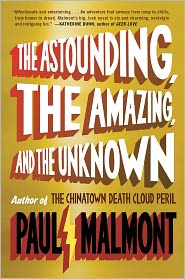
The Astounding, the Amazing, and the Unknown (2011)

By Paul Malmont

“The future begins in the imagination” (p. 24).

I knew going in that I would enjoy this novel, having last year devoured Malmont's earlier Chinatown Death Cloud Peril (which helped inspire this year's current obsession with pulp heroes). As much as I loved that earlier work, I think this one is even better. It's not necessary to have read Peril before AAU, but I think doing so will add to the reader's enjoyment because all of the main characters return, plus others.

In Peril, Malmont took the writers of the great hero pulps of the 1930s – mainly Walter Gibson (The Shadow), Lester Dent (Doc Savage), and L. Ron Hubbard (westerns) – on their own rousing pulp-style adventure. What began as an investigation into what turned out really to be the 1937 murder of horror writer H. P. Lovecraft ended up through various hair-raising adventures thwarting an international plot to supply poison gas to a Chinese warlord fighting against the Japanese.

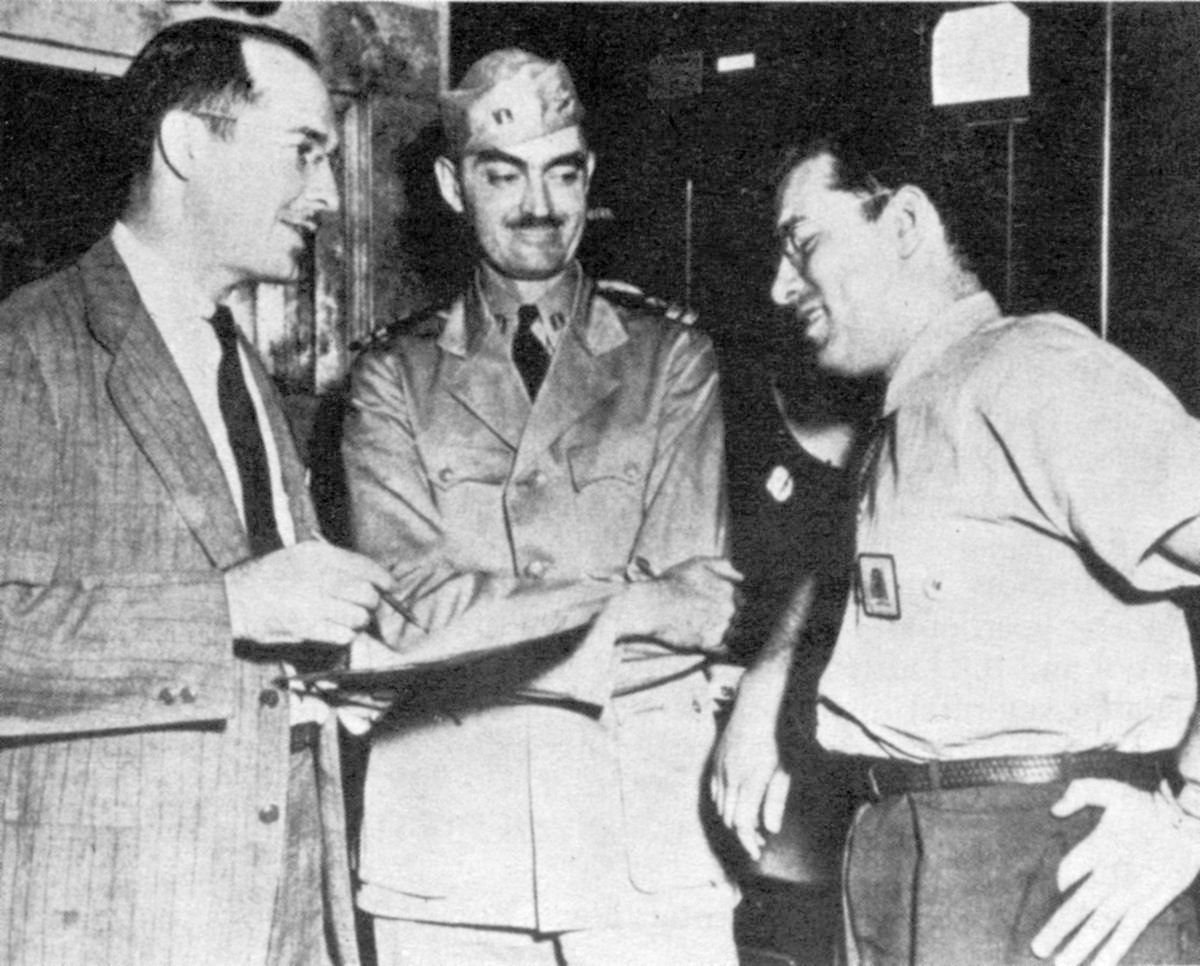
The Astounding, the Amazing, and the Unknown takes place a few years later, in 1943, as the popularity of the hero pulps was waning against the backdrop both of World War II and the early rise of science fiction. The title, of course, is taken from the triumvirate of science-fiction pulps – Astounding Science Fiction (later Analog), Amazing Stories, and Unknown. It's well known (at least I knew it, since I long ago read Isaac Asimov's autobiography In Memory Yet Green) that several early science fiction writers who were also scientists were brought together during the war to work in scientific research at the Philadelphia Naval Yards. Along with Asimov there was L. Sprague de Camp and Robert Heinlein. 
Heinlein, de Camp, and Asimov
They are tasked with developing various fantastic weapons and defenses such as they have written about. Then the mysterious death of Nikola Tesla (turns out to be murder, of course) sends the group on a mission to rediscover a death-ray anti-aircraft defense that the genius had allegedly created long before. Hubbard – still basically a con man and opportunist but now in the navy albeit recently court-martialled for attacking Mexico on a wild-goose chase for a German U-boat only he ever saw – ends up along for the ride, as do Gibson and Dent. And more madcap, pulpish antics ensue! I'll leave off the summary with that – I don't want to spoil the story – but I will say that one of the major incidents around which this story revolves is the so-called “Philadelphia Experiment,” which we find out literally has more to do with magic than it does with science (he says cryptically). And looming in the background there is another, much more secretive scientific program under way – a little thing called the Manhattan Project.

Along with the main adventures, in addition to learning a lot about the orgins of science fiction literature, we learn a lot (sometimes more than we really want to know) about the personal lives of the early giants of science fiction and pulp. The wives of Asimov, Heinlein, de Camp, and Dent are major participants in the action. A whole slew of “minor” characters move in and out of the story as well – from Tesla at the beginning (indeed looming over all) to Hugo Gernsback and John W. Campbell, Jack Parsons, Forrest J. Ackerman, Norvell Page, Albert Einstein, and even Jimmy Stewart. It's all framed, interestingly, as Richard Feynman at the beginning of the book telling Robert J. Oppenheimer a story he hears from L. Ron Hubbard at the end of the book.

Like we did for Gibson and Dent in Peril, here in AAU we get insight into the personalities of the writers, most notably Asimov and Heinlein. In the case of the former his emotionally stunted nerdishness, in the case of the latter his disappointment at having been forced out of active duty as a military officer by tuberculosis and his longing to break out into more prestigious publication – even real books, the holy grail of the pulp writers. Hubbard continues to be a charming rogue, impossible to really dislike even knowing that his fundamental nature as a con man is within just a few years going to give birth to his biggest con of all, the creation of his own new religion. We actually see the germination of that development in discussions of the role of science fiction – science itself as a new faith. Along with such discussion of the nature of science fiction a recurring theme of this book is, as maybe best expressed in the quotation with which I opened this blog entry, the intersection of science fiction and scientific advancement in the wonders of the human imagination.

It's great stuff!  Cheers!